Emma's postpartum mental-health crisis
The ChangelingEmma's postpartum mental-health crisis is a gradual deterioration shaped by prolonged sleep loss, early return to work, fear for Brian Kagwa, and the strain of caring for him while feeling increasingly estranged from him. The novel presents the crisis through observations and relationships rather than a definitive clinical diagnosis: Kim Valentine recognizes that her sister is in danger, Apollo Kagwa tries to reach her, and later members of the public argue over what her actions meant. Their different accounts show both the need to take Emma's distress seriously and the limits of what others can know about it.
Background and Early Signs
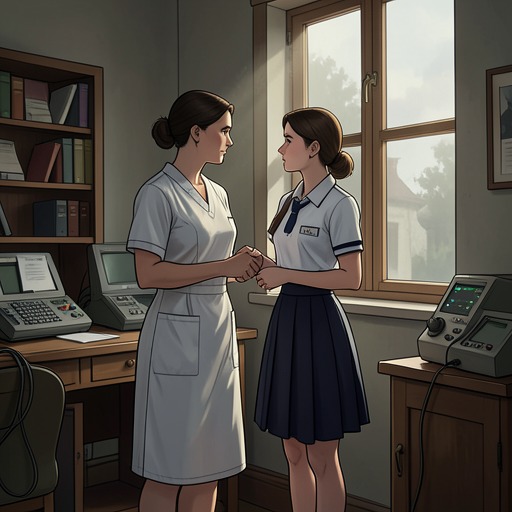
Kim's visit to Emma's home makes the depth of her exhaustion visible. Six months of little sleep, the narrative observes, is not simply an extension of three: it leaves the mind dulled and the body slowed. Kim has encountered exhausted mothers in her work, but seeing her sister in that condition unsettles her. She has to ring repeatedly before Emma answers, and Emma's flat manner makes her sound barely awake. Kim's effort to check on her thus begins with an ordinary act of family care that quickly becomes an encounter with how far Emma has withdrawn.
Kim resists the impulse to reprimand Emma or demand an explanation. She wants to tend to her sister—to fix her hair, wash her face, feed her, and put her to bed—but checks herself and waits instead. She notices that Emma's right eye seems more pronounced than before, though the narration leaves open whether this is an actual change or Kim's perception. These details do not supply a diagnosis; they register Kim's alarm through the body and behavior she can observe. Emma, for her part, agrees to take Kim along on her errands, but does not explain where they are going in advance. The sisters' uneven exchange establishes that care is possible, yet access to Emma's experience remains limited.
Fear, Memory, and Attempts at Care
In a later conversation, Emma tells Kim that she sometimes looks at Brian and does not feel that he is her son. She can recognize the baby she gave birth to, yet experiences a difference she cannot account for, and this estrangement frightens her. Kim responds by naming several pressures rather than treating the fear as proof that Emma does not love her child: she is exhausted, returned to work too soon, and lost both parents when she was a baby. Kim understands Emma's fear in the context of her own history of bereavement and the possibility of losing the person she loves most.
That explanation is an act of sisterly support, not a clinical assessment. Kim does not dismiss Emma's perception, but she places it alongside exhaustion and earlier loss, making room for distress without reducing Emma to it. The conversation also connects emotional fear to a concrete effort to protect Brian. Emma wants chains added to the security gate on his room's fire escape. She anticipates that Apollo may object, so Kim agrees to help and suggests presenting the change as medically advised. The proposed safeguard conveys how unsafe Emma feels; it also shows Kim trying to help in a form Emma can accept.
Surveillance and the Family's Fraying Safety
The family's anxiety is not confined to Emma's inner experience. Apollo learns that Emma received another text containing a photograph of him and Brian in a Zipcar, with the baby in his car seat. The image was taken through the passenger window while they appeared to be stopped at a red light. Its apparent closeness to Brian makes the threat feel immediate to the parents. Emma has discarded her phone, and Apollo's response is to insist that Brian will not be taken anywhere without him. His anger and alarm arise in a household already strained by exhaustion and fear, where surveillance seems to turn ordinary caregiving into exposure.
The photograph does not establish who sent it or explain Emma's subsequent actions, and the account should not be mistaken for a complete cause. It does, however, give her protective fears an external context: she is trying to secure Brian's room while receiving intrusive images of her family. The novel sets these concrete pressures beside the more private fear that the child she holds may somehow be unfamiliar to her. Neither fear is resolved by reassurance alone.
Crisis and the Limits of Reassurance
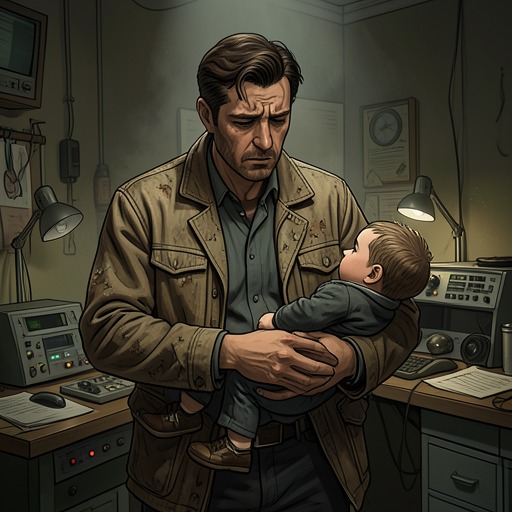
When Apollo tries to speak with Emma during the crisis, he sees her as profoundly depleted and hopes she wants him to talk her out of what she has planned. He tells her that other mothers experience similar difficulties, recalls that Kim had warned them before Emma began medication, and insists that the family can still be helped. Emma's hand and the kettle begin to waver, which Apollo reads as a moment in which she may be returning to herself. Hearing Brian's name seems briefly to reach her, and Apollo tries to summon the different relationships and identities through which he knows his wife: mother, sister, friend, librarian, traveler, and partner.
That appeal fails to restore the person Apollo expects to reach. The scene makes the gap between loving recognition and actual understanding stark: Apollo believes that invoking Emma's roles will bring her back, but the narrative explicitly denies that he has regained her. Emma takes a claw hammer from the counter and strikes him before dropping it. The account presents this as the point at which the family's crisis becomes an act of grave violence, without establishing a clinical explanation that would make the act predictable or inevitable. Apollo's conviction that he can reach Emma through their shared life is shown as sincere, but insufficient.
Public Interpretation and Narrative Significance
Afterward, a younger member of the Survivors asks Apollo whether Emma explained why she did it. The question remains unanswered in the exchange, preserving the difference between the event and a fully knowable motive. Online discussion expands that uncertainty into competing explanations. Some contributors express sympathy for Emma and suggest postpartum depression; others condemn her, blame Apollo, invent conspiracy theories, or use the tragedy to argue about the couple's parenting. Racially prejudiced comments generalize about Black households, turning an individual family's suffering into a stereotype.
These reactions are not equivalent accounts of Emma's condition. The public speculation about postpartum depression is not a diagnosis, just as accusations and theories do not establish what happened within Emma. The novel instead places Kim's attentive observations, Apollo's desperate attempt to make contact, Emma's reported estrangement and fear, and the online crowd's judgments in tension. In that structure, the crisis is neither reduced to a label nor treated as wholly inexplicable: its pressures are visible, but the available evidence does not settle Emma's interior experience or make violence a necessary outcome.