Evacuation of the Wise Ones
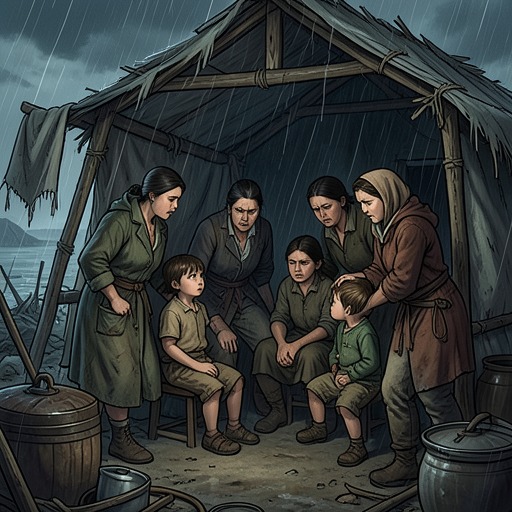
The ChangelingThe Evacuation of the Wise Ones is the community’s carefully organized departure from North Brother Island as Kinder Garten’s voice draws close. Led through the island by a concealed route, the women and children reach the old ferry slip and board a trawler in a sequence designed to protect the youngest. The flight turns a scene of apparent devastation into a revelation: the community is still present, though its numbers seem diminished, and survival depends on discipline, cooperation, and leaving without answering Kinder Garten’s calls.
From Apparent Devastation to Discovery
Apollo Kagwa and Cal first recognize that the ground holds no bodies apart from Gretta’s. Apollo sees no other dead women or children, but the absence of visible victims does not settle what has happened. The population may have survived, yet he cannot know that until the courtyard fills with people. Cal’s sharp slap to his elbow directs his attention to a hole in the wall, and the two slip through it into the courtyard. There, women and children emerge from the Nurses’ Residence carrying packs and bags. The youngest are carried, and even the infants are silent. The population appears somewhat reduced, although Apollo cannot yet say by how much. Relief is therefore inseparable from uncertainty: people are present, but their survival has not erased the signs of danger or answered who may be missing.
The evacuees move in two columns. Their postures register exhaustion and fear, but their formation remains orderly enough for Apollo to compare their discipline to that of a Special Forces team. This order is not presented as ease or confidence; it is a practiced response enacted by people who are frightened and exposed. Apollo follows Cal and the others rather than stopping to assess the courtyard. When Kinder Garten calls out that he is not a bad man and asks to explain himself, Apollo turns as if to answer. Cal strikes him across the face and fixes him with a disciplined, impassive expression. Apollo understands that speaking could reveal their position and endanger the group. He turns away from Kinder Garten’s voice and continues with the evacuees.
The Hidden Route Across the Island
The Wise Ones lead Apollo Kagwa through a landscape he had understood as nearly impassable. Their route passes the coal storage house, goes between the foundry and the chapel, and continues past the morgue to the old gantry crane and ferry slip. Apollo had seen dense underbrush and towering trees where the women reveal a path through the shadows. Their knowledge changes the meaning of the island: it is not only a place of confinement and danger, but also terrain the community knows how to traverse. Apollo does not lead the escape. He follows, relying on the Wise Ones’ familiarity with a passage he could not see for himself.
At the water, Apollo whispers that they are not going to swim. Nobody answers him. The silence leaves his expectation unresolved until a whisper travels across the water from behind the group. A Pilgrim 40 Pilothouse Trawler appears out of the darkness, with one of the Wise Ones, dressed as a guard, at the helm. The vessel eases to the dock. The old ferry slip, once used to load patients and staff when the island was in operation, becomes the community’s means of departure. Its earlier function gives way to a new passage off the island, achieved not by a visible road but by the boat and the route the Wise Ones have kept available to them.
An Evacuation by Design
At the dock, Apollo Kagwa can finally count the assembled community: nineteen women and eleven children. Seeing everyone together makes the group’s vulnerability more apparent; the open pier exposes them in a way the concealed route through the woods did not. At the same time, the count replaces the earlier, uncertain impression of a slightly reduced population with a definite tally. The evacuation proceeds with the same order seen in the courtyard, now expressed through the placement and handling of each passenger.
The children board first, but the older children, seven and eight years old, lead the line. Three guards pull them up onto the vessel. Infants come next: their mothers hand them to the older children, who carry each infant to the forward master cabin, identified as the ship’s most protected part. Only after all the children are below do the women pass their bags and supplies aboard, one to the next, in a chain compared to sandbags. The transfer makes the community’s cooperation visible in practical form: the older children have a role, the infants are moved to the protected cabin, and the women relay what the group needs before boarding themselves.
Two guards pull each woman onto the trawler. Within eight minutes, the Wise Ones are ready to leave. The speed does not undo the fear or exhaustion evident in their posture; instead, it shows how tightly the evacuation has been organized. The account marks the group as ready to go, not as already safely away: Apollo Kagwa, Cal, and Cal’s twin imperial guards remain on the dock. The distinction leaves the departure at a threshold, with the children, women, and supplies aboard while the remaining figures have not yet joined them.
Survival, Silence, and the Unfinished Departure
The evacuation’s decisive shift is from apparent catastrophe toward collective escape. At first, the empty ground gives Apollo Kagwa no reliable measure of survival. The women and children’s emergence confirms that many have survived, while the reduced-seeming population and the exact count of nineteen women and eleven children preserve a sense of loss and uncertainty. The silent infants sharpen that contrast: the scene records their stillness, but does not explain it or establish that everyone has survived.
The escape also depends on refusing the confrontation Kinder Garten tries to provoke. Apollo’s impulse is to turn back and answer; Cal’s intervention makes the danger of that impulse immediate. By following the Wise Ones through their hidden path, Apollo accepts their lead, and by boarding the trawler they transform the former ferry landing into an exit. Yet the scene stops before Apollo Kagwa, Cal, and Cal’s twin imperial guards board. The Wise Ones are prepared to leave, but the departure is not yet complete. That pause keeps the rescue from becoming a simple image of safety: the community has reached the vessel through its own discipline and knowledge, while danger and separation remain active at the edge of the scene.