Fort Washington branch
The ChangelingThe Fort Washington branch is both a neighborhood library and a hinge in the lives of Apollo Kagwa and Emma Valentine: its basement book sale brings them together, while its daily work gives shape to Emma’s identity as a librarian and mother. The branch moves between quiet reading rooms, a crowded sale nook, and the practical routines of service, making it a place where encounters and ordinary acts of care matter as much as books.
Building and Setting
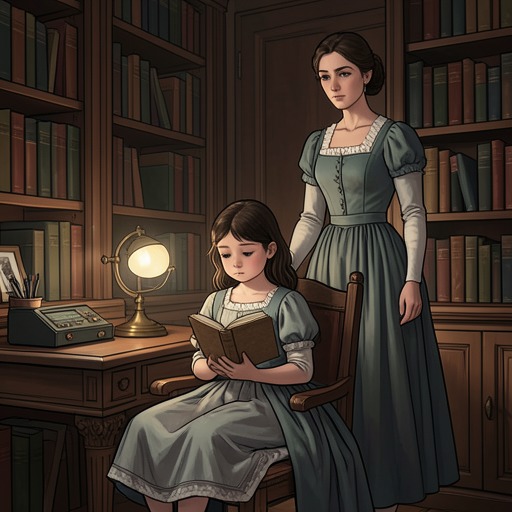
The branch stands in Washington Heights in a three-story limestone building funded by Andrew Carnegie and built in 1914. Its history includes service to notable former locals such as Marianne Moore, Maria Callas, Ralph Ellison, and Lou Gehrig. Emma, however, prefers to think of the many anonymous children who have used the library over the century, and of the women who served them. That emphasis on uncelebrated readers and workers frames the branch less as a monument to its famous patrons than as a continuing neighborhood institution.
The building’s distinct floors accommodate changing tasks rather than a single fixed purpose. The basement includes an adult reading room and, in a nook off the reading room, the book-sale area. Elsewhere, librarians rotate among the children’s section, service desks, and other duties. The branch is small enough that workers trade floors and jobs several times during a day; its public character depends on this flexible, shared labor.
The Basement Sale and Apollo’s Visits
Apollo stops at the branch after a fruitless estate sale in Washington Heights. Library sales are less promising than estate sales or used bookstores: the shelves hold books a branch wants to sell rather than recycle alongside items donated by local residents. A rare and valuable collection like the D’Agostino books is unlikely to appear there, but the economics still suit Apollo’s small business. He may buy a book for fifty cents and sell it for five dollars, or find large-print crime novels for retirees who order from his website. Those modest margins recall his first business model, selling People magazine to Mrs. Ortiz in apartment C23.
The sale is held on Fridays in the basement nook, where one librarian must cover both the books and the service desk. On Apollo’s first visit, she is helping a mother and two children choose worn picture books. The younger child pulls every third book from the shelves, leaving the librarian to add cleanup to her duties. Then a man calls from the reading room that he is in distress. The caller is Emma’s future partner, but at this first encounter Apollo sees her working: she leaves the sale to help him, then returns to the demands of the branch.
Apollo asks Emma to dinner while she rings up his three books, and she politely declines. Because the sale recurs every Friday, he comes back the following week and the week after. In time, Emma tells him her name. Five months after they meet, she agrees to go on a date. The branch therefore gives their relationship a gradual beginning: not a single dramatic exchange, but repeated visits shaped by Apollo’s interest and Emma’s work. Its weekly routine makes the place a point of return before it becomes a site of courtship.
Emma’s Workplace and Community
For Emma, the branch is not merely where she works. She loves being a librarian and hopes to offer its children what Ms. Rook offered her: the quiet assistance of a liberator, safeguard, and salve. Her sense of the library’s history is grounded in service to children, including those whose names will never appear among the branch’s famous former patrons. The building’s long public life thus meets Emma’s personal understanding of care in the everyday work she does there.
When Emma returns to work after Brian’s birth, the branch’s welcome is personal and collective. She arrives at 8:35 to find a gold-lettered welcome-back sign, a carrot cake from Carrot Top, and fresh coffee. Her colleagues Sheryl, Carlotta, and Yurina greet her; Emma hugs each of them, and Carlotta kisses her forehead. They ask to see pictures of Brian, admire him, and offer the familiar advice to cherish every moment. Emma accepts their affection and their parenting clichés as part of a return she could not have wished to improve.
The welcome leads directly back into the branch’s working rhythm. Emma gathers books from the book-drop bin and newspapers from outside, then replaces the previous day’s editions in the basement adult reading room. Carlotta unpacks new books and checks them against packing lists; Sheryl takes the children’s section; Yurina starts the two public computers; and Emma checks that all four loaner laptops are charged. At ten, they open. The sequence makes the library’s care concrete: it is sustained through books, newspapers, charged devices, staff coordination, and the arrival of children who use the branch.
The Branch in Emma’s Later Story
On her return day, Apollo sends Emma photographs of himself and Brian. One shows Apollo beside a rented minivan in the driveway of a large home while Brian lies on a blanket looking up at the trees. Emma has little time to study it before daycare children enter the branch and occupy her attention. She works through the morning with an unsettled feeling, then identifies its cause after returning home: she is not only concerned that her son is lying in a driveway; she wonders who took the picture.
That unease changes the meaning of the branch’s public bustle without turning the library itself into a source of danger. Emma’s workday is filled with colleagues, children, and routine acts of service, yet the photograph raises a question that follows her beyond the building. The branch matters because it shows the life Emma is trying to resume—her profession, her community, and her practical care for other people—at the same moment that an intrusion into her family’s privacy begins to trouble that ordinary world.