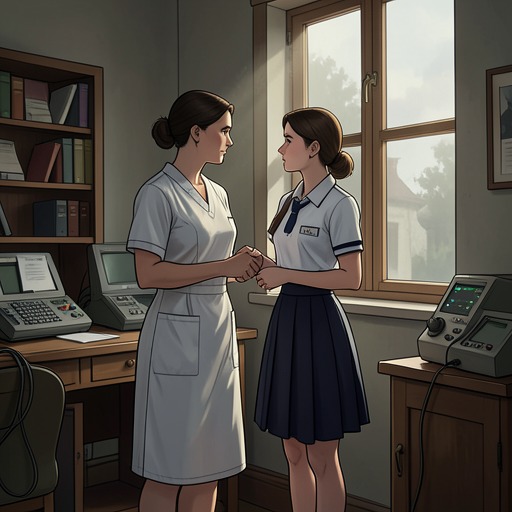
Home birth
The ChangelingHome birth is the planned setting for the birth of Emma Valentine and Apollo Kagwa’s first child, but the novel turns that plan into a test of preparation when labor overtakes them far from home and the A train stops in darkness. The choice belongs to a family network as much as to an individual preference: Kim Valentine, Emma’s sister and chosen midwife, advocates for the approach, while Apollo learns the practical work of assisting with labor and discovers that preparation cannot guarantee the setting in which a child arrives.
The decision and its family context
Emma and Apollo decide on a home birth after Kim, formerly a pediatric nurse, becomes a midwife in what the narrative describes as a midlife conversion. Kim promotes home birth enthusiastically to people around her, and her sister’s pregnancy makes the plan personal: Kim will serve as midwife, and the birth will take place at home. She has never had children of her own, but she has raised Emma since Emma was five. The decision therefore joins professional training to a long-standing family bond and gives Kim a significant role in welcoming her nephew.
When Kim explains the plan over brunch at a diner on Fort Washington Avenue, Apollo asks questions but is curious rather than opposed. By the end of that day he is researching inflatable birthing pools, and Kim promises she can obtain a discount. Their preparation is tangible: the pool is not an abstract symbol of their intentions but equipment Apollo expects to inflate and set up when labor begins. At dinner at Bouley restaurant, Nichelle Murray questions why a couple she considers sensible would choose home birth. Her skepticism, along with the concern of Lillian Kagwa and other women in Emma’s life, makes clear that the choice is not treated as universally reassuring. Kim is the principal supporter among Emma’s women relatives, and her position as the planned midwife helps settle the decision.
Preparation and limits
The Bradley Method classes give the couple a working account of labor and assign fathers a possible role in assisting a delivery. Their teacher, Tonya, presents childbirth as something women have managed throughout history without modern hospitals and emergency teams, and describes the midwife’s task as helping rather than taking over the body’s work. The classes do not make Emma and Apollo reject hospital care: they agree that they will go to a hospital if it becomes necessary, and Emma packs a small suitcase for that contingency, which they keep under the bed. Their plan combines confidence in birth at home with a stated willingness to change course.
The classes also give Apollo specific tasks to rely on. During the sudden onset of labor, he recalls the instruction that a woman who can continue a conversation may not yet be in true labor. That knowledge eases his alarm somewhat, but it does not remove the uncertainty. He has rehearsed how to inflate the birthing tub with an electric pump, fit its plastic liner, and attach the hose; he has practiced each step several times in the preceding month. Remembering the sequence gives him a job and steadies him as he and Emma make their way home.
Labor away from home
The first urgent turn comes at Bouley. A waiter rushes to tell Apollo that Emma needs him. Emma is thirty-eight weeks pregnant, and Nichelle initially wonders whether the contractions might be Braxton Hicks rather than established labor. Apollo nevertheless wants Kim to leave her movie, bring the equipment she keeps in her car, and drive north. He is willing to endure being teased if the episode proves to be a false alarm; what frightens him is the possibility that he and Emma might have to manage the birth alone.
The route home becomes part of the problem. Emma refuses an ambulance because she expects it would take her to a hospital, contrary to their plan, and she also declines Nichelle’s offer to hail a car. From downtown, traffic on the West Side Highway could make the drive to Washington Heights take an hour or more. The Chambers Street station is only four blocks away, and the A train offers a journey of about thirty-five minutes. Nichelle walks with them to the corner, still exasperated and worried; then she hugs Emma at the station stairs and tells her she loves her. Apollo asks Kim to get her car and meet them at home. When Emma can still speak, his class instruction offers some reassurance, and he thinks through the setup awaiting him there. Kim encourages Emma over the phone before reception fails as they descend into the station.
The train does not provide a smooth passage home. It comes to a stop, the lights go out, and Emma’s labor progresses in the dark, with no midwife present. The situation exposes the gap between learning how to assist with a birth and expecting actually to do so: Apollo had repeated the class’s lessons with confidence partly because he assumed he would never need to deliver a baby himself. Now he is on a stalled train with Emma and the other passengers, relying on what he has learned. Brian’s birth on the stalled A train is the decisive reversal in the home-birth plan: the couple’s preparation matters, but the planned room and the planned attendant are absent when labor demands action.
Care after the birth and wider significance
Home birth also sits within the novel’s account of how families distribute care, time, and paid work. Emma’s return to her job is part-time, but retaining health insurance matters to the household and allows Kim to be paid for her work as midwife. The family nonetheless refuses to pay Kim for the delivery because, technically, she was not the person who delivered Brian. The detail registers both the practical value of her role and the limits of a service defined narrowly by who was present at the moment of birth.
After the birth, Kim and Lillian arrive carrying food and supplies. Kim checks Brian and holds him as his aunt; Lillian comforts Emma, drawing on her own experience of struggling to feed Apollo without her mother beside her. The home birth thus opens onto a larger pattern of intergenerational support, not simply a decision about medical setting. Apollo’s later description of New Dads emphasizes the labor that continues after delivery: nighttime diaper changes, cooking, laundry, research, and the sharing of domestic work. William Wheeler’s reflections on the older model of fatherhood, in which providing money was treated as sufficient, sharpen the contrast. The birth plan asks what a father can do during labor; the life that follows makes that question a daily practice of care.
The narrative neither presents home birth as an uncomplicated triumph nor treats its disruption as proof that the choice was foolish. Emma and Apollo have a hospital contingency, seek Kim’s help when labor begins, and act on the knowledge and equipment available to them. Yet their child arrives outside the setting they prepared, making the train’s darkness a measure of the limits of planning. The episode gives home birth its significance through that tension: the choice expresses family trust and a commitment to shared responsibility, while the actual birth reveals that care must respond to circumstances no plan can fully control.