Improbabilia box
The ChangelingThe Improbabilia box is a cardboard container whose contents carry a family history Apollo Kagwa cannot yet fully understand. First left at his apartment door, it offers material evidence of Brian West’s connection to Apollo and Lillian Kagwa; later, Apollo turns it into a time capsule for his own son, Brian Kagwa. The box’s movement from unexplained inheritance to deliberate family archive gives it significance beyond its contents: it holds the unanswered past while making space for stories Apollo intends to tell in the future.
Discovery and Identification
The box appears at a threshold during a dreamlike episode in which Apollo opens a door hoping to see his absent father. His father is not there. Instead, a cardboard box is waiting, with Improbabilia written across its lid in black marker. Apollo carries it inside and opens it on the living-room carpet. Although the box is not heavy, its shifting contents announce a collection rather than a single keepsake.
Lillian identifies it as Brian West’s box. Her response changes the meaning of Apollo’s discovery: the items are not simply discarded objects left by an unknown visitor, but things his mother recognizes as connected to his father. Apollo has spread them out before she arrives, and she scans the collection with visible alarm. When she asks whether he found it in her closet, Apollo understands that she may be withholding information. She soon takes the hotel receipt from the display, apparently trying to keep that particular clue from him. By then, however, he has already committed the objects to memory and is trying to fit them to the stories he knows about his parents.
Contents as Evidence
The collection is specific enough to suggest a life, but incomplete enough to leave Apollo with questions. It includes two movie ticket stubs, a headshot of a young woman, an apartment rental agreement for Jackson Heights, a bill for an overnight stay at a hotel on Ninth Avenue near Times Square, several takeout receipts, a marriage certificate for Brian West and Lillian Kagwa, and a children’s book. Together, the papers and objects point toward relationships and places in his parents’ past, but they do not explain why Brian abandoned his wife and child or how the box reached Apollo’s door. The hotel receipt is especially charged for Lillian, who removes it while leaving the other evidence behind.
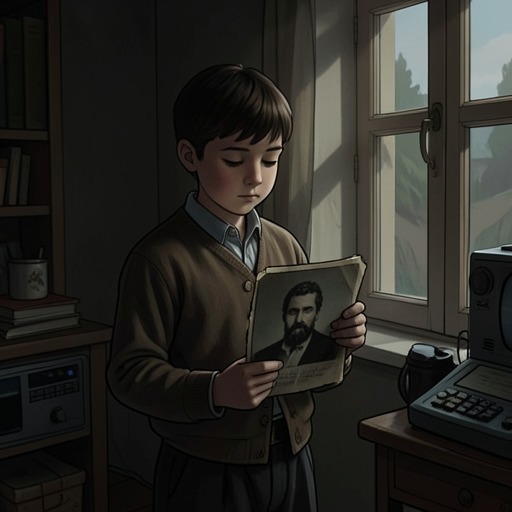
The children’s book, Outside Over There, gives Apollo a more intimate kind of clue. He looks for a dedication or a sample of his father’s handwriting, but finds neither. Instead, the condition of the book tells its own story: its pages are worn, the upper-right corner of each page is faintly smudged, and its spine is cracked. Apollo reads these signs as evidence that the book was used repeatedly, not kept for display. He imagines Brian West reading it aloud to him and begins reading the first page aloud himself. The book cannot confirm the scene he imagines, but its wear makes the possibility of an earlier bond tangible.
The box therefore works as an archive without an accompanying explanation. Its documents can establish connections, while the gaps between them remain unresolved. Apollo’s question about his father’s abandonment persists alongside the physical evidence, and the label on the lid gives the collection a name without clarifying its history.
From Label to Business Name
The word on the lid becomes more than an identifying mark. When Apollo is setting up his rare-book business, he takes the pen from Lillian and writes Improbabilia as its name. By seventeen, he has made the business a thriving concern, known among rare and used book dealers in Queens, Manhattan, and the Bronx. The name thus travels from a private box associated with his parents’ past into Apollo’s public working life. The evidence does not explain exactly why he chooses it, but the reuse links his developing identity as a bookseller to the collection that first brought his family history into view.
A Time Capsule for Brian
Years later, Apollo retrieves the box from a high closet shelf in the room intended to become Brian Kagwa’s bedroom. He has not opened it in years. This time he is ready to add to it, and its purpose shifts from holding the remnants of his own childhood to preserving objects for his son. He removes only Outside Over There, intending to begin reading to Brian as his father once read to him. That choice carries the book’s earlier association forward without treating the imagined memory as certainty: Apollo plans to make reading with his son part of their present.
He adds Emma Valentine’s red string, which he has kept in his wallet. It has become bunched and tight, so he pulls it straight before placing it in the box. He also adds Once Upon a Die, a worn thriller that he cannot sell and that recalls the night Brian was born. A ticket Apollo received on the drive home goes in as well; he expects to tell Brian the story behind it when the boy is old enough. Finally, he places inside a copy of To Kill a Mockingbird, treating the rare find as something appropriate for a box he regards as magical. These additions are not interchangeable souvenirs: each is tied to a memory, a particular day, or a story Apollo means to pass on.
Apollo closes the lid, climbs down from the footstool, and hides the box in the dark. The concealment echoes its earlier appearance as a private family inheritance, but the intention has changed. At first Apollo receives objects whose meanings are partly withheld from him; now he deliberately gathers things he hopes to explain. The Improbabilia box remains a container of unfinished history, yet Apollo’s additions make it an act of fatherhood as well: a promise, expressed through saved objects, that Brian will hear the stories behind them from a father who plans to be there.