Island Library
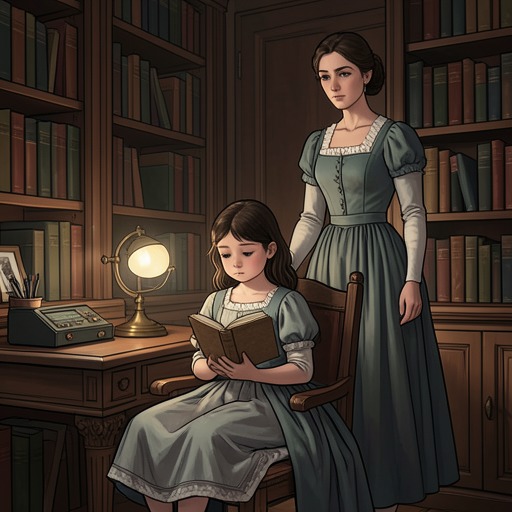
The ChangelingThe Island Library is a small building on North Brother Island that functions as both the island community’s school and its shared space for books and storytelling. Apollo first mistakes the children entering it for pupils in a one-room schoolhouse; Cal explains that it is the library, but that it also serves as their school. The building’s importance lies in that double use: it is where children learn basic skills and where the community gathers, making it a visible center of everyday life before the attack destroys it.
Setting and Purpose
As Apollo and Cal step through brush into the courtyard, Apollo sees women and children moving about. Children are being led or carried along a path he had not noticed the previous night, toward the small building with windows facing the courtyard. He watches their heads disappear inside as a woman gestures for them to sit. A blackboard behind her makes the room look like a schoolhouse, but Cal clarifies that the building is the Island Library as well as the children’s school.
The library teaches reading, writing, and arithmetic. When Apollo asks whether the children are taught what happened, Cal distinguishes those lessons from history: the children learn basic subjects, but not that history. The distinction gives the library’s educational role a deliberate limit. It provides instruction, while the past that Apollo asks about is withheld from the children. The building is thus associated both with what the community passes on and with what it chooses not to tell.
A Place of Ordinary Life
For Apollo, the children visible through the library windows sharpen the absence of the family life he had expected. He imagines his own child sitting cross-legged and attending to a teacher, and recalls the commonplace experiences he had anticipated: looking in on a class, attending parent-teacher conferences, and helping with homework. He understands their value only after losing the chance to share them with Brian. The library’s ordinary schoolroom scene therefore becomes more than a sign of the island’s routine; it gives Apollo a concrete image of the childhood and parenthood he has been denied.
The library also hosts a puppet show for the children. At dinner, which is served in the Doctor’s Cottage, the children eat together while two women play guitar and a small drum and the group sings. When the younger children are put to bed, Gayl refuses to leave. Her mother asks Apollo to take care of her while she takes her son inside the Nurses’ Residence. Apollo carries Gayl to the library on his shoulders; she calls out that she is tall. Inside, the older children move between the walls, pull books from the shelves, and jostle one another before settling. When Apollo tries to set Gayl down among them, she clings to him, and Cal observes that she may be hungry because she ate little at dinner.
These details establish the library as a lived-in communal space rather than a quiet storehouse of books. Children use it noisily and physically; adults organize activities there, and the books share the room with a performance. Its welcome is not unguarded, however. Gayl’s mother is initially wary of leaving her daughter with a strange man, a caution Apollo recognizes as responsible parenting. Cal’s endorsement of him carries weight, allowing the moment of trust without erasing the mother’s concern.
Storytelling and Destruction
Later, as Apollo senses a charge drawing him toward the Tuberculosis Pavilion, he turns back to the library rather than continuing in that direction. Cal is telling the children the tale of Rapunzel. Gretta, standing rigidly at the back, intercepts Apollo and makes clear that Cal’s trust does not mean she trusts him. The scene places storytelling and vigilance together: the children remain gathered around a tale while adults watch the space and assess a possible threat.
The library is destroyed in the explosions that tear apart the Doctor’s Cottage and then the Nurses’ Residence. Apollo hears another thunderous report and looks toward the trees, where something passes overhead. He cannot identify it, considering a missile, a bomb, or a military drone; the weapon and its source remain uncertain in the scene. The next explosion strikes the library, bringing its roof down. The destruction turns the building’s earlier details—the blackboard, shelves, lessons, and children’s gathering place—into a measure of what the attack has put at risk. The passage ends with no screaming, shouting, or crying. That absence does not establish what happened to everyone inside, but it leaves the library’s destruction suspended in a silence sharply unlike the children’s laughter and singing that had marked the island’s ordinary life.