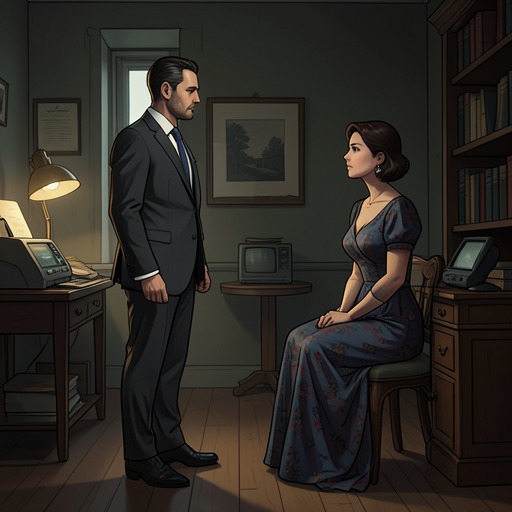
Jorgen Knudsen and William Wheeler
The ChangelingJorgen Knudsen and William Wheeler are father and son, bound by a family legacy that turns protection into a rationale for sacrifice. Jorgen supports William’s decision to renew the pact with the troll, even as he later risks himself to give his son time to escape. Their relationship therefore holds two opposed versions of paternal duty together: preserving a family’s imagined inheritance and protecting a particular child from immediate danger.
Inheritance and the Family Pact
Jorgen describes William as a man who had a wife, two daughters, and a steady job working with computers, but whose income did not seem sufficient to secure the future Jorgen believed his family deserved. His account ties this private anxiety to a larger grievance: he mourns the loss of what he regards as the birthright of white men in America, claiming that William was being passed over in the name of fairness and balance. The explanation does not merely establish the son’s circumstances; it shows how Jorgen interprets them. He treats economic insecurity as evidence that the family has been deprived of a rightful inheritance, a view that makes the old pact appear to him not as a threat but as a possible remedy.
William, in Jorgen’s account, shared that interpretation. He believed the troll was a blessing rather than a burden and that the family should return to its old ways. Jorgen connects this belief to Nils Knudsen’s refusal, one hundred and ninety years earlier, to sacrifice one of Petra Mikkelsdatter’s children. William thought the family’s decline might have begun at that refusal; he saw the troll’s power as something the Knudsen line could reclaim by honoring the pact. Jorgen says he admired his son’s resolve. His pride makes their closeness morally compromised: he recognizes William’s conviction as courage even when that conviction leads him to deliver his own daughter to the creature.
The Sacrifice and Its Rupture
William’s act breaks the family he had hoped to restore. He leaves Agnes Wheeler in a cave in the forest, following the bargain as he understands it. Gretta Wheeler cannot accept his vision and leaves him, taking Grace Wheeler with her. Jorgen presents the departure as the injury that shattered his son: William loved his wife and daughters, he says, yet was willing to sacrifice one child, and Gretta’s rejection broke him. Jorgen then describes himself as the person who has cared for William since he lost his mind.
The account is revealing partly because Jorgen does not frame the sacrifice as an isolated crime. He places it within a chain of inheritance: an earlier generation made a pact, a later generation failed to fulfill it, and William tried to restore what he considered the family’s proper tradition. The wall of images Apollo sees—infants represented across successive generations, none older than a year—gives that inherited practice a material record. Jorgen resists Apollo’s description of the children as simply fed to the troll, insisting that it tries to raise them. The distinction is his defense of the arrangement, not evidence that it protects the children. In Jorgen’s telling, paternal devotion and the family’s violence have become difficult to separate.
Jorgen’s Warning and William’s Escape
When Jorgen tells Apollo the family history, the apparent confession is also a warning. He has left the front door open and the front light on because William knows those signs mean he should run. Jorgen explains that he did not disclose the past merely to unburden himself; the time spent telling it was meant to let his son escape. His final appeal to a father’s duty echoes the admiration he had expressed for William, but now the duty is practical and immediate: Jorgen places himself between his son and the danger approaching the house.
This protection does not undo his earlier approval. Jorgen has helped sustain the belief that sacrifice could restore the family’s fortune and has cared for William after that belief destroyed his domestic life. Yet, at the last moment, he uses the open door and light to communicate what he cannot safely say outright. The warning makes their bond more than ideological agreement: even as Jorgen endorses the pact that injured William’s family, he remains prepared to give his son an opportunity to survive its consequences. Apollo Kagwa kills Jorgen before that protection can become a reunion or reconciliation.
The Son’s Response and the Meaning of Fatherhood
After Jorgen’s death, Apollo Kagwa and Emma Valentine confront William, who has returned to the house by its back entrance. William learns that the front door had been left open and understands it as his father’s warning that Apollo and Emma were there. He recognizes that Jorgen was trying to protect him, while also acknowledging that he had seen his father and left him behind as he attended to other matters. His response does not make him innocent of neglect; it makes visible the damaged terms on which father and son have lived.
William rejects the idea that Jorgen’s protection settles what kind of father he was. He argues that being abandoned is not worse than being raised by a man like Jorgen, and connects his own sacrifice to the family’s lack of preparation for the future. His complaint mirrors Jorgen’s earlier account of economic grievance, but turns it against his father: what Jorgen treats as lost inheritance and William treats as a failure to plan. The disagreement is not simply over whether a father loves his children. Both men invoke protection and provision, yet each uses those duties to explain decisions that have harmed others. Jorgen’s warning is an act of care; his approval of the pact helped enable William’s sacrifice. Their relationship remains marked by that contradiction, with no evidence of reconciliation before Jorgen’s death.