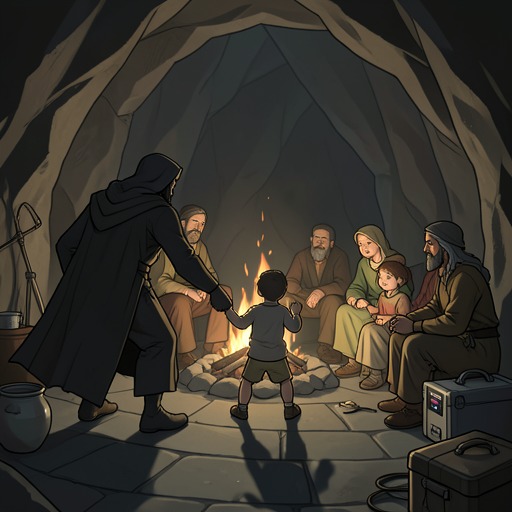
Jorgen Knudsen confesses the family pact
The ChangelingJorgen Knudsen’s confession reveals the Knudsen family’s generations-long pact with a Troll: the creature offered protection, and the family supplied children. His account links a Norwegian immigrant’s desperate bargain to a history of abandoned babies in Queens, then exposes the confession itself as a father’s deliberate sacrifice of time so his son can flee. The family’s story is not merely a secret about a monster; it is a defense of inherited violence, and it ends with Apollo killing Jorgen.
The pact’s origins and setting
Jorgen explains that Nils Knudsen brought the creature from Norway when he left with his wife. The Quakers’ planned sloop seemed too small to Nils, who feared for his family’s safety, so he secured what Jorgen calls insurance. That protection came at a price. The Sloopers continued upstate after reaching New York, while Nils, Anna Sofie, and Petra Mikkelsdatter remained in Queens, which Jorgen describes as farmland rather than a park: thousands of acres of forest and green country.
The setting made the bargain possible. In Jorgen’s account, such creatures belong to the natural world and make lairs in forests and mountains. Queens offered the same cover, with hills, pockets, and caves where something enormous could remain hidden. He places the park’s development in 1898, when the land was bought and plans for golf courses and hiking paths began. The city’s designed landscape, in this telling, never entirely erased the older terrain beneath it. Jorgen gives the creature Norwegian names, Jotunn and Trolde, placing the family’s American history inside an older folklore and a landscape that still accommodates its lair.
Children as the price of protection
The original agreement made Nils the creature’s caretaker, responsible for appeasing it. Jorgen says the Troll demanded one thing: a child. When Nils could postpone the payment no longer, he took his daughter Agnes into the woods and delivered her to the cave. The confession gives the pact a specific human cost: a father’s decision to abandon his own child, carried out not in a distant past but in a place that would become part of Queens.
Jorgen’s account broadens from Agnes to the accumulated record on the den’s walls. The portraits run in a timeline from sketches and charcoal renderings through daguerreotypes, black-and-white photographs, and early grainy color images. Every pictured child is an infant, none older than a year. Apollo recognizes the scale of the collection as a sea of small faces, and the range of the victims’ complexions makes the history one of immigrant children across Queens, not simply the family’s own descendants. The images turn Jorgen’s inherited story into visible evidence of repeated loss.
Jorgen resists Apollo’s description of the children as food. He insists that the creature tries to raise them, presenting its attempted parenthood as a distinction between sacrifice and killing. That distinction does not undo the abandonment: the children were still taken from their families and delivered to the cave. Jorgen also says Nils did not repeat the sacrifice within his later household. Nils quickly married Petra and had seven children with her, but did not take them into the woods again. Jorgen attributes this both to the lesson Nils had learned and, as a belief rather than a certainty, to the possibility that the sacrifice had been too painful to repeat. He remembers the seven children’s stories of Nils’s kindness, setting personal tenderness beside the violence on which the family’s protection depended.
A renewed bargain and its targets
The pact did not end with Nils. Jorgen says his son came to believe the Troll was not a burden but a blessing, and that the family had to restore its old traditions. In his son’s interpretation, the family’s fortunes had gone wrong when Nils refused to sacrifice one of Petra’s children; the creature’s power could now deliver the family again. Jorgen describes this belief as a claim of right and heritage, joining the pact to his son’s sense of lost status and an imagined earlier promise of white men’s economic advancement.
Jorgen then identifies the consequence: his son renewed the pact as Nils had done, leaving his own daughter Agnes in a forest cave. Gretta Wheeler could not accept this act. She left her husband and took Grace Wheeler with her; Jorgen says the separation broke his son and that he has cared for him since. The repetition is especially stark because the earlier history, which Jorgen presents as a precedent, has become a pattern within the next generation. What the family calls tradition requires another child to bear its cost.
The victims were not limited to Knudsen descendants. Asked how the children were selected, Jorgen describes searching for hours or days while in service and, during the 1980s, driving everywhere in a white van. He says he sought a boy or girl without protection: a baby no one was watching, someone treated as a castoff. He claims he learned to recognize such candidates immediately. His earlier justification—that Queens had many immigrants and immigrants had many children—reveals how the pact’s supposed family necessity depended on the vulnerability of other families. His language of hard choices and national prosperity attempts to dignify a practice whose targets were children without anyone able to protect them.
Confession as a father’s diversion
Jorgen’s account appears to disclose family history, but its immediate purpose is also tactical. He reveals that the open front door and the light left on were signals for his son to run. What Apollo took for an old man unburdening himself was, Jorgen explains, a way to give his son time to escape. His invocation of what a good father would do therefore has two meanings: it echoes the paternal justification behind the pact, while describing a present act of protection for his son, even after that son has repeated the family’s violence.
The confession becomes a confrontation. Apollo approaches Jorgen with the utility knife; Jorgen asks him to give it over, and Apollo kneels as if granting the request before thrusting the blade into Jorgen’s neck. The disclosure thus ends not in reconciliation or a negotiated reckoning but in Jorgen’s death. Apollo is blinded and spattered by the blood, an immediate physical consequence that follows the revelation of a long history of harm. The scene’s reversal is complete: the family account that explains the monster’s claim on children also exposes the human choices sustaining it, while Jorgen’s final paternal act helps the son who renewed that claim escape.