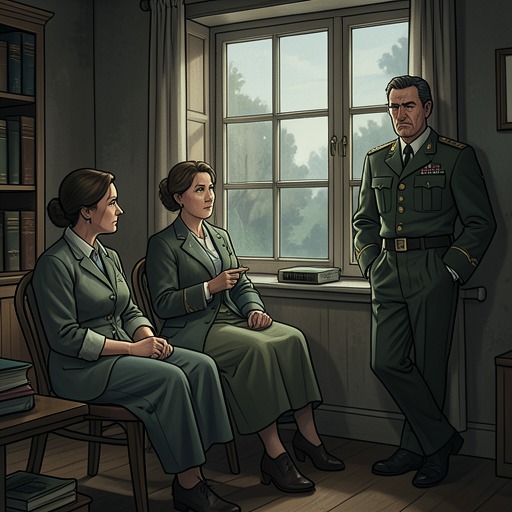
Lillian escapes the GSU checkpoint
The ChangelingLillian escapes the GSU checkpoint is the violent turning point that makes Lillian Kagwa’s departure from Uganda urgent: after a secret-police agent shoots her cousin Arthur, she takes the wheel and drives her surviving cousins out of the agents’ reach. The escape carries her from the immediate danger of state violence toward the decision to leave the country altogether.
The Checkpoint and Escape
In 1967, Lillian and three cousins were traveling toward Kampala when three men claiming to be agents of the General Service Unit stopped their car. They inspected the cousins’ identification and ordered Arthur, the only male cousin, to get out and open the trunk. Arthur hesitated rather than leave Lillian and his sisters alone. One agent leaned into the car and shot him in the stomach.
The gunshot temporarily deafened Lillian and her cousins; the muzzle flash blinded them. Though her senses had not yet returned, Lillian felt the shooter reach into the car for the keys. She shifted into drive and sped away, weaving across the two-lane road. The agents fired after them but could not pursue: their vehicle had run out of gas. The checkpoint had been set up to steal a suitable car, leaving the agents stranded until another one came along.
Lillian reached Kampala in half an hour, driving at speed, but Arthur had died before they arrived. The shooting was treated as an unremarkable occurrence in a country where violence by the authorities had become commonplace. Lillian wanted out; a year later, she secured a visa to the United States.
State Violence and the Decision to Leave
The checkpoint shooting belongs to a broader history of coercion that Lillian had already witnessed in Uganda. She came from Jinja and had lived through the country’s emancipation from Britain and its eventual homegrown rule by Milton Obote, whose army and secret police, the General Service Unit, spread violence across the country. Against that backdrop, Arthur’s killing was not treated as exceptional news: the agents’ use of a checkpoint to seize a car and the cousins’ exposure to sudden, unaccountable violence make the state’s power feel both routine and immediate. The episode also sets the scale for Lillian’s later view of New York’s garbage strike. The city’s crisis was visible in its streets, but it did not compare with the state-sanctioned murder she had escaped.
Aftermath in New York
In 1968, the year after securing her visa, Lillian arrived in New York City at twenty-five, knowing no one. Her command of English, learned under British rule in Uganda, helped her make the transition and led Mr. Aresenyev to hire her at Glamour Time. The agency paid three dollars an hour—twice the state minimum wage—and, after being unable to find work in Uganda, Lillian valued the job without knowing that the business was a scam. Her escape from a place where state violence made ordinary life precarious had brought her to a different kind of vulnerability: an exploitative workplace that depended on her credibility to appear legitimate.
The Limits of Escape
The episode makes escape a threshold rather than a deliverance. Lillian’s ability to act in the instant of danger opens a route out, but it cannot undo the loss that gives that route its urgency. The narrative then carries this unresolved violence across the national border: her later arrival in New York begins a new life without recasting departure as safety or erasing what made leaving necessary.