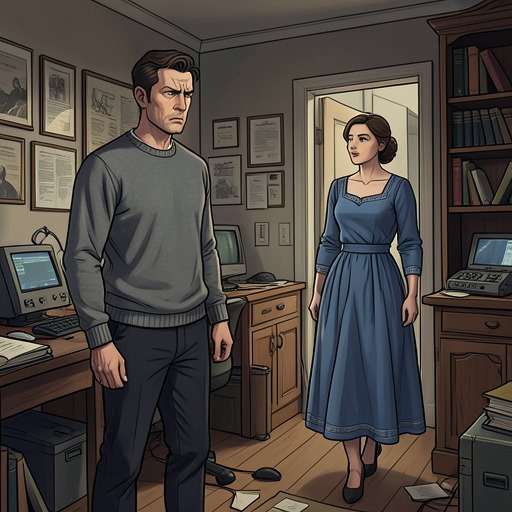
Lillian reveals Brian West tried to kill Apollo
The ChangelingLillian reveals that Brian West tried to kill Apollo Kagwa when Apollo was a child, changing the meaning of his father’s love, his mother’s silence, and the storybook Brian had kept. In her account, Brian’s fear of losing his family did not prevent him from trying to kill Apollo; it was bound up with the crisis that led him to do so. The revelation resists a simple division between a loving father and a dangerous one: Lillian insists both descriptions are true.
The Story and Its Frame
The disclosure comes as Lillian is reconsidering how she has described the past. She explains that another person’s account of an old encounter had become more flattering to him over repeated tellings, until he seemed to believe his own version. That recognition leads her to wonder whether her silence about Apollo’s father had similarly protected a preferred story, for herself as well as for Brian. Her admission makes the scene more than a belated report of violence: it is also an effort to examine how memory and omission can shape a family’s account of itself.
Apollo presses her to tell him what happened. He is standing in Jorgen Knudsen’s kitchen, where the man Apollo killed lies dead; unwilling to hear his mother’s story while facing that body, Apollo stops pacing and braces himself against the door to the den. The present scene therefore places a revelation about one father’s attempted violence beside the immediate fact of a son’s own killing. Lillian is the narrator of the remembered incident, while the novel presents her account as a disclosure to Apollo rather than as an independently staged scene from the past.
Lillian’s Account of the Bathtub Incident
Lillian says she returned from work at one o’clock with McDonald’s for herself and Apollo. She had felt guilty and knew he liked the French fries. The unlocked front door struck her as strange; when she heard the bath running, she feared Apollo might have got into trouble in the water. She dropped what she was carrying and hurried to the bathroom. There, she says, she found Brian attempting to drown their son in the tub.
Lillian falters before naming what she saw, and Apollo asks her to continue even though he is not sure he wants to hear it. She tells him that Brian had removed his clothes and was holding him under the water. She confirms that the water was hot. Apollo’s hand slips, and he slides down to the floor. The revelation turns an uncertain childhood memory into a specific account of a deliberate attempt on his life, delivered by the person who arrived and witnessed it.
Lillian says Brian also intended to kill her and then himself. She connects that plan to her decision to leave: she had served Brian with divorce papers and planned to take Apollo with her. In her telling, the attempt was not an isolated act detached from their marriage; it occurred at the point when Brian faced the loss of the family he had wanted to possess and preserve.
Brian’s Fear and the Storybook
Asked why Brian acted as he did, Lillian describes the childhood he had told her about: his parents had treated him badly, and he had longed for a family of his own. From the age of twelve, he had been telling himself stories about what that family would be. Lillian says that even as an adult he remained attached to a child’s understanding of how life should unfold; he could not change or adapt when the marriage was ending. This account supplies context for his terror of losing Apollo, but it does not excuse the attempt to kill him.
Apollo thinks of the objects in the box, including the book. Lillian explains that Brian had lived in fear of losing his son and saw his own childhood through the story of a child taken by goblins and left without anyone to rescue him. Brian had not had an Ida who could come for him. He kept the book and wanted to read it to Apollo because he imagined himself coming to save his son. The storybook thus joins Brian’s fear and his desire to act as a rescuer, while the bathtub revelation exposes the violence concealed within that self-image.
Consequences and Significance
Lillian’s account leaves Apollo with two truths that cannot be reconciled by choosing one and discarding the other: Brian loved him, and Brian tried to take his life. Her insistence on holding both together corrects any account in which the book or the father’s devotion alone defines their relationship. Love explains what Brian feared losing and what he imagined himself doing; it does not erase what Lillian says he did.
The scene also makes Lillian’s silence part of the family history under examination. Having recognized how someone can settle into a self-serving version of the past, she wonders whether withholding the truth about Brian had allowed a similarly protective account to stand. Telling Apollo does not undo the event or resolve his response. Instead, it gives him a new and devastating account of his father, while making the book’s rescue story newly ambiguous: Brian wanted to be the one who came for Apollo, yet Lillian says that he was also the person from whom Apollo needed saving.