New Dads
The ChangelingNew Dads is the book’s name for a newer model of fatherhood, one defined less by earning money than by sharing the daily work of caring for a child. Apollo Kagwa embodies its practical tenderness: he carries Brian Kagwa, handles night-time care and housework, and tries to make a home safer. But the phrase is neither a guarantee of security nor a simple celebration of progress. Its hopeful account of involved fatherhood is shadowed by exhaustion, bereavement, and the failures of men who also claim to act for their families.
Identity and Daily Practice
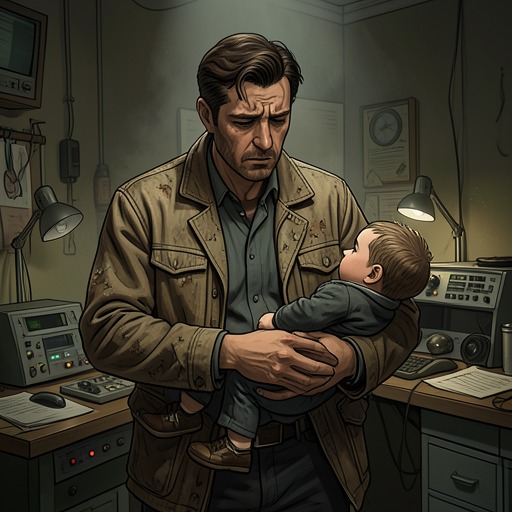
The narration introduces Apollo as having become “one of those men. The New Dads.” The description accumulates in concrete domestic tasks: wearing a child, changing diapers at night, doing dishes and laundry, cooking, reading about infant development, and carrying the diaper bag without shame. It even includes applying coconut oil to prevent diaper rash and preparing sweet potatoes for a child’s first solid food. This list makes fatherhood visible not as an abstract identity but as repeated work, much of it ordinary and easy to overlook.
The passage also measures the new ideal against the Old Dads of the past. New Dads are expected to be emotionally available and to share housework, though the narration undercuts its own aspirational arithmetic by noting that “half the housework” is “really more like 35 percent.” The joke acknowledges how far the ideal remains from equality even as it marks a substantial difference from the old baseline of doing none. New Dads are described as trying to fix their predecessors’ mistakes, but they are not presented as having mastered fatherhood: they are making it up as they go and are “scared as hell.” Care and uncertainty are part of the same identity.
Apollo’s early-morning routine gives the label a social setting. At five-thirty, after Emma Valentine has returned to work and is too exhausted to remain upright, Apollo dresses himself and Brian Kagwa warmly, puts the baby in a carrier, and takes him to Bennett Park. There he seeks out the other New Dads, four men gathered near the padded play squares. Their names escape one another, but they know one another’s children’s names. That small distinction suggests a community organized around the responsibilities that bring them together, even where adult familiarity is still slight.
Care as Protection
For Apollo, practical care also becomes a response to danger. After Emma receives a threatening photograph, he says he will fix the door to Brian Kagwa’s room, which has been without one since the family moved in. He plans to ask the building superintendent to install it and pay him for the work. The narration makes the modesty of this gesture explicit: New Dads may not know serious home repair, but they can pay for it. The door is not a direct solution to the threat, yet it offers a way to fortify the family’s home, much as Emma’s blackout curtains do. In this instance, involved fatherhood means noticing an exposed space and trying to make it safer with the means available.
The limits of that protective role become painfully clear after Apollo’s release from Rikers Island. His body takes him to Bennett Park at the familiar hour, five-thirty in the morning, even though he has been away for months and now carries no child. The other fathers look at him and then away; he sees their discomfort and tries not to acknowledge it. He greets the children by name, while the children ignore him. The contrast with his earlier visits is stark: the same play area and parental gathering remain, but Brian Kagwa is absent, and Apollo’s hands are empty.
The fathers’ response turns the park’s fellowship into a boundary. One father stands beside Apollo, another joins him, and together they form a semicircle that blocks the children from view. One man says he is angry that Apollo came around their children. Apollo stammers that he would never hurt them. Their gesture can be read as an effort to protect their children, but it also makes Apollo’s bereavement visible as exclusion: the men who once shared the space of early-morning care now regard him through what has happened to his family. New Dads here names no uncomplicated solidarity. The identity rests on proximity to children, and Apollo returns to find that he has lost the child who gave him that place among the others.
William Wheeler and the Older Model
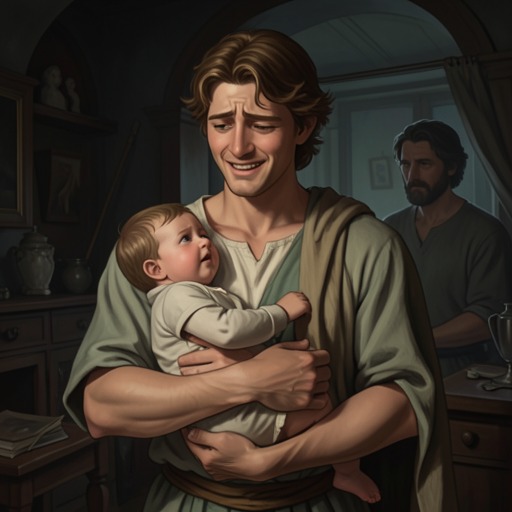
William Wheeler offers a reflective counterpoint to Apollo’s active, everyday fathering. Looking back on his own marriage and family, William says he belonged to a generation that believed a man could be a good father by working and providing. He describes the consequence as a long distance opening within the family: after twenty or twenty-five years, a wife may not know her husband, and children may respect him without sharing happiness or closeness with him. His account does not dismiss provision; it shows what provision alone cannot secure.
William also places this change within altered economic expectations. He tells Apollo that a single income once seemed sufficient, whereas in his account contemporary families in the middle must have both adults working to stay afloat. The New Dads ideal therefore arises not just from a new attitude but from a changed domestic arrangement: employment no longer excuses fathers from care, and earning alone cannot make a family secure. William sees men with strollers on the way to work and fathers at the park at six in the morning as doing “the good stuff” he did not know he should covet.
His regret becomes concrete in the exchange over a first edition of To Kill a Mockingbird. William hopes the book might help persuade Gretta to return home. Her father had read it to her, and she later read it to their daughters; William had once called his wife “Mockingbird,” but he cannot recall when he stopped. He now recognizes that the acts he thought made his love obvious did not replace saying it. The book is no longer merely an expensive sale to Apollo: William holds it against his stomach, hoping it can enter his family’s history as part of an attempt to repair what years of emotional distance have damaged. His account gives the New Dads ideal a backward-looking dimension: it names not only a way of raising children, but a form of intimacy an older father realizes he failed to practice.
The Phrase and Its Contradictions
The contrast between care and provision does not mean that fatherhood automatically makes a man protective or good. Jorgen Knudsen invokes the language of good fatherhood while recounting a family history shaped by resentment, debt, racial entitlement, and a belief in restoring old traditions. He describes his son as having a wife, two daughters, and a computer job that did not provide enough, then connects that grievance to a belief that white men were being unfairly passed over. In his account, the family’s pact with the troll becomes a means of recovering an imagined birthright. The language of duty and inheritance thus stands far from Apollo’s repetitive work of feeding, carrying, and tending a child.
The online presence of Kinder Garten sharpens the contrast between paternal language and action. Apollo encounters the account while reading the “Tribute to Baby Brian” Facebook page, where its cruel comment about dinner is enough to propel him toward confrontation. Later, Kinder Garten claims that being abandoned is not as bad as being raised by a man like his father, then argues that his own actions were necessary because his father failed to plan for the future. Apollo answers that the father tried to protect him; Kinder Garten turns sacrifice into an accusation against the older man. These conflicting claims do not make the characters’ conduct equivalent to Apollo’s care. They show instead how readily the language of protection, sacrifice, and a child’s future can be used to justify harm.
New Dads therefore carries both an everyday and a moral meaning. Its defining acts are intimate and practical, from wearing a baby to arranging a bedroom door, and its ideal asks men to be present in ways earlier expectations could obscure. Yet the book refuses to treat the label as proof that children are safe, families intact, or fathers free from fear. Apollo’s return to the park gives the phrase its deepest contrast: the routine survives in the place, but the child who made it possible is gone. What remains is an ideal of care measured not by the name a man claims, but by the work he undertakes and the limits he cannot undo.