Nils
The ChangelingNils is presented as both an immigrant ancestor and the origin point of a terrible family inheritance. In the account Jorgen Knudsen gives Apollo Kagwa, Nils’s passage to America with his pregnant wife Anna Sofie begins a family history that reaches from the founding of Little Norway in Queens borough to the abandonment of Agnes Knudsdatter in a cave. Jorgen’s story makes Nils’s migration more than a search for a new home: he says that Nils brought a monster with him.
Identity and the family record
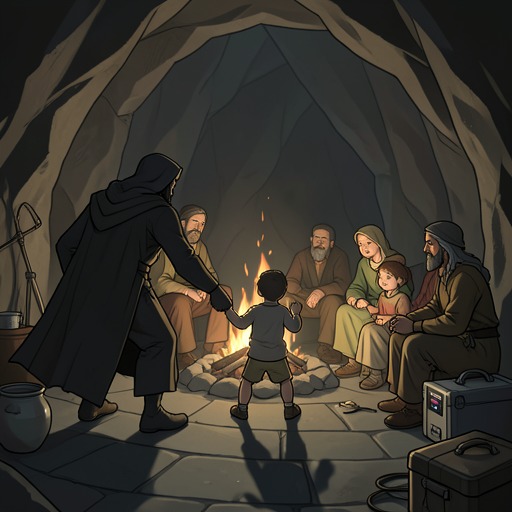
Nils enters the narrative through a drawing Jorgen identifies as a sketch of his great-great-great-grandfather. The image is slight: Nils is beardless and thin, and the ink drawing barely qualifies as a sketch. Yet his eyes are vivid and unusually large. To Apollo, they seem to look across time at the two men examining the image, making the family record feel less like a relic than a presence that can still witness its descendants.
The drawing includes two thin women beside Nils. Jorgen identifies one as his great-great-great-grandmother Petra Mikkelsdatter, whose hands are crossed and whose hair is covered by a scarf. When Apollo asks whether Nils married both women, Jorgen clarifies that the marriages were not simultaneous. The account does not specify the timing or circumstances of Nils’s marriage to Petra, but it places her alongside him in the image and within Jorgen’s account of the family’s early generations.
The voyage to America
Jorgen says Nils and Anna Sofie had been married for four years when they boarded the Restoration. They were not Quakers, but they were willing to seek their fortunes in a new place. Jorgen allows that Nils may have needed to escape his country, while making clear that he cannot establish this as fact. In his telling, the ship’s captain offered work to men willing to crew the vessel, and Nils bargained for Anna Sofie’s passage. She was already pregnant and gave birth during the voyage.
The journey places Nils within the migration of the Sloopers, but Jorgen distinguishes his ancestor from the other passengers. According to Jorgen, the three people in the drawing remained in what was then mostly farmland in Queens borough, in the neighborhood later called Little Norway. He says these three started it, and dates the sketch to about eight months after their arrival in America. A small family image thus becomes a record of settlement as well as ancestry: its subjects are not merely travelers, but people Jorgen associates with the beginnings of a neighborhood.
The monster and Agnes
Jorgen’s account gives Nils’s migration a darker meaning. He tells Apollo that Nils took Agnes into the woods and left her in a cave. Apollo’s immediate response is bodily: after hearing the casual way Jorgen describes the abandonment, he stares at the utility knife in his hand, and the blade begins to rise. Jorgen presses Apollo’s hand down. The danger in the room makes the story of Nils’s past feel active in the present, rather than safely contained in a family anecdote.
Jorgen then recasts the familiar colonial story of settlers fearing monsters in the wilderness. He suggests that the direction of the story may be reversed: the settlers may have brought the monsters with them. He names Nils as the ancestor who brought one to America, imagining it emigrating alongside him. This is Jorgen’s account of the family’s history; the evidence here does not establish what the other passengers knew, or independently explain the creature’s journey.
A contested inheritance
Jorgen believes the other Sloopers did not know about Nils’s relationship with the older power in which he trusted. He contrasts their faith in their crew and their God with Nils’s faith in something older, and suggests that the passengers may have owed their safe crossing to that choice. He presents this as speculation rather than a confirmed bargain: his words leave the other immigrants’ knowledge uncertain even as they place Nils’s conduct at the center of the family’s account.
The distinction between safety and cost gives Nils’s legacy its moral weight. A successful crossing and a new settlement stand beside the abandonment of a child in a cave. Jorgen connects those histories without presenting the first as absolution for the second. Looking back in old age, he says that even when people choose ignorance, the truth still changes them. Nils remains largely known through what his descendant can recover and accuse: the journey, the family image, the supposed monster, and the child he left behind.