Outside Over There
The ChangelingMaurice Sendak’s Outside Over There is both a childhood book and a charged family object in Apollo Kagwa’s life. First encountered as a worn volume among the belongings left at his home, it gives Apollo a way to imagine his absent father reading to him; later, its story of a stolen baby and an ice-made Changeling helps him interpret the danger surrounding his own son, Brian Kagwa. The book’s significance grows through repetition: Apollo remembers its opening, recites it to his infant, fails to establish the reading ritual he imagined, and eventually returns to the pages when he needs to understand what has been lost and where to look.
The Book Left Behind
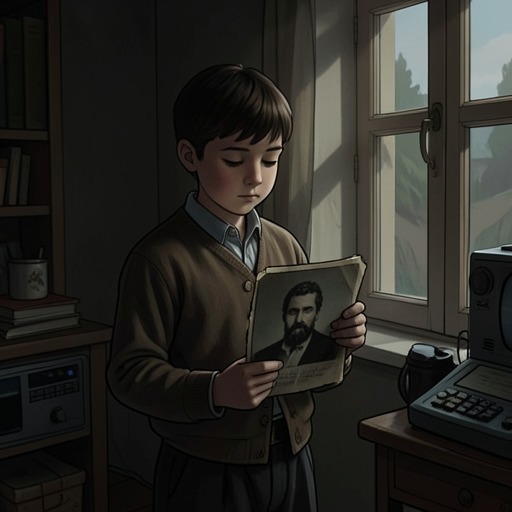
Apollo finds Outside Over There in the Improbabilia box, among objects connected to the history of his parents. The book bears none of the personal evidence he hopes to find: there is no dedication, note, or handwriting from Brian West. Its physical condition tells another kind of story. The pages are well worn, their upper-right corners faintly smudged, and the spine is cracked. This was not a keepsake left untouched for display; someone had read it repeatedly.
That wear allows Apollo to picture his father reading aloud to him, perhaps on the very couch where he is sitting. The scene is imagined rather than verified, but the book gives the fantasy a material foothold. Its opening, with a father away at sea, also places absence inside the story itself. Apollo begins reading the first page aloud, using the words as a point of contact with a father whose departure he cannot reconcile with the evidence that he once possessed and kept these belongings.
The book also becomes part of Apollo’s sense of how he became a reader. Lillian Kagwa worked hard and spent evenings with him watching television, but she was not a reader herself. When she fell asleep, Apollo would take off her shoes, remove her wig, turn off the television, and go to his room to read. He had loved reading since he first learned to sound out words. The book from his father let him imagine that reading had once been shared at home, and that his own appetite for books might have begun with his father’s attention.
A Story Apollo Carries Forward
Apollo’s attachment to the book extends beyond its place in the box. He reads widely as a child, sometimes far beyond what he is old enough to understand. Lillian brings home books and magazines from her law office, asks secretaries in other parts of the building for different magazines, and gets discarded paperbacks from a dentist’s office across the street. She does not screen the books before bringing them home on the 7 train. In this way, Apollo’s reading life develops through both his own hunger for texts and the practical efforts of a mother who does not share that interest.
When Brian Kagwa is two months old, Apollo recites the opening of Outside Over There while changing his diaper in a Riverdale basement. He explains the first scene to the baby: the father is far away, the mother sits outside beneath an arbor, and a young girl named Ida is left in the house with her baby sister. Ida plays a horn to soothe the baby while looking out the window. Apollo follows the story to the moment when the Goblins enter. His recitation turns a familiar book into an act of care, even as the tale’s central danger—the baby left unwatched—hovers within what he is telling his son.
That early scene is followed by an intention Apollo cannot fulfill as he imagined. He keeps a copy on a shelf in Brian’s room and plans to read it to him every night, hoping to turn pages together until Brian can read independently. In six months, Apollo has not read the book to him once. He recognizes that he was exhausted and had assumed there would be time later. The gap between the imagined ritual and what actually happened makes the book more than a symbol of paternal inheritance: it also holds Apollo’s regret over the ordinary closeness he expected to build with his child.
The Tale and Its Changeling
The plot Apollo recounts centers on two children and a failure of attention. Ida is inside with her baby sister while their mother sits outside. As Ida plays her horn and looks toward the window, the Goblins carry away the human baby. They leave a replacement in the crib, dressed like the child but made of ice. Ida holds and loves the substitute without initially recognizing what it is; the ice child cannot return her embrace, and eventually melts. Only then does Ida understand the deception.
Apollo revisits this sequence in a group meeting, where he recites the story until the Goblins slip in through the open window. Alice responds to the tale’s frightening premise by observing that no one is watching the baby. Apollo takes up that thought in the quiet that follows. The book’s neglect is not confined to the mother’s absence: Ida is physically in the room, yet her attention is elsewhere, and the baby is taken while the music continues. The story makes being near a child different from seeing or protecting one.
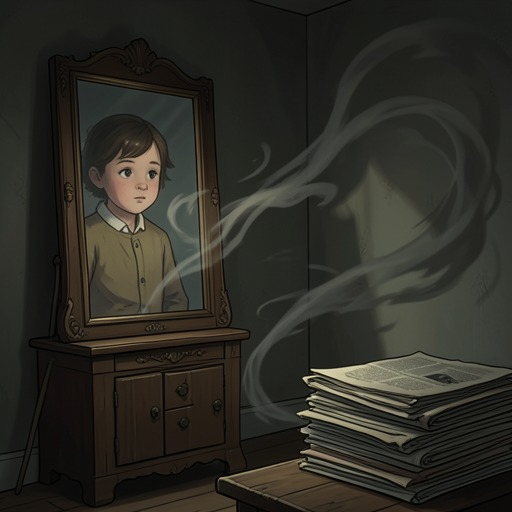
Later, Apollo studies the pages again and traces the contrast between the human child and its replacement. He identifies the Changeling in the crib, in Ida’s arms, and disintegrating on the floor. The printed sequence becomes newly legible to him in the context of Brian Kagwa’s disappearance and the possibility that the child he knew was not what he had believed. The book does not provide evidence about events outside its pages; rather, its images give Apollo a pattern through which he can recognize the possibility of substitution.
Copies, Memory, and Recognition
After Apollo’s original copy has been placed on Brian’s shelf, Cal gives him another copy of Outside Over There. She explains that Emma Valentine had told her about Apollo’s father and the book’s importance to him. Apollo receives it gingerly and scans the story instead of eating the oatmeal Cal has set in his lap. As he turns through the illustrations, Cal turns a page for him: Ida remains absorbed in her horn while the Goblins carry the baby away and leave the ice replacement behind. Apollo withdraws his hand from the page before continuing.
This encounter makes the book’s meaning depend on both repetition and difference. Cal’s copy is not the worn volume left by Brian West, and Apollo knows that more than one copy exists. Yet Emma’s account has carried the original book’s personal history into this new exchange. The story can be reproduced, but its connection to Apollo’s father, his memories, and his son cannot simply be reproduced along with it.
After leaving Cal, Apollo loses the copy she gave him. At home, exhausted and bruised, he searches for it before remembering that his father’s copy is still on the shelf in Brian’s room. He takes that book to the kitchen, moves his son’s grave marker aside to make space, and reads while forcing himself to eat stale crackers. On the page, Ida’s attention, the stolen child, and the melting Changeling become a sequence he can no longer treat as an old childhood tale. Emma has said that Brian is in the forest; Apollo connects that statement to what he has recognized in the book and prepares to go after him.
Narrative and Emotional Significance
Outside Over There binds together paternal absence, reading, care, and the fear that a child may be present but unseen. Apollo first uses it to imagine a father who read to him; with his own baby, he hopes to repeat that act but discovers how exhaustion and postponement can defeat even a cherished intention. Later, the story’s absent-minded music and unattended infant give language and images to his fear of replacement and loss. Its meaning shifts with Apollo’s circumstances, but the physical pages remain a point of return: the worn copy in the box, the book on Brian’s shelf, and the second copy Cal offers all lead him back to the same unsettling story.
The book’s emotional force lies partly in the difference between reading as a memory and reading as a deed. Apollo’s imagined scene of Brian West reading aloud cannot establish what his father intended, while Apollo’s own plan to read nightly to Brian Kagwa remains unrealized. Yet he knows the story by heart, recites it while caring for his son, and finally turns to it in the aftermath of Brian’s death to make sense of Emma’s words. The book does not resolve Apollo’s grief or restore the family life he imagined. It gives him a pattern to recognize—and, at the moment he believes Brian may still be found, a direction in which to act.