Patrice’s Titan computer
The ChangelingPatrice’s Titan computer is both an extravagant piece of hardware and the instrument through which Apollo Kagwa sees Emma Valentine alive after three months apart. Introduced with the ceremony of a prized possession, it fills a cramped spare bedroom with its physical bulk and bright screens. Later, those same screens display street footage that changes what Apollo knows: Emma survived, and Kim Valentine is helping her evade him. The computer’s importance lies in that shift from conspicuous object to indispensable witness.
Identity and Physical Form
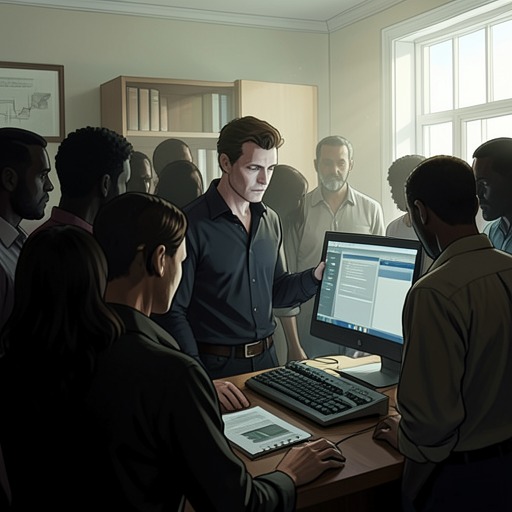
Patrice Green presents the desktop as Titan, a name that suits a machine whose specifications and scale seem almost excessive for its surroundings. It has 32 gigabytes of DDR3-1866 RAM, a 4.7-gigahertz processor, an Intel Core i7-3970x, two terabytes of storage, and a 16x Asus DVD-RW drive. Its display consists of three 27-inch monitors; even its mouse is shaped like a grenade. The inventory makes the computer’s power tangible, item by item, and Patrice’s proud presentation gives the equipment the character of a prized possession rather than an anonymous household appliance.
The room makes that scale more striking. The spare bedroom has wood paneling, dim light, shaggy brown carpeting, and a ceiling only six and a half feet high. With Patrice, Dana, and Apollo gathered inside, it feels cramped; Titan occupies much of one wall. It sits on a silver-powder-coated metal desk that cost $78.89 at Lowe’s, an ordinary, specific purchase supporting an unusually powerful system. The contrast between the machine’s elaborate specifications and its inexpensive desk, crowded into a gloomy spare room, keeps its grandeur firmly domestic.
Power in a Confined Room
When Patrice switches Titan on, all three monitors flare bright blue for a moment as the system boots. Apollo steps backward, startled by the sudden light and by the impression of a machine preparing to unleash its power. The scene places that reaction beside the room’s small space heater: its coils glow orange under the window, and Dana stops Apollo from moving farther, warning him about setting his pants on fire. The computer does not cause the heater’s danger, but the close quarters make the objects and people press against one another. Titan’s launch is dramatic precisely because it occurs in a room too small to make its power feel remote or abstract.
That vivid startup also establishes the screens as the machine’s most consequential feature. Their brightness first draws attention to Titan as an object; later, their shared display gives Apollo access to information his own phone cannot show him. The three monitors do not merely advertise technical capacity. In the scene that follows, they provide a common viewing surface for Patrice, Dana, and Apollo, bringing the three of them close together around evidence concerning Emma.
From Phone Problem to Evidence
The immediate need for Titan begins with a failed device. Apollo tells Patrice that a man sent him a video, but his phone cannot play it. Patrice identifies Flash as the likely format and suggests using Puffin Browser or jailbreaking the phone. Before the footage is shown, he asks whether the sender had actual proof that Emma is alive. The question makes the video’s status central: Apollo has a claim to investigate, not yet confirmation to rely on.
Patrice turns to the email and identifies the clip as apparent street-camera footage, describing it as the kind of surveillance material that would have required serious digging. He enlarges the video window, and the same image appears on all three monitors. Dana, Patrice, and Apollo crowd close to watch. Titan thus solves the practical obstacle posed by Apollo’s phone, but its role is more than technical. Its synchronized screens turn a privately received file into a scene that the three can examine together, while the computer’s capacity gives Apollo access to a mediated record of a person he had thought lost.
What the Screens Reveal
On Titan’s displays, Apollo recognizes Emma walking freely along a Manhattan avenue, downtown near Wall Street and far from Washington Heights. She wears a long winter coat that reaches her ankles. The surrounding pedestrians appear to avoid looking at her, turning away or attending to their phones as she passes. The footage offers movement and visible detail, but also an unsettling impression of social invisibility: Emma is present in public, yet other people seem not to acknowledge her.
The recording continues to a pier, where Emma waits among other passengers. A woman approaches, embraces her, and then leads her through the line for a water taxi using two passes. Emma remains stiff during the embrace. Apollo recognizes the woman as Kim, whom he had seen in Chinatown that same morning and given a check for ten thousand dollars. Patrice and Dana recognize Kim as well; neither looks at Apollo, and both lower their heads. The computer has carried him from doubt about whether Emma is alive to a more painful recognition of who helped her leave. After watching, Apollo takes out his phone and texts William Wheeler.
Titan does not explain Emma’s absence or make the surveillance footage equivalent to direct contact. It shows Apollo what he could not see on his own: Emma moving through the city and Kim assisting her escape. The device’s role therefore turns on a precise reversal. Its imposing specifications and bright blue startup initially make its power visible; its deeper significance emerges when that power becomes a means of seeing. What had been an impressive possession in Patrice’s crowded room becomes the screen through which Apollo encounters proof, recognition, and the limits of what watching can restore.