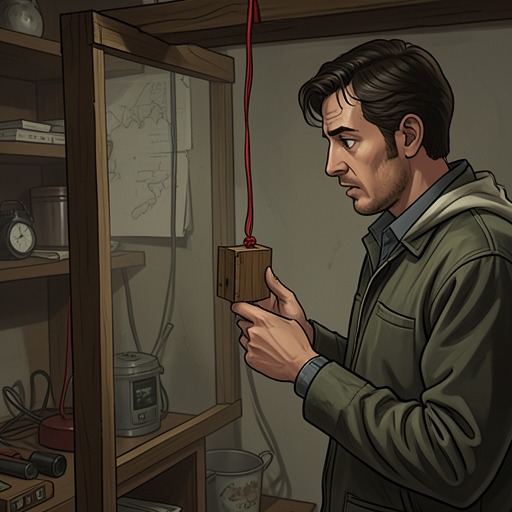
Red string on Apollo's hand
The ChangelingThe Red string on Apollo's hand follows Apollo Kagwa through several moments when he cannot tell what remains of his family: Emma Valentine’s presence, their son’s life, or the possibility of finding either again. Its knot holds through his attempts to loosen it and even when thorns cut his finger; its changing place on his hand gives a physical shape to a bond that survives uncertainty without resolving it.
Appearance and Continuity
The string is first emphasized as a bodily keepsake: after hearing Emma’s voice—the last words she ever spoke to him—Apollo shivers and tugs at it. The knot holds. His gesture is small, but it comes amid his effort to make sense of what he has encountered, making the string a point of contact with Emma when his understanding is unsettled.
Its position changes. On the island, Apollo checks his left hand and notices that his ring finger is bare; he has thrown his ring into the water, while the red string remains on his middle finger. Later, as he feeds Gayl a spoonful of macaroni, she works the string loose without his noticing. Her successful removal contrasts with Apollo’s earlier tug: his own attempt could not shift the knot, but her quiet, distracted persistence does. The string’s movement depends not on a declared power but on these intimate actions and the attention—or inattention—they require.
Gayl’s Intervention and Return
Gayl’s removal of the string happens during an act of care. Apollo uses the plastic spoon to coax her into eating, grinning when she takes a bite; while his attention is on her, she slips the string off his finger. The exchange briefly reverses who is caring for whom: Apollo feeds the child, and Gayl, without fanfare, alters the state of the keepsake he has been wearing.
After Gayl runs to her mother, her mother describes Emma’s care for another child, Freddie. Though occupied with her own problems, Emma read to him before bed each night she stayed there; his mother says that this was enough for her to understand Emma. Mother and child leave the Doctor’s Cottage, then return, and Gayl’s mother holds out the red string in her palm. Apollo takes it and, after looking at the loop for a long minute, slips it onto his ring finger. The return is deliberate where its removal was unnoticed. Moving the string from middle finger to ring finger makes the object newly conspicuous, while the scene’s account of Emma’s kindness gives its return an association with care passed between people, not merely with Apollo’s private longing.
The String at the Grave
The string remains on Apollo’s hand when he digs up Brian Kagwa’s grave. As he touches the dead child, his fingers catch on thorns; the prick tears his skin, and he realizes his ring finger is bleeding. The physical wound makes contact with the body costly. Apollo then steadies himself and touches only the blue blanket, lifting the small, light body from the casket through its fabric. The scene distinguishes the string from the thorns: the thorns cut him, but the string’s knot holds.
When Apollo returns the body to the damaged casket and the shadows of the grave, he checks whether the thorns have cut the string loose. They have not. He apologizes to his child and closes the coffin as best he can before climbing out with Patrice Green’s help. The string cannot undo the grave’s revelation or make the child’s body safe to touch; its persistence is instead measured against that irreversible encounter. Its intact knot offers no simple promise of restoration. It survives as Apollo leaves the grave, carrying the fact of attachment into the aftermath of what he has found.
Remembrance and Significance
Later, alone in his apartment, Apollo struggles to read because his hands shake. He recalls the hours spent digging and says, “No one was watching the baby.” Then he looks toward Emma’s former chair, where he can almost make out her ghostly silhouette, and turns the ragged red string on his ring finger with his thumb. He answers himself: “One person was watching.” The sequence brings together the object, the absent mother, and the question of who was present to protect their child. It does not establish that the string has caused or prevented anything; its force comes from being there when Apollo’s understanding changes.
Across these scenes, the string moves from a reminder he tugs while listening for Emma, to an object Gayl removes and returns, to a keepsake still intact after Apollo’s hand is cut, and finally to something he turns while recalling Emma’s care. Its knot does not function as proof that the family can be restored. Instead, the object makes connection tangible while Apollo remains uncertain and bereaved: a loop on his finger, altered by other hands, that persists beside the painful recognition that someone was watching.