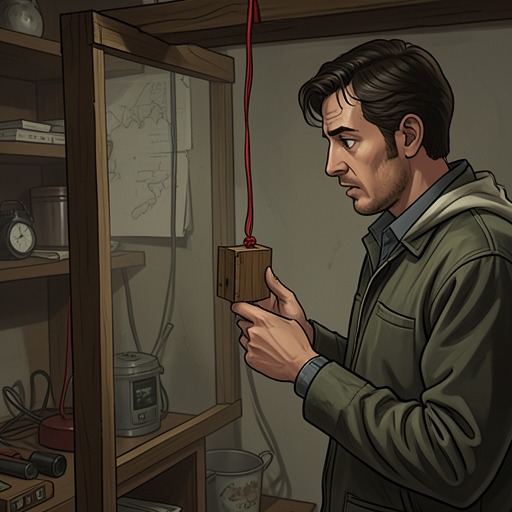
Red string on the ring finger
The ChangelingThe Red string on the ring finger is a modest object with an unusually intimate place in Apollo Kagwa’s story. Seen against the scale of danger surrounding him, it is not a weapon or a practical tool: it is something he turns around his finger, something Emma Valentine recognizes as connected to a wish, and something that eventually disappears without either of them knowing exactly when. Its significance lies in those changes of context. The string moves from private habit to shared conversation, then to an unexplained absence at the moment Apollo and Emma have recovered their son, Brian Kagwa.
Appearance and Use
The clearest early glimpse comes as Apollo enters the woods in Queens borough. He has brought a suitcase and a covered serving plate, and the city’s sounds quickly give way to the creak of trees and the rasp of dried leaves. In that abrupt quiet, he touches the string and turns it around his ring finger “as a Catholic might caress a rosary.” The comparison describes a repeated, bodily gesture: his hand returns to the string while he faces a place that feels strange and charged. The prose does not explain when he acquired it or what he wishes for. Instead, it gives the reader the movement itself, making the string’s presence tangible before its meaning is spoken between the characters.
The scene also places the string within a larger act of entering the woods. Apollo carries food and an offering; around him, what first sounds like running water resolves into words, as if the woods are whispering. The string does not visibly cause or prevent anything, and the text does not identify it as a charm. Its function in this passage is more limited and more personal: Apollo touches it as he crosses from the familiar streets into an uncanny setting. That juxtaposition gives an ordinary object emotional weight without settling whether its importance is practical, ritual, or simply intimate.
A Wish and a Substitute Ring
After Apollo and Emma have reunited, they lie together by a window where sunlight falls across their faces. In a quiet moment, Emma pats his chest, kisses his shoulder, and reaches for his left hand. Before he can touch her ribs, she turns his hand so she can inspect the ring finger. Her question is direct: “Did you make a wish with this?” The string’s association with wish-making, previously suggested by Apollo’s attentive gesture, is now recognized within the couple’s conversation.
Apollo answers, “I did. But I’m ashamed of it now.” The admission confirms that the string is tied to a wish he made, while leaving the wish itself undisclosed in this exchange. His shame matters as much as the answer: the object bears the trace of a hope he no longer feels able to claim without reservation. Emma responds by asking, “Why don’t you wear it until you can put your real ring back on?” Her suggestion makes the string a temporary stand-in for a ring, but not an equivalent one. The wording keeps the distinction visible: the string can be worn in the meantime; the real ring is elsewhere.
Apollo explains that he threw the ring into the East River waters. The contrast between the two objects is concrete: the string remains on his finger, while the ring he calls real has been cast into the water. Emma presses his chin and remarks that finding it there will be difficult. Apollo laughs and says, “You’d make me do it, too.” Their exchange turns the missing ring from a fact of separation into a possibility they can face together, though neither claims that it will actually be recovered. The scene gives the string its clearest relational meaning: Emma sees it, asks about the wish, and proposes a way for Apollo to keep wearing something on that finger until the ring can return.
Disappearance After the Rescue
The next recorded change in the string’s status comes after Apollo and Emma have pulled Brian free from the troll. In the bathroom at the park, they wash Brian’s hair and face and clean themselves as best they can. Apollo then realizes that the string has come off his finger. He cannot say when it happened. He considers two possibilities: perhaps it came loose while his hands were inside the troll’s belly, pulling Brian free; perhaps it lies at the center of a stone in the Northern Forest. He calls the second possibility improbable enough to be true, but the account does not verify either explanation or show the string being recovered.
That uncertainty is essential to the object’s ending. The string’s disappearance is a physical fact, but its timing and destination remain unknown. Apollo’s guesses connect it to the rescue’s bodily struggle and to the story’s uncanny landscape, without resolving which, if either, is correct. Unlike the ring tossed into the river, which Apollo can locate in retrospect even if he cannot readily retrieve it, the string has vanished without a known destination.
Narrative Significance
Across these scenes, the string’s meaning develops through touch, recognition, and loss rather than through an explanation of its origin. Apollo turns it around his finger when the woods overwhelm his ordinary sense of place. Emma later identifies its connection to a wish and treats it as something worth wearing while the real ring is absent. After the rescue, Apollo notices that it is no longer there, but cannot tell whether it fell away in the struggle or has taken on a stranger destination.
The object therefore holds several meanings in tension without confirming any one of them as its sole purpose. It is a tactile focus for Apollo, evidence of a wish he is ashamed to discuss fully, and a temporary answer to the absence of his ring. Its final disappearance accompanies the aftermath of a rescue, when attention turns to Brian and the immediate need to get him to a hospital. The string does not explain the events or guarantee an outcome; its quiet recurrence instead gives physical form to hopes and attachments whose histories are only partly known.