Sloopers
The ChangelingThe Sloopers were the Norwegian emigrants who sailed from Stavanger to New York in the sloop Restoration in 1825. Their celebrated voyage was more than an episode of immigrant history: in Jorgen Knudsen’s account, the safe crossing depended on a secret bargain with a monster, and the group’s brief settlement in Queens ended when that creature destroyed their homes. Their story links the public language of faith, liberty, and national beginnings to a history of migration that its participants did not all know—or did not openly acknowledge.
The Atlantic crossing
Jorgen dates the Sloopers’ departure from the Norwegian city of Stavanger to July 5, 1825. Fifty-two Norwegians sailed aboard Restoration, many of them Quakers seeking religious freedom in America. The vessel was only fifty-four feet long and sixteen feet wide, an exceptionally small ship for an Atlantic crossing. After fourteen weeks at sea, the passengers reached New York harbor on October 9. No passenger died; a girl was born during the voyage, without a hospital or painkillers. In Jorgen’s telling, that birth makes the journey’s material circumstances as striking as its successful arrival.
The voyage became national news. Newspapers called the emigrants the Sloopers because they had crossed in a sloop, and the public was fascinated by the question of how such a small vessel could have made the passage. The group’s leader, Lars Larsen, spoke publicly about religious freedom and the goodness and liberty of the United States. His account helped the passengers gain acceptance and become Americans, while the question of how they had survived the crossing faded from public attention. Jorgen calls Restoration the Norwegian Mayflower, placing the voyage within a familiar national story of migration while disclosing that its celebrated surface concealed another explanation.
The hidden means of passage
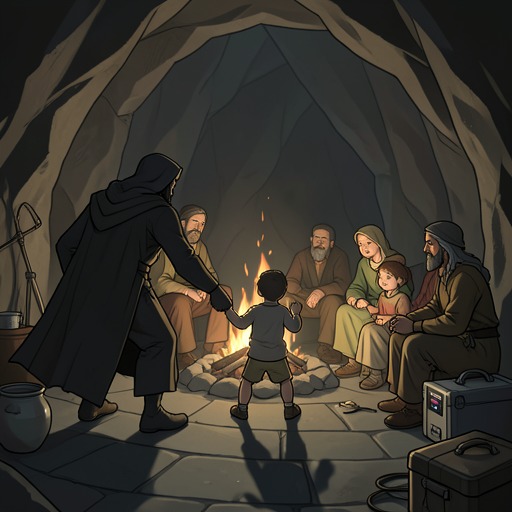
According to Jorgen, the other passengers trusted their crew and their God, but his ancestor Nils placed his faith in something older. Nils doubted that the small sloop could safely carry his family across the ocean, so he brought a monster as insurance. Jorgen says the Sloopers did not know the truth of the bargain: their safe passage depended on Nils’s reliance on the creature, not on the explanation Lars Larsen gave the public. The account therefore separates the voyage’s shared outcome from the different beliefs and knowledge that, Jorgen says, lay behind it.
Nils made the decision in order to leave Norway with his wife, Anna Sofie, and their family. Jorgen presents love and the practical fear of an unsafe crossing as motives for bringing the monster, but insists that the protection came at a price. His revelation turns the Sloopers’ passage from a story of endurance alone into a story of concealed dependence: a group’s collective survival is attributed to a bargain made by one family, without the other passengers’ apparent knowledge.
Settlement in Queens
The Sloopers first settled in Queens, but the settlement did not last. Most soon followed Lars Larsen and his family inland to Orleans County, which Jorgen describes as the first Norwegian colony in America since Leiv Eriksson reached these shores around the year one thousand. Three people did not continue with the larger group: Nils, Anna Sofie, and Petra Mikkelsdatter remained in Queens, then still largely farmland. Jorgen identifies them as the founders of Little Norway, and shows Apollo a drawing made about eight months after their arrival.
In Jorgen’s account, the land helped determine what followed. The family’s monster belonged, in its homeland, to the natural world of forests and mountains. Queens offered broad stretches of woodland and, later, a landscape of hills and caves where a large creature could hide. The land for a park was bought in 1898 and plans for golf courses and hiking paths followed, but development did not erase every secluded pocket. Jorgen invokes this layered landscape to explain how a creature brought across the Atlantic could find a place to settle within the expanding city.
Destruction and public memory
The monster destroyed property in Little Norway. Apollo infers that this means the other settlers must have discovered what was happening, but Jorgen does not confirm that they understood the truth. Instead, he recalls what they said about their losses: it was an act of God. The phrase leaves the community’s knowledge uncertain. It may register the limits of what the settlers could explain, or the easier public account that survived after the group dispersed; the narrative does not resolve that uncertainty into a shared confession.
The Sloopers’ history is thus preserved through competing explanations. Their crossing enters public memory as an extraordinary feat by pious immigrants, their settlement breaks apart after destruction, and the private account Jorgen offers traces both events to a monster’s presence. The contrast between the emigrants’ public story and Nils’s hidden bargain gives the Sloopers’ migration its particular significance in the novel: movement, settlement, and survival are not separate from the histories a community tells about them, or from the truths those stories leave out.