The Knudsen family’s generations-long pact with the trolls
The ChangelingThe Knudsen family’s generations-long pact with the trolls is an inherited bargain that links the family’s migration from Norway, a troll’s continued presence in Queens, and the delivery of children to it. The pact is presented both as a means of keeping the creature appeased and, in a later generation’s interpretation, as a route to prosperity. Its logic shifts from protection to sacrifice and finally to commercial exploitation, while its central cost remains the child made vulnerable by adult decisions.
Origins and Terms of the Bargain
Jorgen Knudsen explains the pact as part of Nils Knudsen’s decision to leave Norway with his wife, Anna Sofie. Doubting that the Sloopers’ small vessel could safely carry his family, Nils brought what Jorgen calls insurance. The bargain required a child in exchange for the troll’s presence and the protection or security the family expected from it. Nils would serve as the creature’s caretaker, ensuring that it was appeased.
The family’s choice of destination made the arrangement possible. The Sloopers continued upstate after reaching New York, but Nils, Anna Sofie, and Petra Mikkelsdatter remained in Queens, which Jorgen describes as farmland covered with extensive forest and greenery. He argues that such terrain resembled the troll’s natural habitat: forests and mountains where creatures of its kind made their lairs. The area’s hills and secluded pockets offered places for something large to hide.
Jorgen connects that hidden landscape to the later development of the park. By 1898, land had been bought for the park and its design had begun, with golf courses and hiking paths among the planned features. But development did not erase the terrain’s hollows and caves. In Jorgen’s account, the modern park overlays a landscape that could still shelter the creature. He gives its Norwegian names as Jotunn and Trolde, placing the family’s American inheritance within the older world from which Nils had come.
The Child as Payment and Failed Care
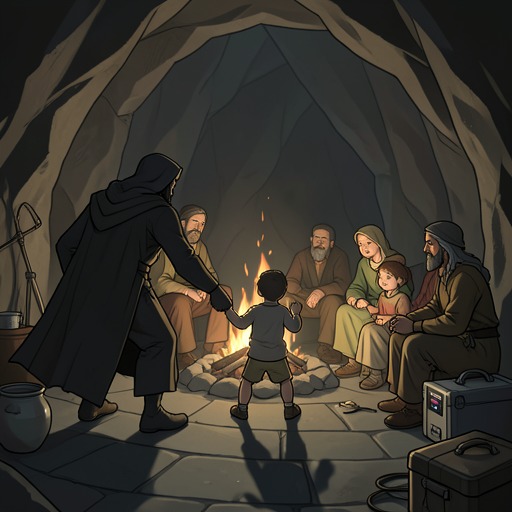
The pact’s most consequential term is its demand for a child. When Nils could no longer postpone fulfilling it, he took his daughter Agnes Knudsdatter into the woods and delivered her to the troll’s cave. The bargain is thus not an abstract family tradition: its first described payment is a father abandoning his daughter in a specific place, leaving her to the creature.
A wall of children’s portraits makes the cost appear cumulative. The images run along the wall in a sequence of changing photographic forms, from sketches and charcoal renderings through daguerreotypes, black-and-white photographs, and early color. Every portrait depicts an infant, and none shows a child older than a year. Their arrangement turns the family’s history into a visual record of repeated losses. Apollo’s realization that the portraits are all children intensifies the horror of the pact beyond the story of Agnes alone.
Jorgen resists Apollo’s description of the children as food. He insists that the troll tries to raise them, and that it feeds only when that attempt fails; after each failure, the family must try again. That defense gives the arrangement its grotesque paternal language, but it does not lessen the consequence: the child is delivered to a being that repeatedly fails to care for the children entrusted to it. Jorgen identifies the obligation as belonging to the men of the Knudsen line, making the bargain hereditary rather than a decision confined to Nils.
Inheritance, Ideology, and Rupture
Jorgen’s account of a later generation joins the pact to grievance about social status and inheritance. He describes his son as a husband and father of two daughters, employed in computer work but earning too little, and presents him as someone who believed that white men had lost a once-assured birthright. The son came to see the troll not as a burden but as a blessing, and to regard a return to the old ways as a means of restoring the family’s power.
In that interpretation, the pact becomes a claim about historical entitlement. The troll, Jorgen says, had brought the family to these shores and might save it again; the family could supposedly channel its power toward its own deliverance. Jorgen reports that his son believed the family’s decline began when Nils refused to sacrifice one of Petra’s children. He admired his son’s resolve to honor the bargain as it had been made, and says the son left Agnes in the forest, in a cave.
The supposed restoration instead breaks the son’s household. Gretta Wheeler could not accept his vision; she left him and took Grace Wheeler with her. Jorgen interprets the loss as devastating: his son had loved his wife and daughters, yet had been willing to sacrifice his own child. Jorgen says that his son lost his mind and that he has cared for him ever since. In this account, the pact does not secure a stable family inheritance. It repeats the abandonment at its center and helps fracture the family that attempts to uphold it.
Kinder Garten’s Commercial Version
Kinder Garten presents a further change in the pact’s meaning. He says that his father performed the service without payment, but argues that this was never the proper arrangement: the Knudsen men were to make the ultimate sacrifice and prosper in return. He describes his father as having failed to make the proper sacrifice and therefore received no blessing. The troll was kept from rampaging, but, in Kinder Garten’s telling, that protection did not pay the mortgage.
Instead of treating the bargain solely as a family obligation, Kinder Garten turns its hidden proceedings into a product. He says he advertised on specialized online boards and offered access to the camera for a monthly subscription. Subscribers could log in at any time to watch; he describes the viewers as watching everyone continuously and claims that no act remained unknown to them. The pact’s secrecy becomes part of its commercial appeal: the cave and its captive subject are offered to an audience as an unprecedented spectacle.
Kinder Garten also frames the scheme through ordinary habits of digital privacy. He observes that covering laptop cameras with electrical tape would prevent people like him from watching, but says most users do not take that precaution. He hopes to expand the subscriber pool, make payments in bitcoins because they are harder to trace, and upgrade from the single camera he had managed to place to a 35-millimeter full-frame CMOS sensor camera capable of full-HD video. He says the single camera reflects the danger of remaining in the cave long enough to install more. He has advertised a finale as the attraction subscribers are waiting to see.
What the Pact Preserves
Across the generations described, the pact preserves a chain of male authority over children while changing the stated reward: safety during migration, the troll’s restraint, a hoped-for blessing, and finally subscription revenue. Its supernatural terms are specific—the caretaker must appease the troll, and a child is demanded—but the bargain supplies no guarantee that the child will be raised successfully or that the family will prosper. The repeated failure of care and the later family rupture expose the distance between the pact’s promise and its consequences.
Its transformation into a camera-based business extends the original violation rather than replacing it. A child delivered to the cave becomes both the center of an inherited sacrifice and an object watched by paying strangers. The pact’s history therefore joins old-world folklore to contemporary surveillance: what began as a secret family obligation is recast as a marketable spectacle, while the vulnerable child remains the price paid by others.