The Knudsen–troll pact
The ChangelingThe Knudsen–troll pact is a multigenerational bargain in which the men of the Knudsen line serve as caretakers to a troll, appeasing it by delivering children for it to raise. Its promise of protection and prosperity is bound to a terrible cost: when the troll fails to raise a child, it feeds, and the family must try again. The pact begins as insurance during migration from Norway, but its inherited obligation is later recast as a source of power, entitlement, and commercial profit.
Origins and the bargain
Jorgen Knudsen explains the pact as part of Nils Knudsen’s decision to leave Norway with his family. The ship the Quaker Sloopers planned to sail seemed too small to Nils, who feared for his family’s safety. He brought the troll as insurance, accepting a bargain with a price. The Sloopers continued upstate after reaching New York, while Nils, Anna Sofie, and Petra Mikkelsdatter remained in what is now Queens borough. At the time, the area was farmland and extensive forest, a landscape Jorgen describes as suitable for a creature whose lairs belong in forests and mountains.
The changing landscape did not eliminate the troll’s hiding places. By 1898, land for the park had been purchased and plans for golf courses and hiking paths were underway, but the hilly terrain still held pockets and caves. In Jorgen’s account, the development of the park and the persistence of concealed caves explain how the creature could remain near the Knudsen family as the area changed around it. He identifies the being with the Norwegian words Jotunn and Trolde.
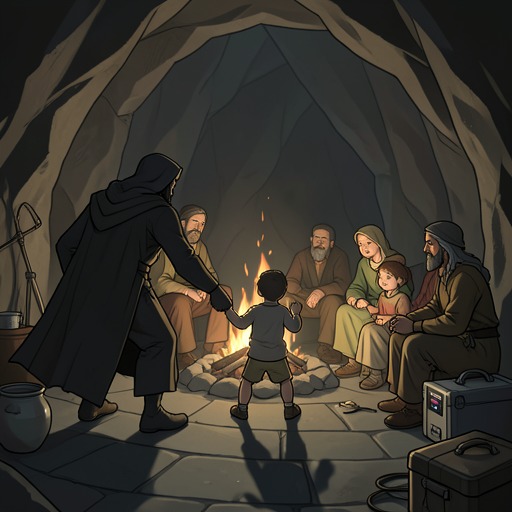
The bargain assigns Nils the role of caretaker: he must make sure the troll is appeased. In return, the troll demands a child. When Nils could no longer postpone fulfilling that obligation, he took his daughter Agnes Knudsdatter into the woods and delivered her to the beast in its cave. The pact therefore turns family protection into a demand made on the family itself; its first described payment is not an abstract offering but a daughter taken from home and left in the forest.
The recurring sacrifice
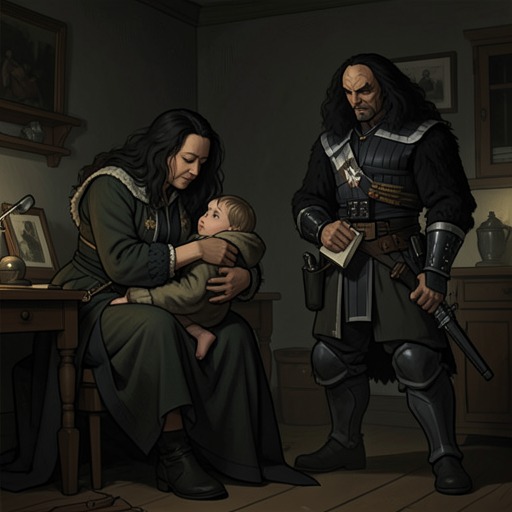
The pact is not presented as a simple exchange in which the child is immediately killed. Jorgen insists that the troll tries to raise the children it receives, but that it fails. When the attempt fails, it feeds, and the Knudsen family must try again. The repeated cycle of attempted care, failure, and feeding is the pact’s grim operating rule: the troll is at once represented as a would-be parent and as a predator, while the family’s promised duty continues across generations.
Apollo sees the evidence of that repetition in a wall of portraits. The framed images run along the room in chronological sequence, beginning with sketches and charcoal renderings, continuing through daguerreotypes and black-and-white photographs, and ending in early, grainy color. They are all portraits of infants, none older than a year. The room gives the pact a material history: what Jorgen describes as successive attempts to raise children appears to Apollo as a collection of children consumed by the family’s arrangement with the troll.
Jorgen distinguishes the Knudsen men’s obligation from the troll’s own offspring, whom he dismisses as too ugly to love. That explanation exposes a further imbalance in the pact: human children are repeatedly supplied to the creature, while its own young are excluded from the affection that Jorgen claims it tries to give. His insistence that the troll attempts fatherhood does not undo the consequence of its failures or make the family’s role less violent.
Inheritance, failed blessing, and profit
Jorgen’s account links the bargain to an inherited sense of duty. He says his son believed the troll was not a burden but a blessing, and that the family needed to return to its old ways. The son suspected that the family’s decline began when Nils refused to sacrifice one of Petra Mikkelsdatter’s children. In his view, the troll had brought the family to America and might deliver it again; honoring the pact as Nils had done was, to him, an exercise of heritage and a path to deliverance. Jorgen says he admired his son’s resolve.
That resolve costs the son his family. After he leaves Agnes Knudsdatter in a forest cave, his wife, Gretta Wheeler, leaves him and takes their daughter Grace Wheeler. Jorgen says the separation breaks his son, who loses his mind and thereafter depends on his father’s care. The supposed blessing thus fails to restore the family: the attempt to fulfill its inherited obligation instead produces abandonment and lasting damage within the next generation.
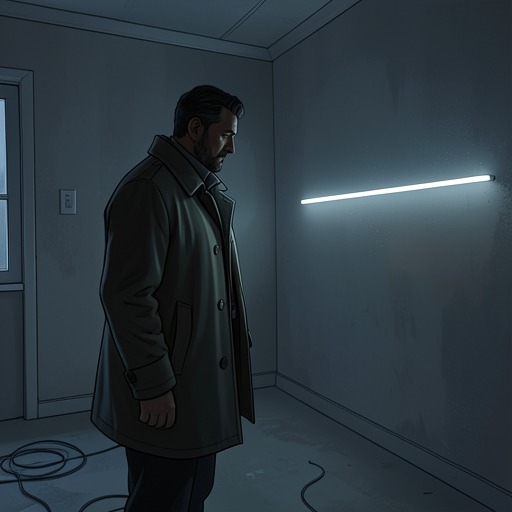
Kinder Garten gives the pact a more openly commercial interpretation. He says the Knudsen men were meant to make the ultimate sacrifice and prosper in return, and describes his father’s service as unpaid and unsuccessful: although his father kept the troll from rampaging, Kinder Garten says he received no blessing and could not meet his mortgage. Kinder Garten responds by monetizing the arrangement. He advertises access to a camera on specialized online boards, charges a monthly subscription, and presents the watched proceedings as a rare mystery worth paying to see. He describes the monitored person as a beta test and hopes to accept payment in bitcoins because they are harder to trace. In this version, the inherited pact no longer yields only its promised supernatural benefit; it is converted into a surveillance business.
Meaning and consequences
The pact’s changing interpretations reveal how an inherited obligation can be made to justify repeated harm. Nils treats the troll as insurance for a perilous migration; later descendants treat the bargain as a claim to ancestral power, a route to prosperity, or an opportunity to profit. Across these accounts, the stated exchange remains unstable: children are surrendered, but the promised blessing is not reliably realized. Jorgen’s son loses his wife and daughter, and Kinder Garten describes financial failure in the generation before him, even as he tries to turn the creature’s activities into income.
The pact also makes parenthood an instrument of the bargain. The troll’s attempted care is invoked to distinguish raising from feeding, but its failures leave children in danger and oblige the Knudsen men to supply others. The portraits of infants make that recurrence visible, while the family’s language of sacrifice and inheritance attempts to contain its meaning. In the story, the pact is not simply a supernatural rule: it is a tradition repeatedly interpreted by men who present the cost to children as necessary, and whose claims of protection, blessing, or prosperity do not erase the consequences.