The supernatural and magic
The ChangelingThe supernatural and magic in the novel are encountered less as a single system of rules than as uncertain forces that gather around books, rituals, memories, and dreams. A rare occult collection gives Apollo Kagwa a tangible link to the history of magic; Emma Valentine’s red string makes a personal wish ritual part of their relationship; and Apollo’s later dream turns his absent father into a threatening, uncanny presence. Across these episodes, magic can be a joke, a source of hope, or an image for emotions that ordinary explanations do not settle.
Occult Books and the Material World
Apollo’s rare-book business places the occult in the ordinary economy of estate sales and collecting. At a sale in the basement of a Bronx apartment building, he buys forty-two containers of books from the estate of the D’Agostino couple, whose children and grandchildren had been unsettled by their collection. Among the volumes are books on magic and the occult, including a third edition of Witch Hunter Manual of the Blood Council. The collection’s domestic origin matters: a snapshot of the couple is tucked into a grimoire, juxtaposing an unremarkable family keepsake with books of sorcery. Their neighbors and descendants may find the collection strange, but Apollo sees both a valuable find and a set of material traces left by its former owners.
A postcard discovered inside the folio sharpens that contrast. Dated 1945 and addressed to the D’Agostinos, it bears the clear signature of Aleister Crowley, whom Apollo identifies through an online search as a famous occultist. The card’s contents surprise and amuse him, and he imagines that authentication could make the find legendary. Yet the discovery also changes the emotional tenor of the scene: after laughing at the card, Apollo raises it to share the joke, then realizes he is alone. The rare object offers excitement and potential professional distinction, but cannot supply the person with whom he wants to share it. In this episode, the occult is simultaneously a collectible artifact, a comic revelation about its owners, and the occasion for Apollo to feel his loneliness more sharply.
Emma’s Red String and the Work of Belief
Emma brings a different kind of magic into the story when she returns from Brazil wearing a thin red string around her wrist. She explains that, while staying with a family in Itapuã, Salvador, she befriended a washerwoman near Lagoa do Abaete. Her host family warned her away from the woman as a witch, but Emma was drawn to her and found in her a resemblance to the mother she had lost. Before Emma left for Manaus, the washerwoman invited her to make three wishes and tied the string around her wrist. The ritual makes belief personal: its authority comes not from a book or a public institution, but from Emma’s encounter with a woman she trusted and the meaning she gives that meeting.
The ritual has a simple condition. Emma must let the string come apart and fall away on its own; she believes she cannot cut it off if she wants the wishes to come true. By the time she tells Apollo about it, the string has been on her wrist for more than six months and looks worn. She admits both that she once treated the custom as fun and that she now wants her wishes to come true. Her explanation makes belief neither an unquestioned certainty nor a mere joke: she recognizes the string’s shabby appearance while remaining attached to the possibility it represents.
Apollo cuts the string with a plastic knife. He has been thinking of himself as a god, and he promises Emma that all three wishes will come true with him. The gesture therefore breaks the ritual’s stated rule even as he offers himself as its replacement. Emma has to decide how to understand his action: as arrogance, or as boldness and worthiness. The episode leaves the wishes’ outcome unresolved, but makes the cut itself consequential. Magic becomes entangled with courtship, risk, and the power one person claims to have in another’s life.
Objects That Gather Memory
The red string continues to matter after the moment of its cutting. Years later, Apollo finds it in his wallet while preparing to add something to the Improbabilia box. The short, frayed thread seems warm to his touch, and he places it inside. The detail does not establish that the ritual worked; it shows instead that Apollo has preserved the string as an emotionally charged object. Its passage from Emma’s wrist to his wallet and then into the box records a change in its meaning, from a rule Emma chose to follow to a keepsake Apollo elects to retain.
The box collects other objects that join family memory to books. Apollo removes a children’s book from it, thinking he may read it to his son as his own father once read to him. He adds Once Upon a Die, a worn thriller he cannot sell, because it will remind him of the night his son was born, and keeps a ticket from the drive home so he can later tell Brian the story behind it. Finally, he places the To Kill a Mockingbird first edition inside and closes the box. Calling Improbabilia a magic box gives this act a fairy-tale coloring, but its contents are also concrete: books, a ticket, and the thread hold stories Apollo hopes to pass on. The box makes remembrance a deliberate practice rather than proof of supernatural power.
Dreams and Unsettled Explanations
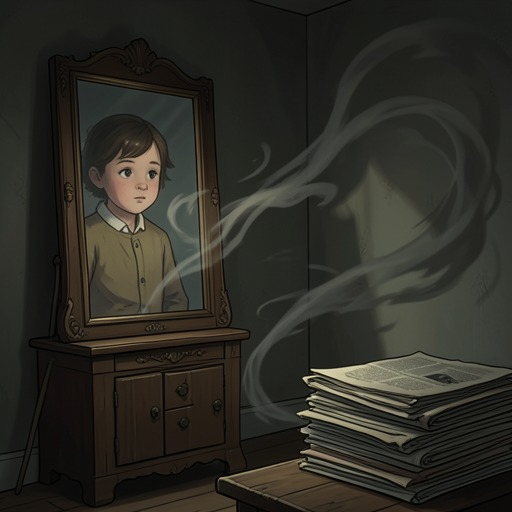
In a dream, a man knocks at Apollo’s front door. Apollo turns all three locks, but the man enters with a blue face and no nose or mouth, then removes his blue skin to reveal Apollo’s father. Apollo embraces him before the dream shifts into an encounter with crashing water and white fog. His father holds him and takes him into the mist. The sequence changes a familiar absence into an uncanny visitation, but its frame as a dream does not confirm that the father has returned or that supernatural forces are acting in the waking world.
Taken together, the episodes sustain a distinction between magic as an asserted fact and magic as a way of interpreting experience. The postcard can be authenticated as a historical object; the red-string ritual depends on Emma’s belief and Apollo’s interruption; the Improbabilia box holds memories in physical form; and the dream gives fear and longing an impossible shape. The novel allows these modes to touch without making them equivalent. Its supernatural atmosphere arises partly from that uncertainty: the objects and images matter, even when they do not settle what, if anything, lies beyond ordinary explanation.