Troll's Cave
The ChangelingTroll's Cave is a cavern beneath a vast, stone-ringed clearing in Queens, hidden within the Northern Forest and bound to a generations-long bargain between the Knudsen family and a creature. The cave is where that pact’s demand for a child was fulfilled, and where Apollo Kagwa and Emma Valentine encounter material evidence of the children sacrificed to it. Its progression from an inherited story to a surveilled, inhabited chamber makes it both a repository of buried violence and the setting for the novel’s decisive supernatural revelation.
Setting and Physical Form
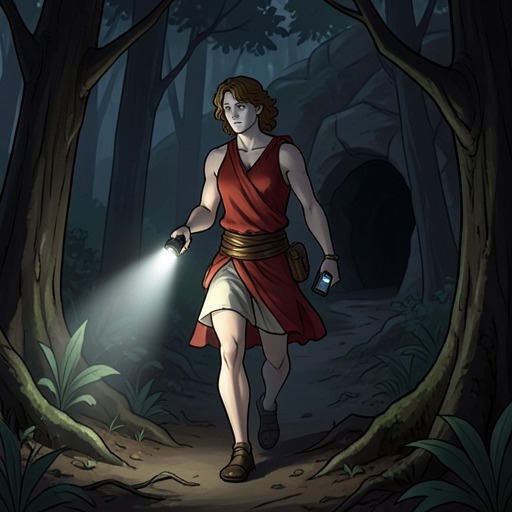
The cave lies at the bottom of a broad pit in a clearing surrounded by the densely packed Northern Forest. From the upper path, Apollo sees rings of gray stone and rubble descend toward its gaping black entrance. The clearing resembles a quarry, though it is smaller and shallower; set against the forest, however, the stone basin seems immense. Emma sits at the pit’s lip, looking down toward the opening, while Apollo stops above her and recognizes the landscape described in Jorgen Knudsen’s account.
The approach makes the cave difficult to separate from its surroundings. Snow covers the stones, the paths divide around the clearing, and a pewter serving lid lies along the route to the entrance. When Apollo descends, he uses the lid as a point of orientation and then holds it up toward Emma, briefly turning it into a token of accomplishment. That ordinary object offers little protection against what lies below: a burst of heat from the cave melts the snow around Apollo in a ragged semicircle, leaving the nearby stones exposed while winter remains farther up the valley. The opening seems to breathe, making the subterranean space register as an active presence rather than an empty geological feature.
The Pact and the Children
The cave’s history reaches back to Norway, where Nils Knudsen agreed to act as caretaker for the creature and to appease it. The bargain required one thing: a child. When he could no longer delay, Nils took his daughter Agnes into the woods and delivered her to the cave. The account gives the place a particular human history: it is not simply where a monster hides, but the destination chosen by a father under the terms of an inherited arrangement.
That first abandonment is connected to a much larger record of violence. In the Knudsen house, pictures of infants are arranged along a wall in chronological rows, moving from sketches and charcoal renderings through daguerreotypes, black-and-white photographs, and early color images. None shows a child older than a year. The collection gives the cave’s demand a repeated history, extending beyond Agnes and making Apollo confront the suggestion that many children were fed to the creature. Later, at the clearing, he finds a child’s skull with a hole above the left ear. Emma warns that entering the cave would mean he would not survive. Apollo retreats among the clattering bones and identifies the skull as that of Agnes Knudsdatter, the first abandoned child in Queens. In this way, the cave’s surrounding ground preserves physical traces that the family’s story had concealed.
Discovery and Surveillance
For Apollo, reaching the clearing changes the status of Jorgen’s account. Hearing a story about the cave is one thing; seeing its entrance in the landscape makes the account difficult to dismiss. The stone basin, the black opening, the exposed bones, and the skull connect the family’s testimony to a place that can be approached and examined. His descent is nevertheless cautious and incomplete: he moves over loose stone, tries to avoid the cave mouth, and turns back rather than crossing the threshold after Emma warns him.
The cave is also under observation. Kinder Garten shows Apollo and Emma a hazy computer image of an underground scene of packed earth and stone. Apollo recognizes it as the cave and understands that Kinder Garten has placed a camera inside. The device extends the Knudsen family’s inherited burden into active surveillance: the hidden chamber is not merely a refuge for the creature but a space watched by people who know what it contains. Kinder Garten presents this watching as part of making the best of what has been inherited, joining the cave’s present-day control to the older pact and its consequences.
The Amphitheater and the Creature
Farther inside, the passage opens into a large earthen amphitheater. Ringed ridges descend toward a broad floor of flattened earth, echoing on a larger scale the rings of stone around the outdoor pit. Apollo and Emma move down the shallow levels and along the arena wall, nearly blind in the darkness. The camera’s view has already established that this underground space is watched, so their uncertainty about whether other men are observing them sharpens the cave’s double character: it is both a lair and a monitored interior.
The chamber initially seems to hold a sleeping child beside a storage box. Its steady breathing continues even after the child wakes; Apollo realizes that the sound is not an echo but a second, matching breath. Then the breathing stops and a low rumble begins. What they had taken for part of the amphitheater wall rolls like an alligator turning its prey, and an enormous eye opens in the dark. The revelation makes the cave itself seem inseparable from the creature concealed within it: a wall can move, and the architecture that appeared to contain the threat is the threat’s body.
Narrative Significance
The cave gathers the novel’s movement between explanation and encounter into one physical geography. Jorgen’s account of a Norwegian bargain, the images of infants, Kinder Garten’s camera, and the remains around the clearing give the place an accumulating history before Apollo and Emma face the creature inside. The landscape therefore does more than provide a setting for danger: its paths, rings, descent, and buried chamber organize the characters’ passage from inherited knowledge to direct evidence.
Its contrasts also give the horror its force. A Queens forest conceals a history traced back to Norway; winter snow gives way to heat that seems to issue from underground; a wall becomes a living body. The cave’s concealed depths hold both the evidence of human choices and a presence that exceeds ordinary explanation. When its apparent wall opens an eye, the story’s earlier uncertainties resolve into physical encounter, while the camera confirms that the secret has never been wholly beyond human reach.