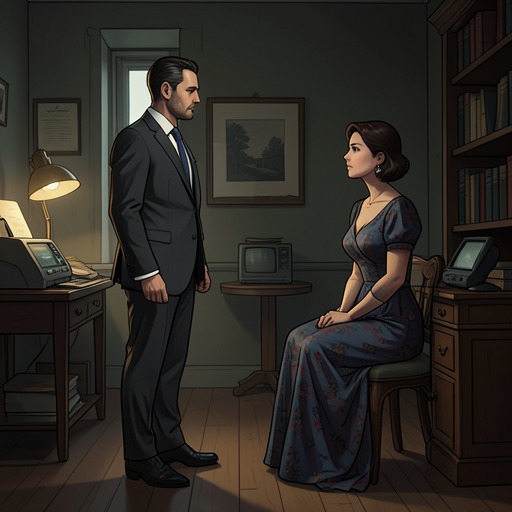
William Wheeler and Grace’s father-daughter relationship
The ChangelingWilliam Wheeler and Grace’s father-daughter relationship is presented less through shared scenes than through the family William tries to recover and the fear his return brings. After the death of Agnes, William seeks a way back to Gretta Wheeler and Grace, while Gretta describes herself and her surviving daughter as people he still believes belong to him. The relationship therefore carries two meanings at once: William’s longing for his daughter and the burden of being claimed by a father from whom Gretta has separated her family.
Family and Separation
William’s family life is defined in the available account by both loss and absence. He tells Apollo Kagwa that he had two daughters, and speaks of Agnes as the baby whose death shattered the family. By the time William approaches Apollo, Gretta and Grace are no longer living with him. He explains that Gretta left and that he did not at first know where she had gone; his account links the family’s separation to his grief, confusion, and inability to find her.
The distinction between the two daughters matters. Agnes is dead, and William identifies her loss as the rupture that preceded his attempt to recover what remains of his family. Grace, by contrast, is alive but separated from him. When William asks Apollo to help him reach Gretta, he does not describe a reunion with Grace as something already arranged or achieved. His wish is still a plea: he wants Gretta and Grace to come home so that the surviving family can be whole again.
William’s Attempt to Restore the Bond
William makes his appeal through Apollo, asking him to speak to Gretta because William himself is not permitted to see her while he is in his current condition. He offers an account of changed understanding: he says he now recognizes that Gretta was not at fault for Agnes’s death, and that both parents had lost their minds in the aftermath. He also acknowledges that he had been short-tempered and quick to accuse her. His request thus includes more than a demand to see Grace; it includes an effort, however uncertain, to accept responsibility and ask Gretta’s forgiveness.
William presents Grace’s return as part of a larger hope of restoring the family. He wants Gretta and their surviving daughter back at home, and frames them as what remains of the family after Agnes’s death. That formulation reveals both his attachment and its limits: Grace is precious to him, but his appeal places her within a project of family repair centered on his wish for a shared home. He asks Apollo to carry his message rather than relying on direct contact, and admits that even forgiveness may not secure his release. At this point, his desire for renewed fatherhood remains unresolved and dependent on Gretta’s response.
Grace’s Position and Gretta’s Account
When Apollo arrives with William, Gretta asks whether he has come and says that Grace is with her parents. This establishes Grace’s immediate situation: she is being cared for away from William, while Gretta confronts his unexpected return. The account does not describe Grace meeting her father during this encounter, so her presence in William’s appeal should not be mistaken for a completed reconciliation.
Gretta’s view gives the relationship its sharper edge. She says William will not give up and that he thinks she, Grace, and Agnes are his. Agnes’s name is spoken in a whisper, binding the dead child to the continuing conflict over the living one. Gretta’s words do not establish what Grace herself feels about William; instead, they show the pressure his persistent claim places on her mother. William’s desire to recover his daughter and Gretta’s insistence that he continues to claim the family exist side by side, without the narrative resolving that disagreement into renewed trust.
Meaning and Unresolved Ending
William’s relationship with Grace is shaped by a contrast between paternal longing and the consequences of his conduct. He speaks of loving family and wanting to make amends, but Gretta remembers him as someone who repeatedly finds his way back into their lives and regards them as his. The narrative gives weight to both accounts: his remorse is expressed in his appeal to Apollo, while Gretta’s guarded response prevents that appeal from standing as proof that the relationship is repaired.
The relationship also remains distinct from William’s grief for Agnes. Her death is the event he says altered the family, and his wish to regain Grace is bound up with the impossible hope of making the family whole again. Yet Grace is not a substitute for her sister, and the surviving bond cannot simply undo the loss or the separation. The evidence leaves the father-daughter relationship at a point of suspended possibility: William wants to return to Grace’s life, Gretta has not agreed to that return, and Grace’s own response is not shown.