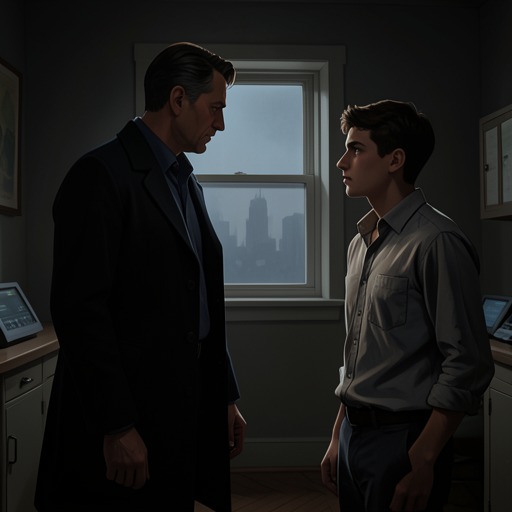
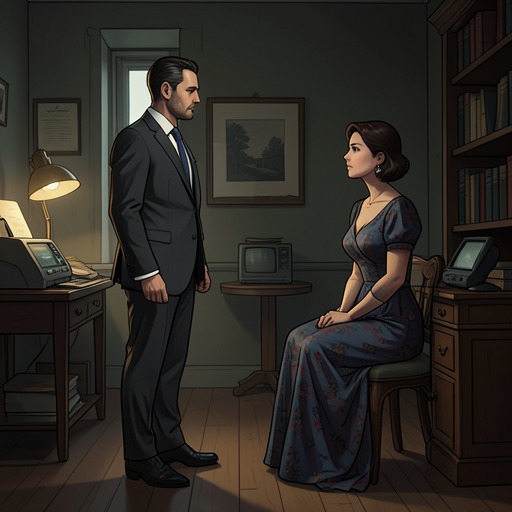
William Wheeler and Gretta Wheeler’s marriage
The ChangelingWilliam Wheeler and Gretta Wheeler’s marriage is defined by bereavement, separation, and an unresolved struggle over whether family ties can be repaired or have become a claim of ownership. After their daughter Agnes died, Gretta left William with their daughter Grace Wheeler and went to be with Cal. William later sought Gretta’s forgiveness and the return of his family, but Gretta described a pattern of intrusion and financial harm that made his pursuit feel less like reconciliation than a refusal to let her go.
Bereavement and Separation
William explained that Gretta had left him and that their home had become empty. He described himself as in a free fall, unable to find information about Gretta, who had gone to be with Cal. His account links the collapse of their marriage to Agnes’s death: he told Apollo that both he and Gretta had lost their minds after losing their baby, and said he had not spoken Agnes’s name aloud in almost a year. The loss remains central to the way William understands the separation, though his account does not erase the consequences of what followed.
Gretta and Grace were, in William’s view, the family he had lost and wanted back. He spoke of them together with Agnes, making his wish for reunion inseparable from his grief for the child who had died. His language casts the surviving family as what remained of a formerly whole household; Gretta’s later account, however, emphasizes that being treated as part of William’s family did not mean she was free from his reach.
William’s Pursuit and Appeal
William’s search for Gretta grew out of a period in which, by his account, he had time but could not discover where she was. He traced Apollo through an account of the A-train birth, found Emma’s name, learned about Apollo’s business, and located his family through Facebook. Apollo’s public family photographs prompted William to see him as someone who understood the importance of loving and protecting a family. William acknowledged that his own family’s destruction had set this chain of events in motion: had Gretta not left with Grace, he said, he and Apollo would never have met.
When William asked Apollo for help, he wanted him to speak to Gretta because she did not know Apollo and, William believed, might listen to him. William wanted Apollo to tell her that he no longer blamed her for what happened after Agnes died. He also wanted to apologize for being short-tempered and quick to accuse, and offered to forgive Gretta if she wanted his forgiveness. His stated aim was to have Gretta and Grace return home and make the surviving family whole again.
The request was also a plea made under immediate pressure. William was confined alongside Apollo and believed that the authorities might kill them or move them elsewhere. He said that if Apollo encountered Gretta, he should pass on the message; he hoped her forgiveness might help secure his release, while admitting he did not know whether that would happen. His appeal thus joined a wish for reconciliation to his own chance of survival. William presented Apollo as his only remaining opportunity to reach Gretta, but the conditions of the appeal also made the proposed reunion serve William’s urgent needs.
Gretta’s Account of the Marriage
Gretta’s words supply a sharply different measure of William’s continuing presence in her life. When Apollo spoke to her, she did not know who he or Emma was; she had been absorbed in her own terrible experience. She described the recurrence plainly: she kept thinking she would be finished with William, but he always found a way back into her life. She believed he thought that she, Grace, and even Agnes still belonged to him. Cal understood the pattern she described, while offering her physical support without drawing her into an embrace she did not return.
Gretta gave concrete examples of how William had reached her. He had found her new address and mailed her a book. When Cal questioned whether she had been careful, Gretta added that William had emptied her bank account, taking seventy thousand dollars. Her account makes the book and the theft part of the same unwanted return: William could approach her through correspondence and through access to her money, even without a direct face-to-face encounter. The financial harm also complicates his appeal to shared grief and forgiveness; his wish to be understood as a bereaved husband exists beside Gretta’s report of material injury.
An Unresolved Relationship
The novel does not show Gretta accepting William’s request or agreeing to return. His apology and offer of forgiveness remain a proposal delivered through Apollo, while Gretta’s account registers the persistence of a relationship she has tried to leave behind. The difference is not simply between a husband who wants his family restored and a wife who refuses him: William describes the loss of Agnes and the destruction of his home, whereas Gretta identifies the repeated consequences of his pursuit, including the mailed book and the theft of seventy thousand dollars.
Their marriage therefore remains suspended between kinship and coercive attachment. William invokes the family bond as a reason to reunite; Gretta experiences that same bond as something William uses to claim continued access to her and their daughters. Agnes remains part of both accounts, but in different ways: for William, her death is the grief that helps explain the marriage’s collapse, while Gretta’s naming of Agnes among those William considers his own exposes how far his claim, in her view, extends beyond the living. The available account ends without reconciliation, leaving William’s appeal unanswered and Gretta’s separation intact.