Wise Ones’ policy of proactive defense against men
The ChangelingThe Wise Ones’ policy of proactive defense against men is a collective security rule formed after an outsider’s attack killed three women and seven children and left Cal wounded. The women’s retreat to an island, their decision to arm themselves, and the guarded reception they give Apollo show how protection became not only a principle but a way of meeting male visitors before trust could be established.
Origins in an Earlier Attack
Before the Wise Ones moved to the island, a husband found the community and arrived with two guns and intense anger. Cal recalled that her attempt to reason with him failed: he killed three women and seven children and shot her twice, though she survived. The attack gave the women a direct reason to regard an arriving man not simply as an individual visitor but as a possible danger to the whole community.
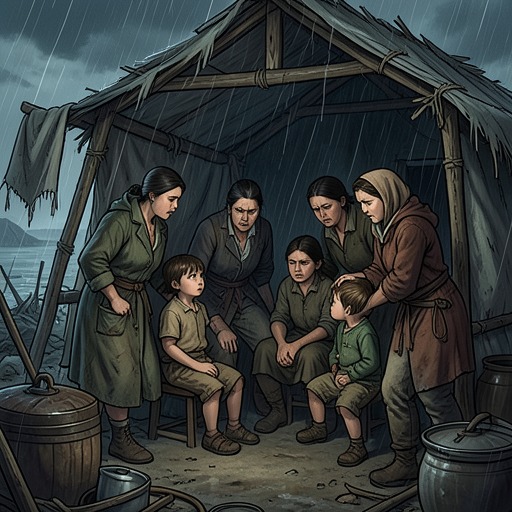
In its aftermath, the women left the outside world for the island and armed themselves as best they could. Cal described the change in their approach as becoming more proactive when men appeared. The policy thus grew from a specific failure of negotiation and a demonstrated inability to keep the community safe through trust alone; its aim was to prevent another visitor from gaining the opportunity to inflict comparable harm.
How the Policy Meets Apollo
Apollo experiences the rule before Cal explains its history. When he approaches her, two women emerge from the darkened corners of the room in dark green robes, each carrying a club fitted with nails. Apollo recoils, fearing another beating, and Cal catches him. She tells him the guards are protective and asks whether he intends to do anything harmful.
Cal’s reassurance does not mean Apollo is free to move as he wishes. Her grip holds his arms at his sides while the guards remain close, so the encounter combines personal reassurance with visible coercive restraint. Apollo recognizes that a sudden attempt to resist could bring the armed women upon him. The policy is therefore enacted through both the guards’ presence and Cal’s control of the visitor: his safety depends, in that moment, on their judgment of him.
Protection, Trust, and the Wider Story
The rule makes the cost of the community’s earlier vulnerability visible. The Wise Ones have chosen collective safety over ordinary hospitality toward men, and Apollo must encounter that choice as a possible target before he can hear its justification. Cal’s account makes the guards’ weapons legible as a response to prior violence, without erasing the fear their defensive posture creates for an arriving man.
Elsewhere, the novel places this decision beside men’s competing ideas about fatherhood and responsibility. William Wheeler reflects that providing for his family did not make him emotionally close to his wife and daughters; he regrets failing to tell them plainly that he loved them. Jorgen Knudsen, by contrast, argues that modern technology lets men reach vulnerable children without leaving home, extending the threat of intrusion into devices people treat as domestic spaces. These episodes do not explain the Wise Ones’ policy, which Cal roots in the earlier attack, but they enlarge the story’s concern with who can enter a family’s or community’s protected space—and what protection requires when trust has already failed.