You're coming with me
The Changeling“You're coming with me” is the sentence at the center of Apollo Kagwa’s recurring dream of his missing father, Brian West, and later becomes the promise Apollo makes to his own son, Brian Kagwa. Its significance lies in that reversal: in the dream, the words carry Apollo away from home with a father who has vanished from his waking life; spoken by Apollo to his baby, they express a determination not to abandon him. The repetition links paternal absence to paternal care without making the two meanings identical.
Identity and First Appearance
The phrase first belongs to a dream that begins after Brian West goes missing. Apollo is four, and the dream comes to him night after night for weeks. Its final words are the part that Lillian Kagwa can make out clearly from her frightened child’s nighttime babble: “You’re coming with me.” The sentence gives the dream an unmistakable direction. Apollo is not simply seeing his father return; he is being told that he will go with him.
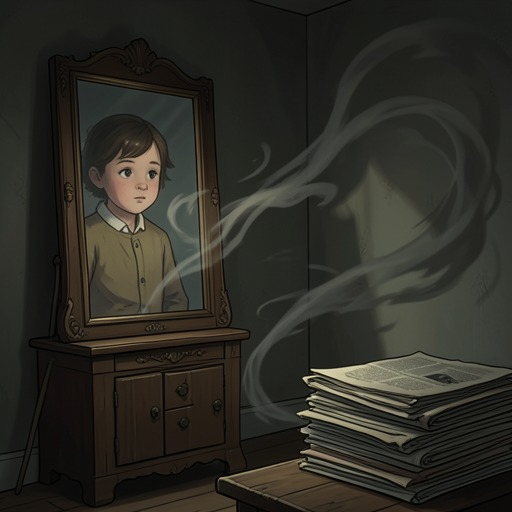
The dream surrounds that declaration with images of recognition and alarm. A man knocks at the apartment door, pushes inside, and kneels before Apollo. The man removes his face, revealing Brian West beneath it. Fog pours from his father’s mouth and fills the apartment; the sound of rushing water grows overwhelming as Brian carries the boy into the mist. Apollo wakes screaming. The words are therefore joined from their first appearance to a father who is both familiar and frightening, and to a departure whose destination remains obscured.
Longing Beneath the Fear
The dream’s emotional meaning is not exhausted by its frightening imagery. Apollo stops wanting to sleep, while Lillian lies awake anticipating the next episode. When she asks why the words make him cry out, the answer is not that he fears being taken. He longs for his father to take him along. His question, “Why didn’t he take me with him?” makes the sentence an expression of the abandonment that followed Brian West’s disappearance: what sounds like a threat within the dream also names the reunion the child wants.
Years later, the dream returns in a fuller scene. Apollo hears knocking, turns all three locks on the apartment door, and sees a blue-faced man with no nose or mouth, only eyes. The stranger pushes in, removes his blue skin, and reveals Apollo’s father. This time Apollo smiles and embraces him. His father holds him tightly while fog rises from his throat and the apartment fills with cloud; then he picks Apollo up and walks with him into the mist. Apollo wakes beside his wife and son, with Emma Valentine breastfeeding the baby, but cannot fall asleep again. The familiar words remain attached to an imagined departure, even in the presence of the family Apollo has made.
From Dream to Promise
The phrase crosses into waking life when Apollo holds Brian Kagwa after Emma leaves the apartment. He has seen that she left her keys behind, briefly thinks of giving them to her, and instead locks her out. Looking into the baby’s eyes, he whispers, “No matter what happens,” followed by “you’re coming with me.” The words now come from a father addressing his son, not from the missing father addressing Apollo in a dream. Their repetition makes the scene a conscious answer to the old sentence: Apollo casts himself as the parent who will take responsibility for keeping his child with him.
That pledge is not presented as a simple erasure of the past. It follows a charged separation from Emma, and the wording echoes a dream in which being taken away is inseparable from fear, fog, and loss. Apollo’s promise thus holds protection and the remembered force of separation in the same expression. The novel’s return to the words gives them weight through changed speaker and circumstance rather than through a newly explained meaning.
Memory and Inheritance
The phrase resurfaces when Apollo clears Brian’s room. Among the prepared clothes, diapers, pacifiers, and books is a copy of Outside Over There, the book he had imagined reading aloud to his son but had never read to him. As he takes it from the shelf, the old dream returns to memory. He says the sentence aloud, stops, and tells Lillian that it was the last thing he ever said to Brian. He explains that he had started having the old dream again after Brian was born. The recollection joins the words to a particular loss, not merely to a recurring nightmare: Apollo recognizes them as part of his final exchange with his child.
Another dream scene gives the phrase a still more specific setting. Brian West arrives at the door; after the face beneath the blue skin is revealed, father and son watch The Smurfs together while hot water running in the bathroom sends steam into the living room. As fog gathers, Brian West picks Apollo up, holds him tightly, and says, “You’re coming with me.” He then walks into the mist. The familiar sentence arrives amid an ordinary domestic image, a father and son watching television, before the fog turns that apparent reunion into another passage away. Across its appearances, the expression binds Apollo’s childhood wish to be taken along, his last words to Brian Kagwa, and his resolve to remain a father who takes his son with him. The promise matters because its tenderness does not silence the history of absence from which it came.