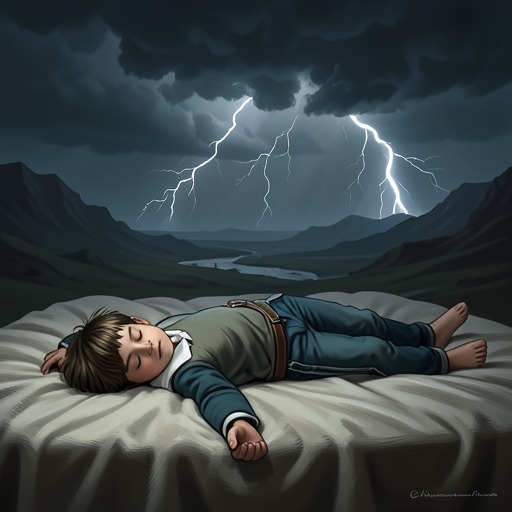
Drowning and Rescue at Tottori Beach
The Character of RainDrowning and Rescue at Tottori Beach is a childhood near-drowning that changes the Narrator (God)’s understanding of survival and makes the capacity to speak newly visible to the family. What begins as an imagined miracle—walking across the sea toward Korea—ends with Mother rescuing the child after Hugo notices the danger. The episode’s significance extends beyond the rescue: it becomes a point of comparison for later thoughts about death, nonintervention, and whether a life can be saved against what seems inevitable.
The Attempt to Walk Across the Sea
The incident begins with the Narrator’s conviction that the sea floor is rising beneath her feet. She has already learned to swim by moving her arms and legs, but ordinarily stays in water shallow enough to stand in. On this occasion, walking out from Japan toward Korea, she interprets the seabed’s continued support as one of her personal miracles and decides to continue toward the Asian continent. The attempt is not described as a deliberate effort to die; it grows from a child’s imaginative interpretation of what is happening underfoot.
That belief collapses when the seabed drops away and she loses her footing. She struggles to reach the surface, but cannot make her way back to safety. From the water, she can see the beach and her parents, who are napping, as well as people watching without intervening. The distance to shore and the spectators’ inaction turn the emergency into a public ordeal: the Narrator later remembers being frightened not only by the possibility of dying but by being watched while it happened.
Calls for Help and Rescue
The Narrator first calls for help in Japanese, then abandons her reluctance to speak French and calls out in that language too. The shift matters within the scene: faced with immediate danger, the earlier inhibition about speaking French no longer seems worth preserving. The people on the beach continue to stare, an inaction the child explains through what she understands as The Japanese Principle of Not Rescuing Others: saving someone, she believes, would create a heavy debt of gratitude.
The rescue comes through Hugo. He is playing with André and Juliette when he sees the Narrator disappear beneath the water. He goes to warn Mother and points out where the child is. Mother then reaches the Narrator and brings her to the surface. The account identifies Hugo’s warning as decisive: without it, Mother would not have known where to find her in time. The sequence therefore separates the spectators’ failure to act from the intervention that actually saves her, while locating that intervention in a child’s observation and prompt warning.
Mother holds the rescued child close and cares for her on the beach. Through tears, she explains Hugo’s role and tells the Narrator that his warning made the difference between life and death. The rescue is thus not presented as an abstract reversal of danger; it depends on someone noticing what has happened, communicating it, and directing help to the right place.
Speech and the Family’s Reaction
After hearing what Hugo did, the Narrator thanks him. The exchange produces stunned silence, followed by Father’s excited realization that his child can speak. His reaction moves from jubilation to a quiet, inward pause and then back to laughter. The Narrator answers that she has been talking for a long time. The moment does not establish that speech began at the beach; rather, it reveals that the family had not recognized the speech already taking place.
The emergency makes communication unavoidable in another sense as well. The child who had been reluctant to speak French calls out in French when Japanese appeals have not brought assistance. Once rescued, she can use speech to acknowledge Hugo directly, and the family hears her in a new way. The episode links the practical urgency of asking for help with a more intimate change in how her speech is perceived, without making those two consequences identical.
Survival and Its Later Meaning
On the beach, the Narrator considers the possibility that Hugo’s action is the reason she is still alive. She reasons that without him there would be no self left to decide whether survival was welcome; having been saved, however, she finds that she is glad to be alive. The conclusion is plain rather than triumphant: the world appears beautiful, and living seems worth the effort. The rescue gives the child a direct experience of dependence on another person, then becomes the occasion for affirming survival.
The sea’s role also receives a more ambiguous interpretation. The Narrator says that it had made her confess, connecting the near-drowning with the surfacing of speech. This retrospective idea sits beside the concrete sequence of calls, Hugo’s warning, and Mother’s rescue. The event can therefore be read both as an external emergency and as a threshold in the Narrator’s account of becoming able to speak openly.
Recurrence and Contrast
The rescued child’s later recollections complicate any simple conclusion that rescue resolves her relationship to death. In a subsequent episode at the koi pond, she deliberately stops resisting and understands her descent as a choice, unlike the earlier sea emergency, when she wanted to get back to the surface. Kashima-san watches without intervening. The Narrator explicitly recalls the beach spectators while interpreting Kashima-san’s stillness, but now treats nonintervention as consistent with the prospect that the child is meant to drown. The earlier rescue remains the counterexample: Mother did intervene, and the Narrator survived.
The book also places these personal episodes beside its account of mass deaths on Okinawa shortly after Japan’s surrender. Thousands of inhabitants, still believing earlier assurances that the Americans would kill them, leapt from cliffs rather than be captured. When the Narrator visits the site in 1989, no sign marks what happened there. She reflects on the paradox of people dying because they feared death. This historical account does not explain the beach incident, but it widens the questions raised by it: what people believe about danger, who acts to prevent a death, and how fear can shape a choice. Against those later reflections, Hugo’s warning and Mother’s rescue remain a specific, contingent intervention—not proof that every threatened life will be saved.