Grandmother's Death
The Character of RainGrandmother’s death is the first loss the narrator confronts after describing Grandmother’s White Chocolate as the gift that awakened self-awareness. The child receives the news in a quiet house, where Mother comforts a grieving Father, and responds with an assertion that seems at once to contest the adults’ view of the child and to mark death as something already intimately known. The scene’s lasting consequence is a reciprocal bond imagined across death: Grandmother gave the narrator a self and memory, and remembering her becomes a way to give something back.
The News in the Quiet House
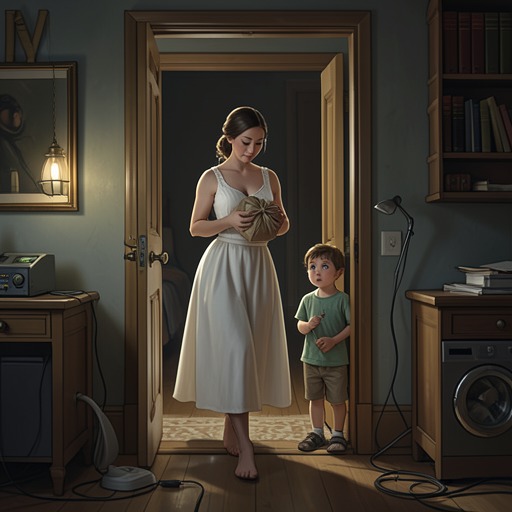
The narrator recalls going downstairs because the house seemed unusually quiet. In the living room, Father was crying, while Mother held him as if he were a child. The sight was unimaginable to the narrator and, in retrospect, never repeated. The reversal of roles made the loss visible before it was explained: the adult who ordinarily occupied the position of authority was being comforted, and the family’s familiar order had been interrupted.
Mother told the child that Father had lost his mother and that Grandmother was dead. She also acknowledged that the narrator, at two and a half, did not know what death meant. The narrator appeared on the verge of a tantrum, then answered assertively with the word death and left the room. The exchange sets the adults’ assumption of childhood ignorance against the narrator’s insistence that the word carried knowledge. The child did not explain that knowledge to the family; the scene instead lets the confident response and the departure stand as its outward expression.
A Loss Bound to an Earlier Gift
The news follows an event the narrator places in Japan in February 1970, at the age of two and a half, in Kansai’s village of Shukugawa. Grandmother had offered the child White Chocolate from Belgium. At first the narrator understood only the word white; the other words were obscure, until the explanation that the stick was for eating. Its sweetness brought forth a voice that recognized itself as a self rather than an it. The narrator presents that moment as a birth made possible by Grandmother’s gift.
The remembered death therefore enters a story already shaped by the relation between gift and identity. Sitting on the stairs, the narrator thinks of Grandmother and the White Chocolate, and interprets the sequence as an exchange: she had helped free the child from death, and soon afterward she herself died. The narrator wonders whether Grandmother knew of this imagined payment. The account does not establish that she did; the sense of exchange belongs to the narrator’s retrospective understanding, not to any stated intention on Grandmother’s part.
Mourning, Memory, and Childhood Speech
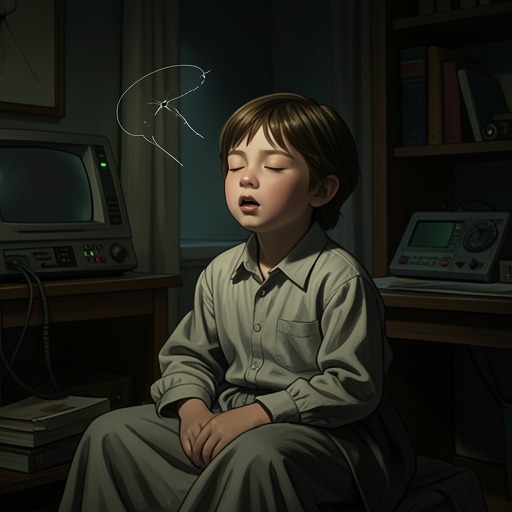
The narrator does not cry after hearing the news. Instead, the child returns to the room and plays with a spinning top, watching it turn for hour after hour. Its apparently perpetual motion gives the child a grave appearance, while the narrator’s account distinguishes understanding death from knowing how to talk about it. The child has many questions but is officially limited to six words, none of which, as far as the narrator knows, is a verb. Although an inner vocabulary is available, speaking more freely at once would reveal the secret of how much the child can say.
That contrast helps explain why the scene ends without a conversation about what Grandmother’s death means. The narrator’s outward vocabulary is restricted, but the remembered account gives the child a forceful inward interpretation: death is not an unfamiliar concept merely because adults think a two-and-a-half-year-old cannot understand it. The narrator’s departure from the living room and return to solitary play leave the family’s grief and the child’s private knowledge side by side, without suggesting that they are the same experience.
Remembering as a Return Gift
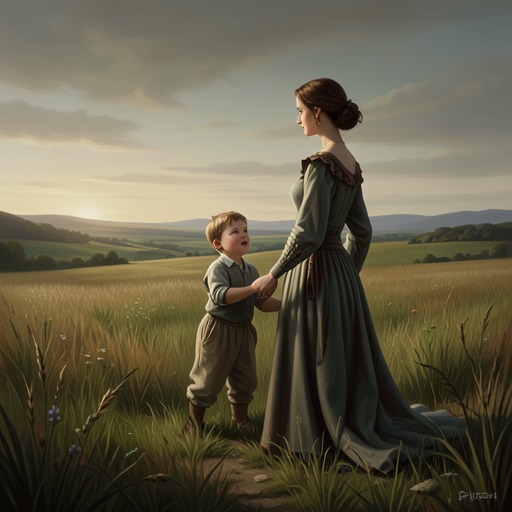
The narrator turns memory into a form of continuing relation. Grandmother, the account says, gave the narrator memory; in return, remembering her keeps her alive. The image is not of a physical reunion but of Grandmother continuing to carry her bar of White Chocolate like a queen carrying a scepter. Memory preserves the specific gift and the moment attached to it, allowing the narrator to return what was received without claiming that death has been undone.
The episode also sits within a meditation on death as both terrible and seductive, and on the need to resist it because a journey into death would be one-way. Against that pull toward nonexistence, the spinning top’s repeated motion and the narrator’s act of recollection offer forms of continuation. Grandmother’s death cannot be reversed, but neither is she reduced to the moment the family names her loss: she persists in the account as giver, as the figure associated with the narrator’s awakening, and as the person memory is meant to return.