Inertia
The Character of RainInertia is presented as more than physical immobility: it is a force that emanates from stillness, taking hold of bodies, ideas, and even the imagined contest between earth and sky. In the account of Narrator (God)’s infancy, that force is embodied by the Tube, a baby so unmoving that the family could leave it in the same position all day. Later, during the rainy season, the earth becomes inertia’s champion, absorbing the clouds’ assault and outlasting them. Across these scenes, stillness is not mere absence of action; it is a formidable way of resisting change.
The Tube as an Embodiment of Inertia
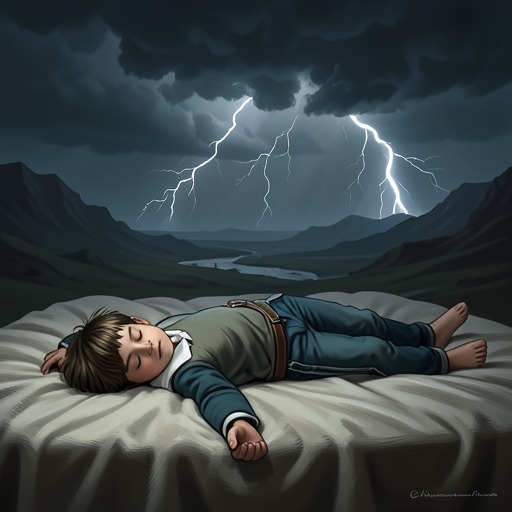
The Tube is introduced through a peculiar domestic fact: its parents could leave it alone for an entire day and find it in precisely the position where they had left it. Caring for it meant changing its diaper and giving it nourishment; a goldfish, the narration observes, would have been more trouble. Apart from its apparent lack of sight, the baby looked ordinary enough to show to guests. That contrast makes the stillness stranger: the Tube’s inertia is not an outwardly monstrous appearance but an extreme absence of response in a seemingly normal infant.
The narration names this condition the incarnation of inertia and describes the force through several kinds of resistance: a body going limp, a car that ten strong men cannot move, a child immobilized before a television, or an inane idea that continues to exert influence. The examples move from bodies to objects to thought, giving inertia a reach well beyond the mechanical. Its power belongs precisely to what refuses to be set in motion. The Tube is the most concentrated instance of that paradox: its passivity becomes an active, numbing grip on the people and world around it.
The feeding routine sharpens the image without making the child wholly inert in every respect. Narrator (God) does not instinctively move toward the Mother’s breast; she puts the baby and breast together and eventually feeds it from a bottle. The cylindrical bottle suits the child’s nature, and it takes to that source of nourishment at once. In the narration’s plumbing metaphor, this repeated feeding reinforces a connection between tubes: even the baby’s necessary intake of nourishment is framed through an apparatus rather than reciprocal bodily attachment. The Tube does not initiate the action, but its distinctive nature shapes the form that care takes.
Stillness Against Flux and Language
The concept is also set against the philosophical claim that everything changes. The narration invokes the familiar image of a river that cannot be entered twice, then imagines the Tube as the negation of that fluid view: in its world, things endure and the river remains the same. The contrast is deliberately paradoxical. A being defined by having no motion becomes the clearest possible challenge to a universe understood through movement and transformation.
That challenge remains unspoken. The narration explains that language requires movement of some kind, an engine to drive it, and that thought in turn requires language. Because the Tube can neither move into speech nor formulate its speculations, its static metaphysics cannot be communicated. Silence thus serves two functions: it is an outward sign of the infant’s inertia and a barrier that keeps its imagined denial of change from affecting humanity. The Tube’s lack of speech is not simply a missing ability; within the book’s logic, it prevents stillness from becoming a doctrine.
The Rain and the Earth’s Victory
During the rainy season, inertia reappears not as an infant’s immobility but as a contest staged across the natural world. Narrator (God) spends whole days beneath the terrace roof watching the sky attack the earth, pretending to referee the cosmic matches and keeping score. The clouds are more impressive, swollen with water and dramatically active, yet the earth always wins. It is the champion of inertia not because it strikes back, but because it can absorb the assault and remain.
The earth’s imagined taunt turns endurance into a form of defiance: the clouds may drench and batter it, but they will eventually be spent, while the earth will still be there. The scene gives inertia a temporal advantage. The clouds possess spectacle and force in the moment; the earth possesses persistence. Their conflict echoes the Tube’s opposition to flux, but now stillness is not only a condition. It is a strategy by which the apparently passive outlasts the active.
Narrator (God) sometimes leaves the shelter and lies on the earth during the final, most violent downpour, joining the assault physically. The storm’s beauty makes the impending victory of the earth sad rather than comforting: although the narrator belongs to the earth, she roots for the clouds and thinks them more interesting. That preference complicates the book’s image of inertia. The earth may prevail through absorption, but the narrator’s allegiance goes to the forceful, transient spectacle that cannot endure.
Conceptual Significance
Inertia links the infant Tube to the rain-soaked earth by making immobility a source of power rather than an empty lack. In one scene it immobilizes a baby and defines the limits of what the baby can think or say; in the other it allows the earth to receive a succession of blows and survive its more vivid attackers. The same principle therefore carries sharply different implications: inertia can be numbing and constraining, yet it can also be durable resistance.
The book’s contrast between stillness and flux is not resolved simply by declaring movement superior. The Tube’s silence prevents its rejection of change from becoming communicable, while the earth’s patient absorption makes endurance the actual winner of the storm. Meanwhile, Narrator (God)’s sympathy for the clouds registers the emotional cost of that victory: what lasts is not necessarily what fascinates. Inertia is thus both a force in the narrated world and a measure of the tension between persistence and life’s attraction to movement.