Narrator (God)
The Character of RainNarrator (God) is both the central character and the voice that retrospectively makes a life out of remembered experience. The character’s decisive beginning is not birth but an awakening at two and a half, when White Chocolate turns sensation into self-awareness. From that moment, pleasure becomes a source of identity and memory; later, the expectation of loss shapes how the narrator interprets childhood and its aftermath. The memoir’s first-person certainty is striking, but it is not unqualified: the narrator acknowledges gaps, admits uncertainty about some events, and offers a scar as material evidence for a memory that might otherwise be doubted.
Identity and First Awakening
Before awakening, the narrator describes an existence organized around ingestion, digestion, and excretion. These bodily processes occur without awareness, and nourishment is monotonous enough not to command attention. The book names this early condition the Tube: a body that takes in and passes out food without yet experiencing itself as a conscious subject. Its apparent fullness conceals an inward emptiness, since no observing self has emerged to give sensation meaning.
The transition announces itself through a sudden disturbance in the household. On an otherwise ordinary day, screams send Mother and the nanny searching from room to room. In Mother’s bedroom, the child is sitting up in the crib and howling. The transformation is visible in the eyes: previously gray-green and fixed open, they now have pupils described as entirely black. The scene makes awakening bodily before it makes it philosophical. The child’s cry and changed gaze register an event whose importance the people around the child cannot yet understand.
The narrator dates this new beginning to February 1970, in Shukugawa, Kansai, Japan, under Grandmother’s gaze. The date and place do more than locate a childhood episode: they divide existence into a before that cannot be remembered firsthand and an after that becomes the narrator’s account of a self.
White Chocolate, Pleasure, and Selfhood
The immediate cause of the change is White Chocolate. The child recognizes eating as a familiar activity, associated with a bottle, carrot purée, crushed banana, and apple, but the white stick itself has an unfamiliar smell. Fear and desire arrive together: the child grimaces in disgust while salivating. After taking a bite, the child discovers that the substance melts on the tongue. Its sweetness takes command of the mouth and provokes a voice that recognizes itself as a speaking subject rather than an impersonal thing.
The narrator presents pleasure not as a reward added to an already established identity, but as the condition that makes identity possible. White Chocolate supplies an experience strong enough to turn bodily sensation into a felt self, and the narrator’s account binds the emergence of the voice to that pleasure. The moment’s consequence persists beyond the taste itself: the voice has continued speaking in the narrator’s head ever since. In this telling, a small piece of food acts as the hinge between an unobserved bodily life and a life capable of saying, inwardly, that it exists.
Grandmother remains in Japan for only a month, but the narrator says that the idea of pleasure has already set the child in motion. After two years as a placid, vegetable-like child and six months as a wild one, the narrator becomes more or less normal in the eyes of the parents. They are relieved and begin calling the child by a first name. The change therefore affects family life as well as inward experience: the newly attentive child is described as alert yet judicious, quiet yet present, and independent while obedient.
Memory and the Making of a Life
The narrator claims to remember everything after February 1970, while recognizing that the breadth of the claim may not be believed. The account narrows that claim rather than treating memory as a perfect record. The narrator does not remember every parental worry or conversation with friends, but insists on retaining what feels essential: the greenness of the lake where the child learned to swim, the garden’s smell, and the taste of plum wine sipped unseen. Memory is selective, yet in the narrator’s understanding its selectivity follows the importance of pleasure.
The contrast with the period before White Chocolate is categorical. From that earlier time, the narrator remembers nothing and must depend on other people’s recollections, which are then filtered through the narrator’s own mind. After the awakening, the narrator describes knowledge as firsthand, associated with the same hand that writes the account. This division makes memory part of the character’s identity: the narrator is not merely someone who remembers a past, but someone whose remembered past begins at the moment a self appears.
At the same time, the narrator refuses to make belief a condition of telling. The claim of comprehensive post-awakening memory cannot, the narrator observes, be proved or disproved, and the narrator becomes less interested in persuading a reader. The memoir thus holds assertion and qualification together: its account is intimate and emphatic, but it admits that some early knowledge comes secondhand and that the reliability of recollection cannot be settled by declaration alone.
Loss as a Governing Expectation
A childhood conversation becomes the source of the narrator’s recurring formulation that whatever is given will eventually be taken back. The narrator describes the realization as a kind of death already undergone: the child has learned that everything loved must eventually be lost. This is not presented as a passing sadness but as the theme of childhood, adolescence, and the years that follow.
The losses named are concrete and varied: the country the narrator loves, a mountain, flowers, a house, Nishio-san, and a language. Their accumulation turns the lesson into a forecast. The narrator expects mourning to punctuate life and rejects the idea that substitutes can restore what has disappeared. Consolation may offer another home or other attachments, but the narrator regards such replacement as unable to return the original object of love. The insistence gives the character’s later recollections a double force: memory preserves specific pleasures, while the expectation of loss makes preservation feel necessary and fragile.
Suicide Attempt and the Scar
The narrator eventually describes a first and, to that point, only suicide attempt, which the parents were never told was intentional. The narrator also kept silent about Kashima-san and what she had or had not done. Kashima-san is described as hating the narrator and perhaps being glad that death seemed near, but the account stops short of claiming certainty about her understanding. The narrator leaves open the possibility that she recognized the act’s meaning and respected the choice. That qualification preserves ambiguity rather than resolving Kashima-san’s role.
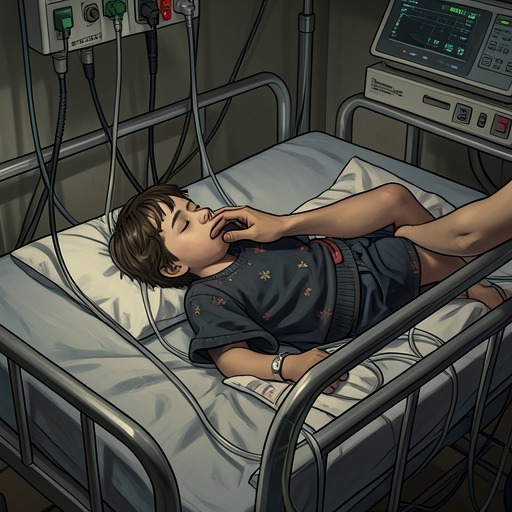
The episode ends not with a complete explanation but with a physical trace: a doctor stitching the narrator’s temple with thick black thread, remembered like a tailor sewing a suit. The narrator wonders whether the remembered events were dreamed or invented, then looks in a mirror and finds the scar on the left temple. The scar does not establish every detail of the account, but it anchors the remembered attempt in the body. The closing assertion that nothing more happened after this episode leaves the character suspended between survival and silence, while the mark remains as a visible counterweight to doubt.