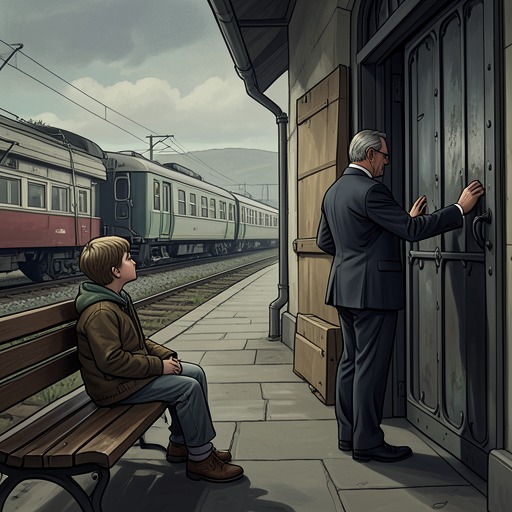
Narrator’s Self-Deification
The Character of RainNarrator’s Self-Deification is the child’s effort to understand a newly awakened self as the center and ruler of its world. It begins with the discovery of pleasure and language, takes the garden as its sanctuary, and depends on the devotion of a small circle of followers. Its certainty is never complete: Kashima-san refuses the child’s authority, and the adult narrator’s recollections place claims of divine power beside acknowledged limits, secrecy, and doubt.
From the Tube to a Speaking Self
Before the awakening, the child had been known as the Tube or the Plant. Even after its rage began, it remained, in its own later account, the center of the universe. When the parents took it into the yard during a calm interval, it contemplated the toys around it and became upset by their independent existence. The objects were outside the child and did not depend on it; their autonomy provoked profound displeasure. This early response supplies a basic premise of the self-deifying outlook: a world that exists apart from the self is a troubling world to be brought under its authority.
The child also noticed that the people around it made precise sounds with their mouths and seemed able to use those sounds to control or annex objects. It wanted the same power, imagining that naming belonged to a divine prerogative. But when it pointed at an object and tried to speak, only incoherent sounds came out. Surprise gave way to humiliation and outrage, followed by screaming. The gap between imagined sovereignty and actual helplessness was therefore present before the child acquired words.
White chocolate changes that balance. At two and a half, in February 1970, in Shukugawa, Kansai, Japan, the child bites into the sweet substance and experiences a voice declaring a first-person identity. The narrator describes this as a birth: the child is no longer merely an it, but a me, and pleasure becomes the means by which that me recognizes itself. The connection is reciprocal rather than incidental. The child understands pleasure as proof of its own presence, while also claiming that pleasure depends on the child to be experienced. The chocolate disappears bite by bite, but the voice it awakens remains.
Pleasure, Memory, and the Shape of Identity
The narrator’s selfhood is grounded less in an abstract name than in sensation. Pleasure teaches the child where the self is: wherever pleasure occurs, the child takes itself to be present. The repeated equation of self and pleasure turns a particular bodily experience into a general account of existence. It also explains why the child’s earlier rage and inability to speak matter: self-deification follows not effortless mastery but a sudden passage from frustration into a felt capacity to say me.
The narrator links this awakening to the beginning of memory. The adult voice claims to remember everything after February 1970, while acknowledging that the claim cannot be proved or disproved and that belief from others is not its chief concern. The account is qualified: the narrator does not remember every parental worry or conversation, but says that essential impressions remain, including the greenness of the lake where the child learned to swim, the garden’s smell, and the taste of plum wine sipped unseen. Before the chocolate, the narrator has no firsthand memory and must rely on others’ recollections, filtering them through the present self; afterward, remembered experience is presented as belonging directly to the same hand that writes.
That account makes memory part of the child’s sovereignty, but also shows how the adult narrator constructs it. The date of awakening divides an unknowable before from a remembered after, and the narrator openly admits the limits of what can be recalled. The claim to a continuous self is thus powerful but not uncomplicated: it rests on pleasure as an origin point and on a retrospective account whose certainty the narrator does not demand that readers accept.
The Garden as Sanctuary and Kingdom
The child’s self-religion acquires a community and a setting. The narrator says Japanese was the first language disclosed because the cult of the self required an idiom for communicating with followers. The circle was small, including Nishio-san, the futago, and passersby, but the child considered their reverence sufficient. On walks, holding the hand of the woman who adored it, the child expected public acclamation with serene confidence.
The garden offered something stronger than public praise: privacy and a place in which the belief could intensify. Its flowers, trees, simple stone pool, and walls capped with tiles made the small yard a temple and sanctuary, shielded from the eyes of outsiders. The narrator presents the garden as a meeting point between humanity and the universe, and as a fitting seat of earthly delight. Within its walls, plants became subjects and seasonal growth seemed to accompany the child’s advance. The narrator recalls commanding a budding stalk to blossom; the next day it had become a white peony. Nishio-san did not deny the child’s claim to powers, and the flowering appeared to confirm the child’s sense that nature was allied with its progress.
This imagined kingdom is already shadowed by change. The narrator describes the garden as entering the first Spring of the child’s existence, without yet being able to imagine that its flourishing would reach a peak and decline. The child interprets each fading flower and new bloom as a continuing profusion of marvels offered to its rule. In this way, the garden gives visible form to a belief that pleasure and attention can turn the surrounding world into an answering domain.
Refusal and the Limits of Divinity
Kashima-san is the exception that unsettles the child’s religious order. She does not believe in the child, and the narrator presents her as the only Japanese woman who rejects the new religion. Her refusal is not an abstract disagreement: she will not let the child eat from her plate. When the child tries anyway, she slaps it. The incident directly contradicts the expectation that others will submit to its wishes, and the narrator remembers being stunned by the affront.
The child tries both command and charm. It orders Kashima-san’s garden to blossom, only to learn that she has no garden; the attempted demonstration therefore produces no result the child can perceive. It then approaches her with an extended hand and a magnanimous smile, but she ignores the gesture. The child interprets this denial as evidence that Kashima-san is its opposite, not evidence against its own divinity. It pities her for missing the happiness that devotion brings to Nishio-san and the other followers, and searches her expression for a cause of her disinterest while assuming that the fault must lie with her.
That explanation preserves the child’s self-image, but the episode reveals its dependence on recognition. The garden’s apparent obedience and the followers’ affection affirm the child; Kashima-san’s refusal cannot be absorbed as another act of praise. Her resistance marks a boundary the child cannot erase by naming, commanding, or offering affection.
Retrospective Doubt
The later account sets this confidence beside a severe contradiction without supplying a simple explanation for it. The narrator identifies a later incident as the first and, to that point, only suicide attempt, says the parents were never told it was not an accident, and keeps secret what Kashima-san did or did not do. The narrator suspects she may have been glad at the prospect of the child’s death, but also allows that she might have understood the choice and respected it. These possibilities remain unresolved; the account does not turn them into certainty about her motives.
The narrator’s recollection is itself uncertain at the edge of the event. The experience of being between the waters felt like home, yet the narrator wonders whether it was dreamed or made up. A scar on the left temple supplies a visible trace against that doubt, but does not settle every question about what happened or what Kashima-san understood. The self-deifying child had treated pleasure, followers, and the garden as signs of an ordered world centered on itself. The adult narrator preserves that early conviction while acknowledging refusal, vulnerability, and gaps in knowledge. Self-deification remains both the child’s answer to the discovery of being a self and a story whose later telling admits that experience cannot be made wholly sovereign.