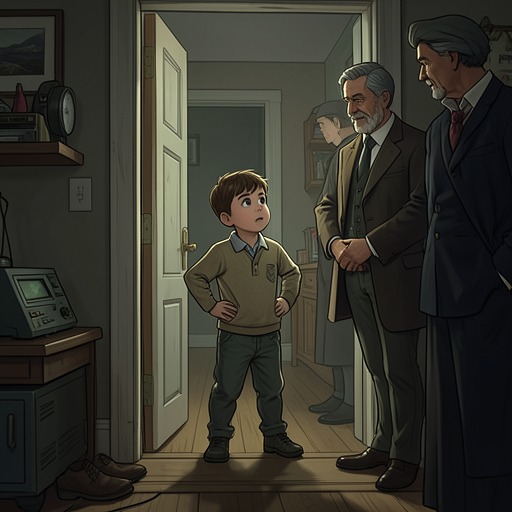
Sight, Choice, and Life
The Character of RainSight, Choice, and Life defines life not as mere existence or sensory capacity but as the ability to select, distinguish, and refuse. Seeing is already a choice: attention settles on one object rather than everything at once, making exclusion the condition of meaningful engagement. The idea turns refusal from a negative response into a basic sign of vitality, and makes Narrator (God)'s failure to choose the central evidence of its former, nonliving state.
Sight as Selection
The concept begins with an ordinary act and gives it existential weight. Whoever looks at something fixes attention on it, and that attention necessarily leaves other things outside its field. Sight therefore does not amount to passive reception of everything available; it is selective, and selection is inseparable from rejection. Life, in this account, begins not with an inventory of what can be perceived but with the act of preferring one thing to another.
The example of choosing between Mother and the ceiling makes the distinction deliberately plain. Both are overhead, but their physical position does not make them equivalent: the living observer becomes interested in one rather than the other. The example reduces the principle to a small, almost comic decision while showing why choice matters. A person who treats every possible object as equally present has not achieved a richer attention; the person has failed to distinguish at all.
The argument makes the absence of choice the decisive error. The alternatives themselves need not be ranked by a universal rule: the principle allows attention to fall on Mother or on the ceiling. What it excludes is not one particular selection but the refusal to select. The emphasis falls on the existence of a preference, rather than on whether the chosen object is important by any external measure.
Nonchoice and Narrator (God)
This distinction supplies an explanation for Narrator (God)'s earlier condition. Narrator (God) had not refused anything, because refusal would itself have required a choice. Its nonresponse was not a deliberate rejection or an act of defiance; it was the absence of the prior act that would make rejection possible. The account thus separates silence from refusal: a refusal would demonstrate engagement, while this silence indicated that no preference had formed.
The comparison with a toilet bowl sharpens the point through an intentionally undignified image. An entity that takes in everything without distinguishing among it is described as scarcely more alive than an object designed to receive what enters it. The analogy does not praise indiscriminate openness as a generous or enlarged form of attention. Instead, it makes undifferentiated receptivity resemble emptiness: without selection, perception cannot become a particular relation to the world.
Narrator (God)'s condition is also distinguished from a physical inability to perceive or communicate. Specialists had determined that it was not deaf, blind, or dumb, yet it had produced no sound from the moment it emerged from the womb. The explanation offered is therefore not that an identifiable sensory defect blocked a response. The image of a sink without a stopper presents an existence that can receive but cannot retain or organize what it receives into a chosen attachment. Had speech been possible, the only word it would have repeated endlessly was an unqualified assent. That imagined yes underscores the difference between answering everything and making a choice: consent without discrimination would still leave no particular object selected.
Birth, Cry, and Refusal
The principle also locates the beginning of life at birth. The newborn's cry of pain is treated as a revolt in itself, and revolt is in turn a form of rejection. The cry matters not because it expresses a considered opinion, but because it marks a first opposition: the newborn is no longer simply a passive condition but an existence that registers and resists. In this formulation, life does not begin before birth and then merely become visible at birth; the act of emergence and its cry constitute the beginning.
This account gives refusal a broader meaning than conscious disagreement. The newborn need not understand what is being rejected for the cry to function as an inaugural separation from an undifferentiated state. In the essay's sequence, selection, refusal, and revolt describe related thresholds: attention distinguishes one thing from others, refusal establishes a boundary, and the cry makes that boundary audible. The claim that life begins on the day of birth follows from this chain of ideas, rather than from an appeal to gradual development before birth.
What Makes a Life Particular
Together, the claims offer a criterion for distinguishing biological presence from lived particularity. Sensory equipment alone does not settle the question: Narrator (God) is described as neither deaf nor blind nor dumb, but those assessments do not make it alive in the relevant sense. The decisive difference is whether perception can become preference, and whether an entity can exclude one possibility in order to engage another. The account defines life through an activity, not merely through the possession of faculties.
The argument also makes rejection generative rather than purely destructive. To reject is to draw a boundary around what receives attention; that boundary is what lets a relation to a particular person or object take shape. The freedom to choose does not guarantee that a choice will be wise or socially approved, since the example permits either Mother or the ceiling. What matters is that the observer differentiates at all. Against the inert image of total receptivity, Sight, Choice, and Life presents selective attention as the first evidence of a distinct self: to live is to stop treating everything as interchangeable.