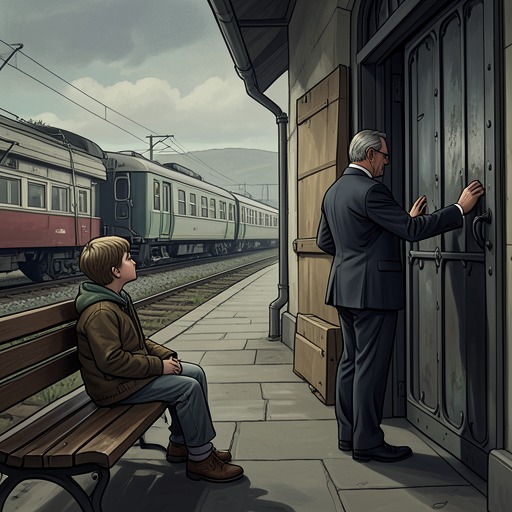
That which is given you will be taken back
The Character of RainThat which is given you will be taken back is the narrator’s recurring formulation of loss as a rule of life, first grasped in childhood when the family’s departure from Japan made the end of a beloved world feel unavoidable. Its force lies in the absence of blame: what is taken away is not a punishment for misbehavior, but something that can happen simply because things are as they are.
Childhood Formulation
The phrase takes shape when the narrator is told that the family will leave Japan. She describes the news as being lost at sea, with the water rising around her and no foothold in sight. The immediate fear of death becomes a deeper recognition: the country, people, places, and language she loves will not remain hers indefinitely.
The narrator retrospectively makes this the theme of her childhood, adolescence, and later years. Loss is not confined to one departure. She names Japan, a mountain, flowers, a house, Nishio-san, and the language as things that will be mourned. The list gives the rule its intimate scale: a country and a familiar person belong to the same vulnerable world of attachments.
An Impersonal Rule
The phrase insists that loss does not depend on whether the person who suffers has done anything wrong. The child asks what she did to deserve the tragedy; the answer is that she did nothing wrong, and that this is simply how things are. The narrator reflects that, had the loss been a punishment, it might at least have had a cause she could understand. Instead, sweetness and naughtiness make no difference. The rule is not a judgment that can be avoided by behaving well.
The narrator distinguishes this knowledge from a young child’s awareness of death. At three, she says, death can seem so distant that it might never happen. Learning that the garden will be taken away in one, two, or three years is different: the loss is close enough to imagine and will arrive despite the child’s having disobeyed no one. She presents that premature certainty as the first of many torments.
Repetition and Scope
Repeated as a refrain, the phrase turns a single childhood shock into a principle the narrator carries forward. Its repetitions widen the meaning of the departure: consolation may offer substitutes, as in the biblical story of Job receiving another household, but the narrator expects no replacement to restore what was uniquely lost. The rule is therefore not merely that life contains bereavement; it is that replacement cannot undo the original loss.
The final recurrence sharpens the phrase into a warning about its own reach. What has been given will be taken back, and the narrator adds that one day someone will have the impudence to take the recipient back as well. The expression thus extends beyond the loss of possessions, places, and relationships to the vulnerability of the person who loves them. Its repeated return gives the childhood lesson the shape of a lifelong expectation, connecting particular griefs to an enduring sense that nothing received is guaranteed to remain.