The Contingency of Mind and Evolution
The Character of RainThe Contingency of Mind and Evolution is the book’s challenge to the assumption that human development follows a natural, necessary path from helplessness to speech, movement, and adult life. It proposes instead that evolution can turn on accidents, including accidents of the mind: disturbances that generate new capacities without proving that those capacities were inevitable or that the resulting life is better. The infant Narrator (God), whose early stillness is treated as a blockage before a sudden awakening, makes that abstract argument bodily and personal.
Normal Development and the Rejection of Chance
The argument begins with a cultural preference for normalcy. Humanity wants to imagine that its history unfolded through a proper biological sequence, as if upright walking and the end of crawling were guaranteed stages of progress. An account that attributes such changes to accident is disturbing because it makes the familiar world contingent: things might have turned out otherwise. The objection is not merely that chance is difficult to explain. It is that chance unsettles the belief that human capacities were always destined to appear.
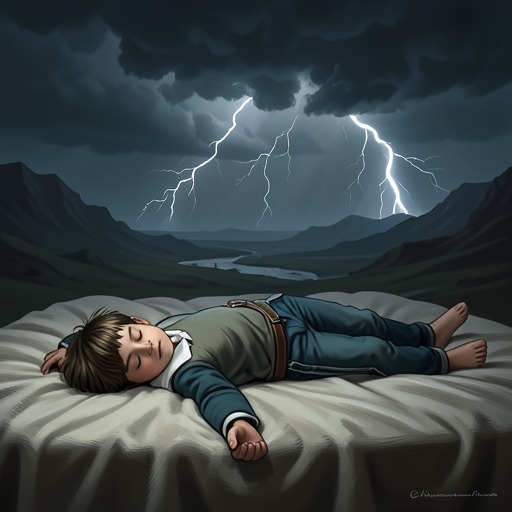
The same resistance shapes how adults interpret an infant who does not develop on schedule. By the age of two, the child called the Tube has not tried to crawl or made a sound. The parents, doctors, and nanny assume there is a developmental blockage. The book stresses what this diagnosis cannot readily accommodate: that the child might not want to move or speak, rather than being physically unable to do so. The specialists have found no deafness, blindness, or inability to speak; nevertheless, the child remains silent and inert. The image of a sink without a stopper captures an existence that receives without visibly responding, while the adults’ interpretation reveals how readily difference is classified as defect.
Accident as a Force of Invention
The book distinguishes physical accidents from mental ones, observing that the latter are readily dismissed when evolution is discussed. Yet a mental accident, it argues, may be more fundamental to the human story than people care to admit. The comparison is the oyster: a particle of grit enters its soft interior and violates its defenses. The oyster responds by producing nacre around the irritant, and the resulting pearl is an invention prompted by disturbance. What becomes beautiful and valuable begins not as a planned advance but as a defense against something unwanted.
A mental accident can arise within the brain as well. A thought appears without an evident cause, and the creature’s prior well-being vanishes. The book describes this thought as a kind of infection: it brings an urgent question that demands answer after answer. Under its pressure, the creature begins to walk and speak and adopts numerous attitudes in the hope of escape. The metaphor makes thought less a calm instrument of reason than an invasive force that alters the conditions of existence. Like grit in an oyster, it provokes a response; unlike the pearl, its consequences are not presented as uncomplicated improvement.
Activity, Progress, and Loss
The resulting activity does not resolve the disturbance. The more the creature talks, the less it understands; the more it walks, the farther it has to go. Movement and speech, conventionally celebrated as marks of human development, become futile attempts to evade the question that has awakened the mind. The new capacities enlarge the creature’s burdens rather than simply freeing it. It begins to miss the peaceful larval state, although it cannot bring itself to admit the longing.
This reversal complicates any straightforward account of evolution as progress. The creature’s development is real, but the text refuses to treat increased activity as proof of greater happiness or wisdom. Before the mental disturbance, the larva is at rest; after it, the mind generates questions and the body undertakes actions that cannot restore that rest. The cost of becoming active is therefore not incidental to the theory. It is its central irony: the accident that produces what people call human development may also make the earlier, quieter mode of being seem desirable.
The Infant’s Awakening
The infant Narrator (God) supplies the intimate counterpart to this evolutionary thought experiment. Its silence and lack of movement are initially legible to the adults only as a failure of development. Then, at two and a half, in Shukugawa in Kansai, the taste of white chocolate produces a sudden voice. Sweetness forces speech and self-recognition into being: the child recognizes itself not as an impersonal thing but as a self, and links that self to pleasure. The narrative calls this moment a birth in February 1970, distinct from the child’s physical birth. An ordinary object and an unexpected bodily sensation become the occasion for a decisive change in identity.
That personal awakening resembles the book’s account of mental accident without being reduced to it. The text locates the beginning of a speaking self in a specific experience of taste and pleasure, rather than in a gradual, inevitable sequence. The voice persists after that day, so the moment is not a passing sensation but the beginning of an enduring inner presence. The episode gives the theory a concrete scale: a change that might look like a developmental milestone from outside is remembered from within as an abrupt arrival of selfhood.
Development as a Threshold
The child’s later experience of turning three extends the argument from biological development to changing social and emotional status. The third birthday is the first birthday the Narrator (God) can remember, and it initially seems cosmically important. Yet turning three is also described as the end of the child’s divine condition, associated with the approaching transition to Japanese nursery school. The loss is not simply a new activity or institution; it is the loss of belief in the world’s goodness, a change the narrative presents as impossible to reverse.
Set beside the awakening at two and a half, this birthday makes development a sequence of contingent thresholds rather than a smooth ascent. An unexpected taste inaugurates speech and selfhood; a birthday marks the loss of an earlier assurance. In both cases, a small and particular circumstance carries consequences larger than its outward scale would suggest. The book’s theory therefore resists the comforting equation of change with progress: accidents can make a new life possible, but each new state may also close off a former one. The infant who once seemed content to remain inert and the speaking child who has crossed into a changed world belong to the same argument about what development gives, and what it takes away.