The May Carp-Streamer Custom
The Character of RainThe May Carp-Streamer Custom enters the story as a red paper fish raised in the family garden, but its meaning quickly becomes larger than its bright, flapping presence. The narrator learns that the carp symbolizes boys and that families display one in May when they hope to have a baby boy. The custom’s absent counterpart—a month for girls—turns a seasonal decoration into the occasion for the narrator’s first suspicion that the difference between male and female may carry unequal weight.
The Fish in the Garden
The discovery interrupts a month that had seemed exceptionally promising. Around Little Green Lake, azaleas have burst into brilliant pink, spreading across the mountain; the narrator is close to deciding that May is an excellent month. Then the parents hoist a giant fish made of red paper in the garden. It is raised like a flag and clatters in the wind. Its size and noise make it difficult to ignore, while its unfamiliar purpose gives the child a new question to pursue.
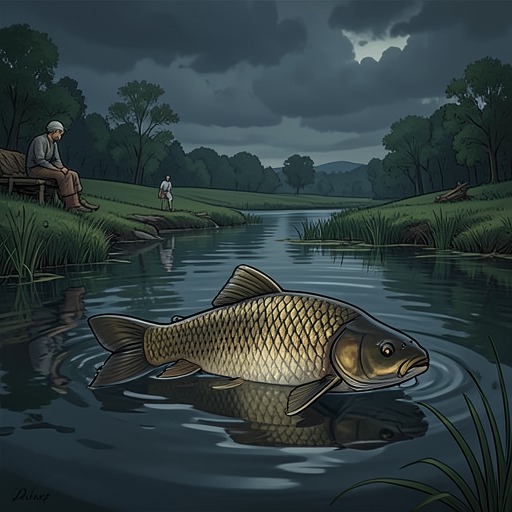
The narrator asks what the fish is for and learns that it is a carp, customarily raised in May because May is the month of boys. The explanation connects the carp to boys as a symbol and says that families raise one when hoping for a baby boy. The account establishes the custom as a visible expression of that hope: a fish is set above the household, making the desired child’s gender public in the garden. It does not explain why the carp acquired this meaning, and the narrator’s attention falls instead on what the custom includes—and what it leaves out.
The Missing Month
The narrator asks which month belongs to girls and is told that there is none. That short answer changes the scene. The issue is no longer simply why a paper carp has been hung; it is why boys receive a month of their own while girls receive no equivalent. The narrator is dumbfounded by what seems a staggering injustice, and the brother and Hugo respond with teasing looks. Their reaction does not settle the question. The narrator asks again why a carp stands for a boy, still treating the explanation as something that ought to make sense.
The custom thus becomes the first occasion on which a familiar distinction begins to look like a hierarchy. The narrator has noticed differences between boys and girls before, but had placed them among many ordinary contrasts: Japanese and Belgians, short and tall people, kind and nasty people, Nishio-san and Kashima-san. In that earlier understanding, gender was one difference among many, not a principle that seemed to organize special recognition. The carp unsettles that arrangement. A symbol is raised for boys, and the calendar itself is described as theirs; for girls there is no month, pennant, or even day.
A Child’s Reading of the Custom
The narrator’s objection is not presented as a settled argument about the custom’s history or purpose. It is an immediate response to the imbalance made visible by the family’s explanation. The question about a girls’ month exposes the limits of the explanation: saying that May belongs to boys does not answer why boys should have this distinction and girls should have none. The narrator’s repeated inquiry keeps that gap open rather than accepting the symbol as self-explanatory.
The scene’s child’s-eye perspective gives the question its force. The narrator understands the carp through what can be seen: a red fish above the garden, associated with boys, and an empty place where a girls’ celebration might be. The household’s ordinary custom is therefore encountered not as neutral background but as a claim about which identity merits public marking. The brother and Hugo’s teasing contrasts with the narrator’s earnestness, but does not erase the unease. The narrator leaves the garden irritated and still convinced that the question was pertinent.
May’s Changing Meaning
The seasonal setting sharpens the reversal. The azaleas first make May seem like a month of abundance, colored across the mountain. After the exchange about the carp, the narrator sits beneath its pole and wonders why it expresses the brother’s identity more than the narrator’s, and why masculinity should merit the month of sweet air and blooming azaleas while femininity receives no marker at all. The custom has altered the meaning of the garden: its decoration now seems to announce an asymmetry the narrator cannot reconcile.
The narrator then kicks the pole. The gesture does not change the custom, but it gives the objection a physical form. By this point the cherry trees have lost their flowers, and the narrator describes the change as a kind of fall in spring. May’s freshness seems to be fading; perhaps, the narrator concludes, it is fitting that this be the month of boys because it is when things begin to decline. The seasonal judgment is also a child’s bitter aftertaste from the discovery. The carp remains a sign of the custom, but it has become inseparable from the question that the custom raised: why one gender is publicly celebrated while the other is left without its own sign.