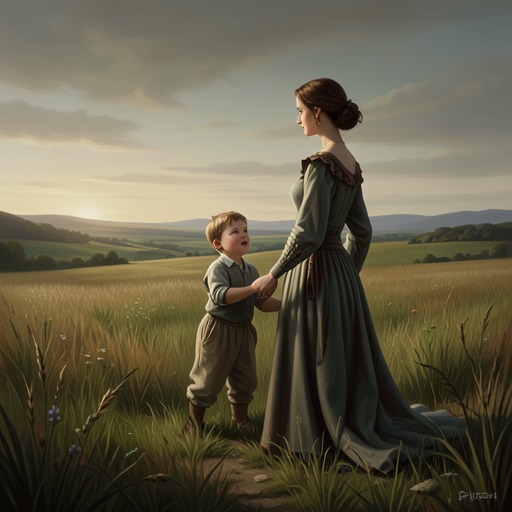
The Narrator and Her Grandmother
The Character of RainThe relationship between the Narrator (God) and Grandmother begins with an act of feeding and grows into a lifelong exchange between gift and memory. Grandmother’s White Chocolate does more than comfort a difficult child: in the Narrator’s account, it awakens pleasure, gives the child a sense of self, and marks the beginning of remembered life. When Grandmother later dies, the Narrator understands that first gift as bound to loss, and memory becomes the means of giving something back.
The Gift That Begins a Self
At two and a half, the Narrator encounters Grandmother’s hand approaching with an unfamiliar white stick. The child is prepared to bite the hand, as adults have often brought their fingers near its face, but the object interrupts that defensive response. Grandmother identifies it as White Chocolate from Belgium and offers it for eating. The Narrator knows the word for eating, but not the names of the food or its origin; its smell is strange, and fear exists alongside desire. The first taste resolves that uncertainty in the body: the substance melts on the tongue, sweetness overwhelms the mouth, and a voice emerges that recognizes itself as a me rather than an it.
The Narrator later fixes this moment as a birth: in February 1970, in Japan, in Kansai, in Shukugawa, under Grandmother’s benevolent gaze, and through the grace of her White Chocolate. The account gives the relationship an unusually intimate scale. Grandmother does not merely provide a treat; her gift becomes the material occasion on which the child discovers an identity and a voice. The narrator says that this voice has never since fallen silent.
Grandmother’s intervention also changes the family scene. She arrives carrying a docile, contented child, and announces her new friend triumphantly. Mother and Father are stunned by the child’s transformation, thrilled by it and irritated by the mystery of how it happened; they ask Grandmother to explain her apparent miracle. The contrast is sharpened by Mother’s suspicion of sugar, which she regarded as responsible for many of the world’s ills. The substance she considered poison has, in the Narrator’s telling, helped make her third child fit for social life.
A Brief Visit, a Lasting Inheritance
Grandmother and her sweets remain in Japan for only a month, but the Narrator treats that short visit as sufficient to set a life in motion. Before the change, the child remembers being disappointed by a world of pureed vegetables and by the restrictions of childhood. Through Grandmother’s gift, pleasure becomes more than a taste: it offers a reason to participate in the world and a way to name the self. The Narrator presents identity not as something Grandmother explains, but as something the child discovers through the experience she makes possible.
The change is visible in the child’s conduct as well as in the Narrator’s account of consciousness. The child becomes alert yet judicious, silent but present, lively but attentive, and both obedient and independent. After Grandmother’s month-long stay, Mother and Father are relieved to have a child they consider more or less normal, and they begin calling the child by the first name. Grandmother is no longer physically present, but the effect of her visit persists in the family’s changed understanding of the child and in the Narrator’s own account of becoming a person.
The gift also establishes the terms of the Narrator’s memory. The Narrator says that everything after February 1970 is remembered, while acknowledging that ordinary conversations and many of the parents’ worries have been forgotten. What remains, the Narrator insists, are essential experiences: the green water of Little Green Lake, the garden’s smell, and the taste of plum wine. The claim is expansive, and the Narrator openly notes that it cannot be proved or disproved and that being believed matters less and less. Before White Chocolate, recollection depends on what other people report, filtered through the Narrator’s mind; afterward, memory is presented as firsthand, carried by the same hand that writes the account. Grandmother’s gift thus becomes inseparable from the narrator’s authority to tell a life story, even as the narrator marks the limits of that authority.
Loss and the Return of the Gift
After Grandmother dies, the Narrator sits on the stairs thinking about her and her White Chocolate. The loss is interpreted through the language of exchange: Grandmother had helped free the child from death, and soon afterward death took her in turn. The Narrator wonders whether she knew that her life was being imagined as the price of the child’s. This is presented as the child’s later interpretation, not as knowledge of Grandmother’s thoughts.
The Narrator’s answer to that imagined exchange is memory. Grandmother gave the child memory, and remembering her is described as a fair return: through recollection, she remains alive in the account, still carrying her bar of White Chocolate like a queen carrying a scepter. The image joins the ordinary object that began the relationship to a ceremonial emblem of its lasting importance. The narrator does not claim to reverse Grandmother’s death; instead, the act of telling restores her presence in the form the gift made possible.
The response to loss is quiet rather than openly demonstrative. The Narrator says there were no tears, then returns to playing with a top, watching it spin for hours. That juxtaposition places the child’s absorption in motion beside the adult narrator’s reflective account of death and repayment. Grandmother’s absence is not resolved, but the memory of her becomes a continuing bond, sustained by the object, the awakening it caused, and the story told afterward.
Recollection, Rescue, and Uncertainty
The relationship’s importance is clearest in how the Narrator frames remembering: Grandmother is both the person remembered and the figure through whom memory itself begins. The account insists on a sharp boundary between the period before White Chocolate, which must be reconstructed from others’ reports, and the period afterward, which the Narrator claims as firsthand experience. At the same time, the narrator admits omissions and refuses to treat the claim as independently verifiable. The result is a bond preserved through a memory that is passionately asserted but not presented as complete or beyond question.
Later episodes make that tension visible without displacing Grandmother’s role. When the Narrator nearly drowns, Mother pulls the child from the water; after learning that Hugo alerted her, the Narrator solemnly thanks him. In recounting this rescue, the Narrator recognizes help through a direct expression of gratitude, just as the remembered gift from Grandmother remains a formative act of care. Much later, the Narrator calls an attempt to die the first and, to that point, only suicide attempt, but also wonders whether the events surrounding it were dreamed or invented. A scar on the left temple serves as material corroboration of injury, not proof of every remembered detail. These later qualifications echo the larger tension in the account: memory is the Narrator’s return gift to Grandmother, while the act of remembering remains subject to uncertainty.