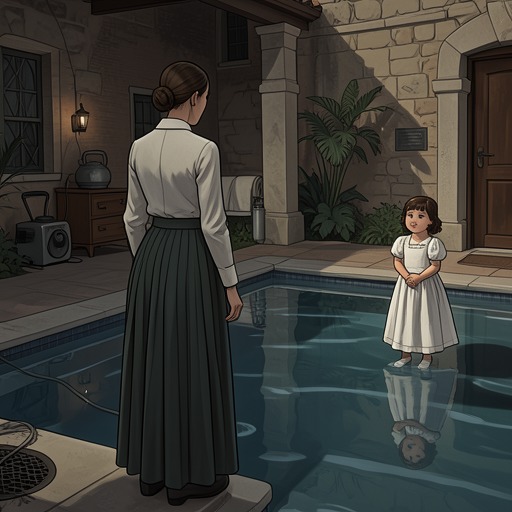
The Narrator and Kashima-san
The Character of RainThe Narrator and Kashima-san have a relationship shaped by rejection, competing interpretations, and a secret neither of them is shown discussing. When the young Narrator imagines herself divine and surrounded by devoted followers, Kashima-san is the conspicuous exception: she does not believe in the child’s new religion, refuses to share her food, and later remains unmoved by repeated attempts to charm her. Years later, during the Narrator’s suicide attempt in the koi pond, that distance becomes a matter of life and death in the child’s understanding. Kashima-san’s silence leaves the Narrator both certain that she has been abandoned and uncertain whether her choice was understood.
Formation of the Conflict
The conflict begins during the Narrator’s self-deification. She regards the flourishing garden and the happiness of her family and followers as evidence of her own divine importance. Kashima-san, identified as the Narrator’s aristocratic nanny, does not join this imagined religion. The Narrator takes her refusal personally: Kashima-san is not merely unconvinced but, in the child’s account, the only Japanese woman who rejects her and hates her.
A practical rebuff makes the difference between them immediate. Kashima-san will not let the Narrator eat from her plate; when the child tries anyway, Kashima-san slaps her. The Narrator asks whether this is normal and rejects the explanation that it is simply Kashima-san’s way. She considers the act an unjustified challenge to her authority and decides that people who question her religion should pay. The incident establishes a pattern that continues: Kashima-san sets a boundary, while the Narrator interprets it as an affront to her status and seeks a way to overcome or punish it.
The Narrator first tries to exert divine power at a distance, commanding Kashima-san’s garden not to blossom. The command seems to have no effect, and she then learns that Kashima-san has no garden. This small failure redirects her from punishment toward persuasion. She extends a hand in a gesture she associates with God reaching toward Adam in the Sistine Chapel, but Kashima-san ignores it. The Narrator casts the refusal in religious terms, making Kashima-san an adversary to her imagined divinity rather than considering that the gesture might not mean the same thing to both of them.
Failed Efforts at Affection
Unable to imagine that Kashima-san’s indifference might reflect the Narrator herself, the child decides that Kashima-san suffers from a kind of self-denial. She watches for signs of it: at moments of celebration, she observes Kashima-san’s mouth tighten and her expression remain restrained. The interpretation makes Kashima-san’s reserve into a problem to diagnose, and the Narrator treats her subsequent gestures as experiments designed to reveal or cure it.
She brings Kashima-san a fragrant camellia picked especially for her and receives a curt thank-you. At the Narrator’s request, Nishio-san prepares Kashima-san’s favorite savory egg custard, which Kashima-san eats quietly. When the Narrator sees a rainbow, she calls Kashima-san to share the sight; Kashima-san only shrugs. Each gesture has a different occasion and object, but the result is similar: Kashima-san does not respond with the delight the Narrator expects. The child records the refusals as evidence of Kashima-san’s supposed inability to enjoy things, rather than as evidence that her efforts have not created closeness.
The Narrator’s most elaborate attempt is a performance. She puts on a traditional Japanese outfit Nishio-san had given her: a red silk kimono decorated with water lilies, a red obi, lacquered geta, and a purple-paper parasol bearing storks in flight. She adds her mother’s red lipstick, admires herself in the mirror, and first presents the spectacle to her loyal followers. Their enthusiastic response confirms her expectation that the display will be irresistible. She dances in the garden and places a large peony on her head before presenting herself to Kashima-san. Kashima-san offers no visible reaction. The episode completes the child’s series of tests, but not her explanation: she concludes again that Kashima-san is holding back and feels sorry for her, unable to imagine a place for this unresponsive figure in her vision of the world.
The Koi-Pond Encounter
The relationship changes in the Narrator’s memory of the suicide attempt. At three years old, overwhelmed by the choice she imagines between life and death, she collapses into the koi pond. As she floats in the water, the garden no longer appears to her as a protected paradise; it has become a place where death is possible. Kashima-san’s appearance at the water’s edge brings their earlier conflict into the scene. The Narrator recognizes her through the water and thinks that Kashima-san will not intervene because she is Japanese and hates her.
Kashima-san looks at the child, and the Narrator describes her face as impassive. From that stillness, the child draws a firm conclusion: Kashima-san will let her die. She connects this imagined decision to the people who watched her during an earlier drowning at sea, contrasting their calm with the rescue her mother eventually provided. In the child’s interpretation, both the earlier spectators and Kashima-san are submitting to a law that says someone destined to drown will drown. This is the Narrator’s explanation of what she sees, not an account of Kashima-san’s thoughts; the text does not establish what Kashima-san knows or intends.
The Narrator also revises her reading of Kashima-san’s face. At first she thinks she sees a smile, then becomes convinced that Kashima-san has smiled at her at last. Kashima-san moves away, and the Narrator remains in the water until she is eventually taken out. The child’s interpretation turns the encounter into a final, paradoxical moment of recognition: she believes she has at last understood Kashima-san, but the understanding depends on an expression and intention that the Narrator cannot verify. The woman who had ignored her gestures of affection is now imagined as accepting her choice, whether or not that is what happened.
Secrecy and Lasting Uncertainty
The Narrator’s account of the aftermath preserves rather than resolves the uncertainty. She never tells her parents that the incident was not an accident, and she does not tell them about Kashima-san or what she did, or did not do. She says that disclosure might have caused Kashima-san problems. The silence protects Kashima-san from consequences, but it also means that the adults are not given the Narrator’s account of the encounter.
Looking back, the Narrator continues to suspect that Kashima-san may have understood the nature of the child’s act and respected her choice. She presents this as a possibility, not a recovered certainty. Her memory thus holds two claims in tension: Kashima-san had seemed to hate her and to leave her alone in danger, yet the Narrator can imagine that this nonintervention was a form of recognition. The account does not settle whether Kashima-san understood, whether she chose not to act, or how the child was ultimately rescued.
The relationship’s significance lies in this gap between action and interpretation. In the earlier episodes, the Narrator turns every lack of response into proof of a defect in Kashima-san; at the pond, she again reads silence as a statement, but now gives it the weight of acceptance. Her later concealment prevents either interpretation from being tested between them. Kashima-san remains, in the Narrator’s story, both the person who most decisively refused her adoration and the person whose silence she eventually believed she could understand.