The Narrator and Nishio-san
The Character of RainThe relationship between the Narrator (God) and Nishio-san transforms a nanny’s everyday care into the child’s first great attachment in Japan. Nishio-san is at once a practical caregiver, a private channel for speech, and the person the Narrator chooses to love with full awareness that their time together cannot last forever. Their closeness is tested when Nishio-san announces that she is leaving; her eventual promise to stay brings relief, but not the child’s belief that the separation has been permanently averted.
A bond formed through care
Nishio-san is the Narrator’s nanny and speaks only Japanese, a fact that initially matters as much for secrecy as for intimacy. When the child wants to ask a question about death but is officially thought capable of using only a handful of words, Nishio-san offers a way to speak without immediately exposing the full extent of that ability. The Narrator addresses the question to her, and Nishio-san’s astonished response makes clear that she has discovered the child can talk. What begins as a means of concealment also makes Nishio-san the person to whom the child entrusts a difficult question.
The Narrator’s understanding of language is not yet divided into separate systems. Japanese and French seem like different versions of one large language, rather than distinct tongues with separate boundaries. In this early relationship, Nishio-san’s Japanese is therefore not an obstacle separating the pair; it is the language through which the child can speak, ask, and be understood. She provides a setting in which the Narrator can communicate while still controlling what others know.
The emotional attachment becomes explicit when the Narrator tells Mother that Nishio-san understands what is being said and then declares love for her. Nishio-san’s affection is likewise described as extending to the Narrator as fully as to her own daughters, ten-year-old identical twins. She does not distinguish the twins by their first names, which she cannot reliably tell apart, and calls them by a shared Japanese term. The detail places the Narrator within a household already shaped by Nishio-san’s maternal care, while also showing that the child occupies a special place in her affections.
The chosen child in Japan
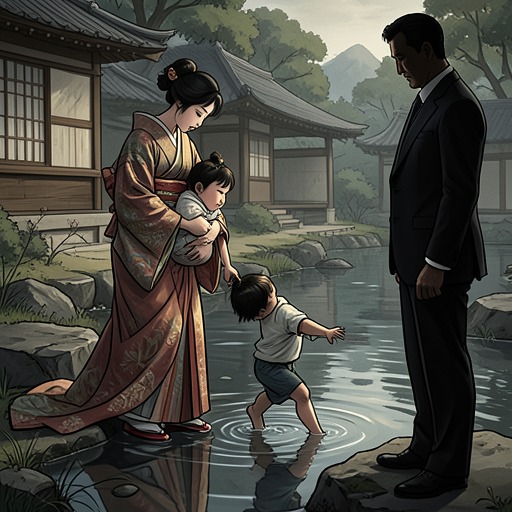
At two and a half, the Narrator says that Japan has become home. That belonging is described through beauty and adoration, but Nishio-san gives it a personal center: the child is her chosen one. If the Narrator asks, Nishio-san will stop what she is doing, take the child into her arms, and sing about gardens and blossoming cherry trees. Her readiness to respond makes affection concrete as repeated attention, not merely a feeling named after the fact.
Nishio-san also tells stories that hold the child’s attention: tales of bodies being cut to pieces and of a witch cooking people in a cauldron. The Narrator listens in stunned silence and marvels at them. Such stories enlarge the relationship beyond soothing and physical comfort; Nishio-san is also a teller whose words bring the child into contact with frightening, fantastical material. In Kansai, in Shukugawa, the Narrator’s sense of becoming Japanese is thus bound closely to Nishio-san’s presence and to the particular world she opens through song, story, and care.
The threat of separation
The bond is placed under immediate pressure when Nishio-san tells Father that she is leaving. She explains that she has too much work, is tired, and needs to spend more time at home caring for her ten-year-old daughters. The parents have to accept her decision. For the Narrator, the announcement is not an abstract change in household arrangements: it threatens the daily presence of the person who has become the child’s chosen source of comfort and attention.
The Narrator pleads with Nishio-san not to go, but Nishio-san weeps and does not change her mind. Kashima-san is seen smiling quietly. Having overheard the conversation while hiding under the kitchen table, the Narrator runs to the parents and manages to tell them what has happened. Father is furious with Kashima-san and asks Nishio-san to speak with him privately. Meanwhile, the child stays in Mother’s arms, sobbing and repeating that Nishio-san has to remain. The scene shows the Narrator acting on the attachment: the child does not merely grieve the prospect of departure but tries to intervene in the decision.
A reprieve and a conscious choice
Father and Nishio-san eventually reappear, and Nishio-san runs to the Narrator, lifts the child into her arms, and promises that she is staying. The child understands this news differently from how it would have been understood before: the promise is a reprieve, not an assurance that separation has disappeared. The Narrator anticipates that the painful part will come later, and turns that foreknowledge into a choice to love Nishio-san more fiercely rather than withdraw from the bond.
The Narrator hugs Nishio-san with all the child’s strength. Kashima-san sees them together and senses that the Narrator has played some role in Nishio-san’s decision, though she does not know that the child overheard the earlier conversation. Nishio-san looks contented and peaceful in the embrace; Kashima-san purses her lips and looks balefully at the child. The immediate outcome is that Nishio-san stays, but the relationship’s deeper consequence is the Narrator’s decision to accept attachment despite its anticipated ending. Their embrace resolves the crisis for the moment while preserving the child’s awareness that love cannot guarantee permanence.