The Narrator's Suicide Attempt in the Koi Pond
The Character of RainThe Narrator's Suicide Attempt in the Koi Pond is the episode in which a three-year-old narrator deliberately enters the garden pond and is rescued before dying. Its significance lies not only in the attempted death but in the account’s unsettled distinction between choice and accident: the child experiences the act as intentional, while the family is given—and accepts—a different explanation. The Narrator also interprets Kashima-san’s failure to intervene through a private theory of Japanese restraint and destiny, then carries that interpretation into adulthood without claiming certainty about what Kashima-san understood.
Background and Setting
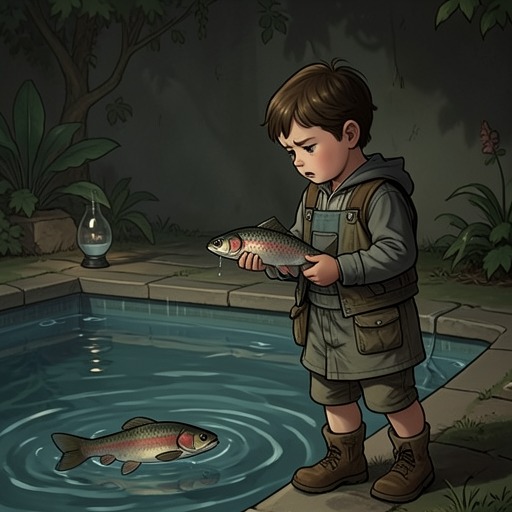
The episode takes place at noon near the end of August 1970. The Narrator has been feeding the Koi (carp) every day at that hour for two weeks. The task has not become routine. Instead, the sight of the fish feeding has left the child increasingly depressed, and the act has acquired the weight of a message that must be understood. The Narrator considers allowing an inner voice to speak rather than suppressing it, framing the fish and their need for food as an image of life that consumes without ever being filled.
The garden, previously experienced as a refuge from the outside world, now seems to contain death as well as beauty. With the Narrator’s feet at the pool’s edge, the choice is imagined as one between the fish’s appetites and gradual decay. This stark opposition narrows the child’s perception: the garden is no longer simply a protected paradise, and feeding the fish is no longer merely an unpleasant chore. The attempt emerges from this increasingly absolute way of seeing, rather than from a practical plan described in the account.
The Attempt and Kashima-san
The Narrator retches, loses strength, and falls into the water. After striking the edge, the child floats below the surface and describes a striking absence of panic. Unlike an earlier drowning at sea, which had brought an urgent desire to reach air, this time the Narrator understands the submersion as a choice and does not miss breathing. The calm is accompanied by a changed view of the garden: the water seems to absorb the child, and the bamboo becomes the focus of attention through the still pool.
Kashima-san appears at the water’s edge, interrupting that view. The Narrator expects her to want to pull the child out, but believes she will not intervene. The child thinks Kashima-san hates them and calls her a true Japanese, connecting her stillness to the principle that a person destined to drown will drown. In the Narrator’s interpretation, Kashima-san’s presence makes sense of the people who had watched during the earlier sea incident: they, too, had seemed unwilling to disturb what the child now regards as the order of events. The account presents this as the child’s understanding, not as a confirmed explanation of Kashima-san’s thoughts.
The Narrator sees Kashima-san smile and take that expression as recognition, even as the woman slowly moves away. The child imagines the rescue she could have performed and concludes that doing so would have contradicted who Kashima-san was. This moment gives the attempt a second, interpersonal dimension: the Narrator is not alone in the garden, but interprets another person’s inaction as a confirmation of destiny. The adult narrator later preserves some uncertainty, wondering whether Kashima-san understood the act and respected the child’s choice, while also acknowledging that she may simply have been pleased by the prospect of the child’s death.
Rescue and the Official Explanation
A hand seizes the child and brings the Narrator back to awareness. Air returns, pain follows, and the child recognizes Nishio-san. Nishio-san calls for help, carries the Narrator into the house, and finds Mother, who immediately joins the alarm. She then accompanies them as they hurry to the car, trying to explain how she found the child in a mixture of Japanese, French, and English.
On the way to Kobe Hospital, Mother tells the Narrator that the fall was accidental: the child had been feeding the fish, slipped, struck their head, and lost consciousness. The Narrator knows that this account is not true but agrees when Mother asks whether it is understood. The child recognizes that the truth should not be disclosed and also lacks the word suicide with which to explain what happened. The only wish the Narrator manages to express is not to feed the fish again. That response gives the immediate practical consequence of the episode: the daily task that had become unbearable is rejected, while the deeper account of the attempt remains unspoken.
Aftermath and Meaning
The account identifies the episode as the Narrator’s first and only suicide attempt. The parents are never told that the fall was deliberate, and they are never told that Kashima-san was there. The Narrator says that disclosure might have caused problems for Kashima-san; the later recollection neither settles her motives nor turns the child’s interpretation into an established fact. Instead, the withheld knowledge becomes part of the episode’s lasting structure: the family remembers an accident, while the Narrator remembers a choice, a witness, and a rescue.
The episode also sits beside the narrator’s account of the mass deaths on Okinawa shortly after Japan’s surrender in 1945. There, thousands died because they feared what would happen if the advancing Americans captured them; the narrator reflects on the paradox of dying to avoid death. The adult account sets that collective event beside the child’s private attempt without making the circumstances equivalent. Both passages ask how fear, choice, and beliefs about death shape action, but the child’s experience is narrated through a personal conviction that death would end the obligation to feed the fish and keep the Narrator in Japan.
The ending refuses a simple verdict on survival. The Narrator recalls being both disappointed to remain alive and glad to have been pulled from the water, describing the choice at the time as indifference between life and death. From adulthood, the narrator still cannot say whether it would have been better to die in the pond; life has proved interesting, but the alternative remains unknowable. The attempt therefore concludes physically with rescue and medical care, but interpretively remains open: what happened is remembered clearly, while its ultimate value cannot be decided.