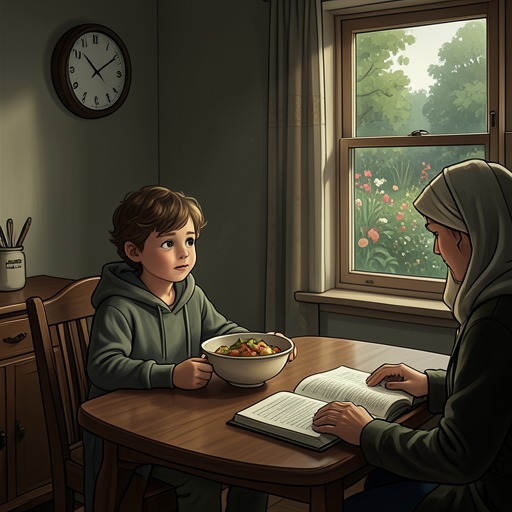
White Chocolate Awakens the Narrator
The Character of RainWhite Chocolate Awakens the Narrator is the remembered turning point at which a child described by adults as inert begins to speak, experience pleasure, and recognize a self. The Narrator dates this awakening to February 1970, at two and a half years old, when Grandmother offered a stick of White Chocolate in Shukugawa, Kansai. In the account, its sweetness does more than feed the child: it sets the child in motion and becomes the first point from which a life can be remembered.
Before the Awakening
Before the encounter, doctors tested the child's body for signs of response. Tapping the knees and elbows produced no reflex, and shining a light into the pupils did not make them move. The parents reported that the child never cried, moved, or made a sound. Specialists called the condition pathological apathy, described the child as a vegetable, and recommended hospitalization. The parents declined. They already had two children whom they regarded as fully human; accepting a third as a vegetable seemed bearable, and even stirred tenderness. They affectionately called the child the Plant.
The medical description did not explain the child's apparent stillness. By age two, there had been no attempt to crawl and no peep. The adults around the child—the parents, doctors, and nanny—assumed a developmental blockage. The Narrator later sets this interpretation against the possibility that the condition was not physical: the child might, in the account's striking formulation, have remained inert rather than having been prevented from developing. The awakening therefore overturns not only the family's expectations but the certainty with which they had read the child's silence.
Grandmother's Offering
Grandmother approached with something the child had never encountered: a white stick. The Narrator recalls recognizing the word white, familiar from walls and milk, but not the words for chocolate or Belgium. Grandmother identified the treat as White Chocolate from Belgium. At the sight of it, the child forgot the impulse to bite the approaching adult's hand. The unfamiliar object redirected attention before the child could understand its name.
Eating itself was familiar, but the new food's smell was not. The child was both afraid and tempted, grimacing in disgust while salivating with desire. Then the child took the stick in its teeth. A hard bite proved unnecessary: the substance melted on the tongue, and its sweetness seemed to seize command of the mouth. This sensory encounter is the event's hinge. The child does not first reason toward an identity or receive one through an explanation; bodily pleasure arrives, and speech follows.
Pleasure, Speech, and Selfhood
The sweetness brought forth a voice the child had never heard before. It announced that the speaker was not an it but a me, and connected that self to the pleasure provided by the food. The Narrator describes this as the birth of an inner voice that has continued to speak ever since. Mouthful by mouthful, the stick disappeared as the voice grew louder. The child came to understand pleasure and self as inseparable: pleasure made the self perceptible, while the self made the chocolate's sweetness an experience rather than merely a property of the food.
The Narrator locates this birth precisely: in Japan, at two and a half, in February 1970, in Shukugawa, under Grandmother's care and through her White Chocolate. The specificity makes the scene a personal origin story as well as a sensory recollection. Grandmother's offering gives the child a first name for inward experience, while the child imagines itself as necessary to the pleasure the chocolate produces. The episode thus turns an apparently passive object into the occasion for a change in consciousness: the food melts, but the self that emerges from the encounter remains.
The Narrator later interprets the change as more than a sudden ability to speak. Before the sweetness, boredom and the body's ordinary food had offered no felt justification for joining the world. Pleasure supplied one. The child who had seemed feral and withdrawn began to understand the body and spirit as capable of delight, and no longer had reason to despise either the world or the self for participating in it. The Narrator also contrasts this experience with Mother's suspicion of sugar, which she regarded as a source of many of the world's ills. What she considered poison had helped make her previously unresponsive child fit for society.
Memory and What Followed
For the Narrator, the awakening also marks the beginning of autobiographical memory. The claim is broad—everything after February 1970 is said to be remembered—but the account qualifies it. The Narrator does not claim to recall every parental worry or every conversation; instead, the claim is to have forgotten nothing essential. Before the White Chocolate, there is no personal memory, only what others have reported and what the Narrator must reconstruct from their accounts. Afterward, knowledge is described as firsthand, belonging to the same hand that writes the story. The Narrator acknowledges that such a claim cannot be proved or disproved and says that belief from others matters less and less.
The remembered particulars that anchor this claim are sensory and domestic: the greenness of the lake where the Narrator learned to swim, the garden's smell, and the taste of plum wine sipped unseen. Memory, like identity, is linked to pleasure; what has no connection to pleasure seems to the Narrator to have no reason to be remembered. The origin scene therefore establishes the terms on which the later life is narrated: sensation provides evidence of a self, and recollection preserves experiences that might otherwise be lost.
The change soon became visible to the family. After two years as a vegetable and six months as a wild creature, the child became alert but judicious, silent but present, and both obedient and independent. Grandmother and her treats remained in Japan for only a month, but the Narrator says that the very idea of pleasure had already set the child in motion. The parents were relieved, and began using the child's first name. The awakening was not simply a momentary reaction to sweetness: in the Narrator's account, it marks the transition from a child treated as barely responsive to a recognized person, and the start of the memory through which that person can tell a life.