
Fear, Suspicion, and the Scapegoat
The Chemistry of DeathThis thread traces how Manham’s desire for safety turns grief into communal suspicion, directs blame toward outsiders and vulnerable residents, and allows fear to become a source of public disorder.
increasing Bearing strength in each event
 decreasing
Bearing strength in each eventdecreasingA Tragedy at Arm’s Length
A Tragedy at Arm’s Length
The stranger explanation
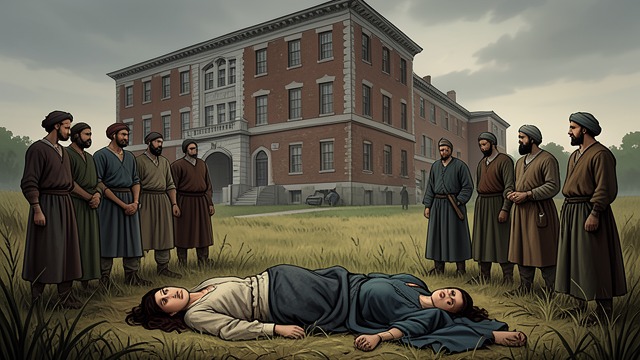
Before the victim is identified, many residents assume that the dead woman must be an outsider. The village treats the murder as a disturbing spectacle at a safe distance, believing that a stranger could have entered the landscape and disappeared without implicating anyone local.
That confidence depends on a comforting but unsupported idea: that a close community would necessarily notice its own missing members and recognize danger among its own people. Sally Palmer’s absence has already gone largely unnoticed.
The failure of belonging
The body is identified as Sally, who lived at the edge of the village but was never fully absorbed into it. Her death exposes the gap between communal closeness as an ideal and the actual attention people pay to one another.
When Lyn Metcalf disappears, the outsider explanation becomes harder to maintain. Fear shifts inward, and Manham’s inhabitants begin to regard ordinary neighbours as possible threats.
The Search Turns Inward
The Search Turns Inward
Solidarity under suspicion
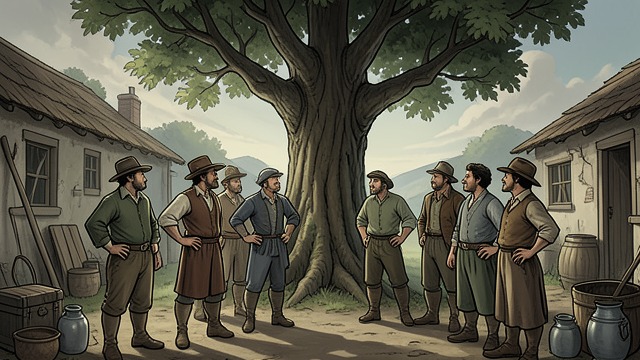
Villagers join the public search for Lyn Metcalf, appearing united in their concern. Yet the very fact that the killer is likely local makes each searcher a possible object of suspicion to the others.
The gathering therefore performs two contradictory roles. It offers practical help, but it also gives residents an opportunity to watch one another and wonder who may be pretending to grieve.
Community as a fragile pact
David sees how quickly familiar gestures can become unreadable. The village has not yet openly condemned anyone, but suspicion is already altering the emotional distance between neighbours.
The search reveals that communal belonging cannot by itself guarantee trust. When fear has no identified target, the crowd becomes both a resource for finding the missing and a setting in which the next accusation can take root.
A Vulnerable Scapegoat
A Vulnerable Scapegoat
Old stigma, new danger
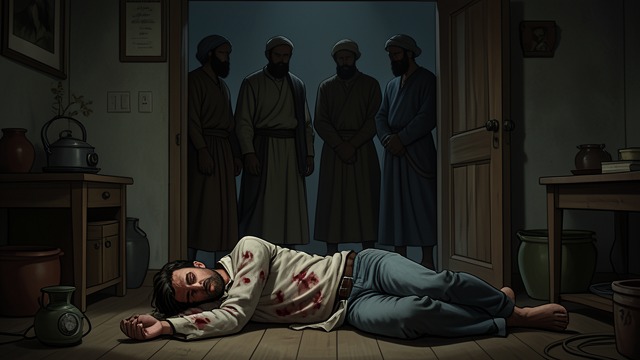
As the investigation stalls, James Nolan—already isolated because of his sexuality and an old arrest—becomes an easy target for men looking for somewhere to direct their fear. A group breaks into his home, beats him, and destroys his belongings.
The attack is not evidence against Nolan; it is evidence of the village’s willingness to turn prior stigma into a substitute for knowledge. His long exclusion makes it easier for neighbours to imagine him as dangerous and harder for him to expect protection.
Silence as participation
No one comes forward as a witness, although David senses that residents watched or chose not to intervene. The anonymous call for medical help preserves the village’s boundary against outside authority while acknowledging that Nolan might die.
The episode shows how collective violence can flourish without a public order to commit it. Fear supplies the occasion, while silence and social exclusion make the assault possible.
The Reverend’s Call to Arms
The Reverend’s Call to Arms
Fear made political
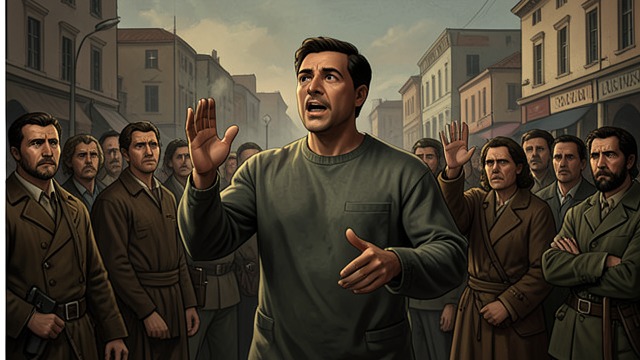
At a public meeting, Scarsdale places Marcus Metcalf before the crowd and argues that the police cannot protect the village. Grief becomes part of a call for residents to take action themselves, while Scarsdale casts the killer as a hidden enemy among them.
The speech gives direction to an emotion that had previously circulated as rumour. Its appeal is potent because it presents vigilantism as solidarity and self-defence, not as a further danger to the community.
Authority without restraint
David recognizes that the meeting may intensify the very disorder its speaker claims to oppose. A recent assault on Nolan has already demonstrated how quickly self-appointed moral certainty can become physical violence.
Scarsdale’s influence illustrates that public leadership is not automatically responsible leadership. In a frightened village, a confident voice can become more persuasive than careful evidence, and collective action can outrun the facts it needs to justify itself.
Suspicion After the Arrest
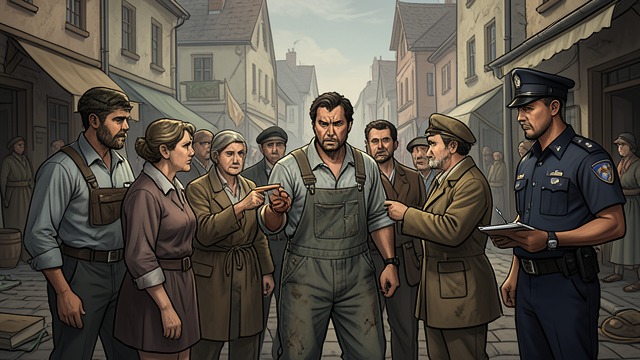
Suspicion After the Arrest
A false certainty
After Ben Anders is arrested, rumours and circumstantial details make a familiar villager appear to fit the crimes. His later release exposes how easily the demand for an answer can turn a lead into a judgment before the evidence is sufficient.
The police investigation is not the only arena affected. Ben’s reputation, David’s place in Manham, and the village’s fragile sense of itself all become entangled with the accusation.
The cost of belonging
Even after the killer is exposed, David finds that helping the village has not made him one of its own. He leaves, recognizing that residence and service cannot guarantee acceptance when a community has learned to interpret difference as suspicion.
The resolution does not condemn every villager equally. Instead, it shows how fear can make a community fail both its victims and its members, then continue to preserve the social distance that helped the failure take hold.
The first days after the discovery in Farnham Wood
The evening villagers begin searching for Lyn Metcalf
The Saturday night when James Nolan is attacked
The public meeting after Lyn Metcalf’s body is found
The days surrounding Ben Anders’s arrest and David’s departure
