
Animals as Ritual and Message
The Chemistry of DeathThis thread traces how dead and captive animals shift from apparent rural background to a killer’s language of threat, staged meaning, and control.
increasing Bearing strength in each event
 decreasing
Bearing strength in each eventdecreasingThe Angel with Swan Wings
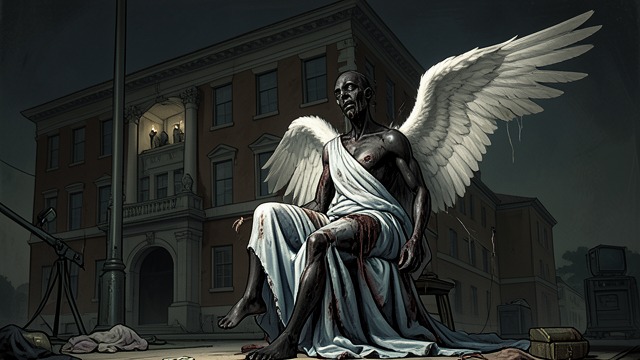
The Angel with Swan Wings
A body made into an image
The photographs show that two swan wings have been cut into the back of Sally Palmer’s body. Against the darkened skin, the staging creates the appearance of a fallen, decaying angel, a visual transformation that is at once theatrical and obscene.
The image tempts observers to search for religious or classical meaning. David initially treats the wings as a material clue, while the scene itself makes the body seem to have been turned into a message for whoever might find it.
Interpretation under uncertainty
The feathers may suggest symbolism, but they do not explain the killer’s motive. The remains are evidence of deliberate violence before they are an interpretable emblem.
That distinction becomes important as the investigation accumulates other animal traces. The apparent ritual cannot be understood by assuming that every image expresses a coherent belief; it may instead express the killer’s desire to control and display what he has harmed.
The Hare and the Mallard
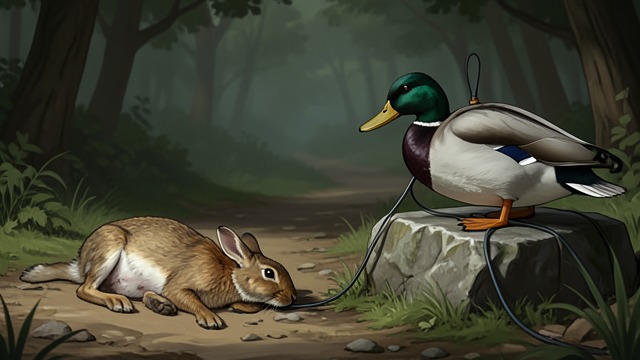
The Hare and the Mallard
A warning on the route
During her run, Lyn Metcalf finds a dead hare deliberately laid on the path. The next morning she sees a live mallard wired to the standing stone; its desperate movement makes clear that someone has recently placed it there.
The animals turn Lyn’s familiar landscape into a scene of possible surveillance. The dead hare can be rationalized as ordinary predation, but the trapped bird makes the possibility of a human message difficult to ignore.
Fear made physical
Lyn realizes that whoever placed the bird may know she will find it. She runs for open ground but is caught by a wire snare before she can escape the woods.
The sequence gives the killer’s animal use a double force: it stages cruelty for the victim and helps create the conditions of the abduction. Nature is not merely a background to danger; the killer manipulates its paths, creatures, and concealment.
A Pattern Across the Village
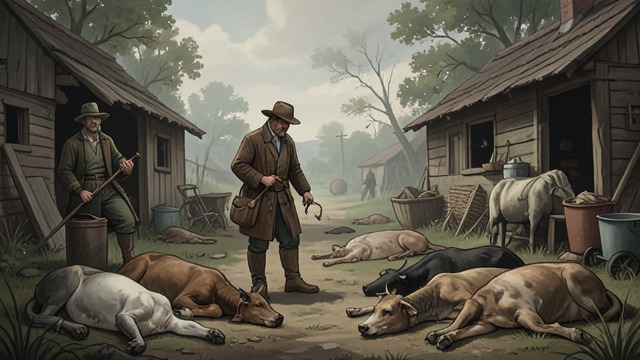
A Pattern Across the Village
Rural death as camouflage
Mackenzie and David hear about dead animals in different settings: an animal left near Sally Palmer, the hare on Lyn’s route, and livestock neglected at the farm. In the countryside, death among animals is common enough that each incident can be dismissed on its own.
This ordinary familiarity becomes a screen. The village’s practical relationship with wildlife makes it harder to distinguish casual animal death from a deliberate sequence of staging and intimidation.
A signature not yet understood
David argues that the animals may mark victims or frighten them before an attack. Mackenzie hesitates to publicize the possibility, concerned that an announcement will generate false alarms and panic.
Their disagreement exposes a difficult problem of interpretation: a pattern is clearest only after its parts are recognized, but waiting for certainty may leave another person without warning. The animal motif functions as evidence and as a test of how investigators manage uncertainty.
The Secret Menagerie
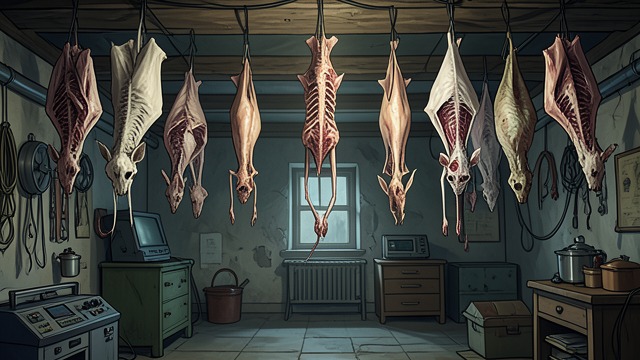
The Secret Menagerie
Cruelty preserved indoors
Through a crack in the partition, Jenny sees animal bodies hanging from the cellar ceiling: birds, rabbits, foxes, and other creatures, some reduced to skin and bone. The collection turns the hidden room into a private museum of violence.
The animals explain the recurring images without making them less disturbing. Their preservation suggests that the killer has returned to these acts repeatedly, surrounding his human captive with the physical record of earlier harm.
Control through display
The cellar’s dead creatures are not simply discarded remains. They organize the space around the captive, making cruelty part of the room’s atmosphere and demonstrating the captor’s command over living bodies and their aftermath.
When David later enters, he encounters the same suspended remains as direct evidence rather than a glimpse through a barrier. The staged animal world connects the killer’s private ritual to the wider landscape in which victims have been abducted and abandoned.
The Ritual’s Human Meaning
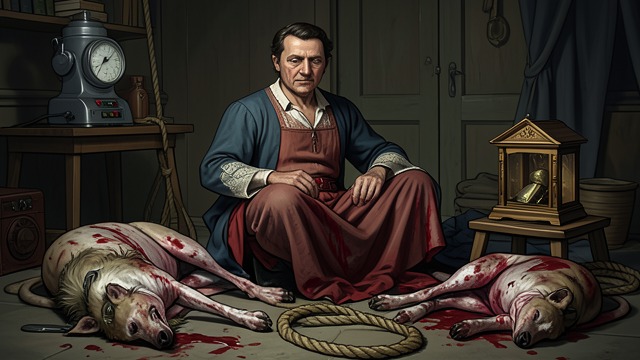
The Ritual’s Human Meaning
A practice made explicit
In the cellar, David sees animal corpses, a rope, the bloodied wedding dress, and the music box used to stage the victims’ humiliation. The objects show that the animal display belongs to a broader arrangement of ritualized control rather than an isolated symbolic gesture.
The killer’s acts are not governed by a clear religious doctrine. Their repetition gives them the appearance of ritual, but the pattern grows from cruelty, fixation, and the captor’s ability to impose a private scene on helpless victims.
Meaning without justification
The animal imagery helps David identify the hidden violence, but it does not make that violence intelligible in any moral sense. Calling the scenes symbolic cannot redeem or explain the suffering they contain.
The thread resolves when the staged setting becomes tangible evidence against its makers. What was once a disturbing motif in a photograph becomes a room that exposes the practical and psychological machinery of the crimes.
When David studies the photographs of Sally Palmer’s body
The two mornings before Lyn Metcalf disappears
The investigation’s first week, as animal incidents accumulate
When Jenny Hammond surveys the cellar during captivity
Near the climax, after David reaches the cellar
