
Decay as a Forensic Clock
The Chemistry of DeathThis thread traces how physical decomposition turns death into measurable time, drawing David Hunter back toward the expertise he abandoned and making forensic knowledge a form of reluctant witness.
increasing Bearing strength in each event
 decreasing
Bearing strength in each eventdecreasingThe Southbound Maggot Trail
The Southbound Maggot Trail
Nature’s timetable
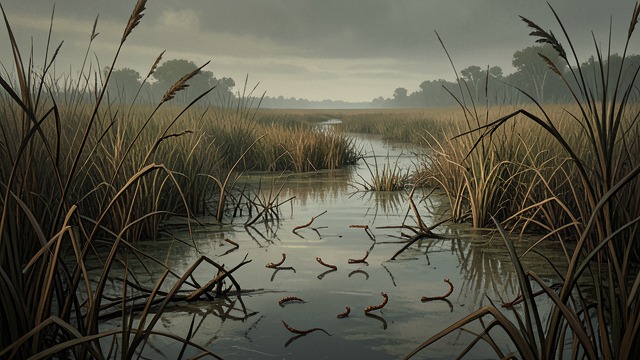
At the opening of the investigation, David Hunter explains that death starts a physical sequence almost immediately: cells break down, insects arrive, and larvae eventually migrate away from the body. Their trail across the marsh makes decomposition visible long before the victim can be recognized.
The procession is orderly but not fully understood; its apparently consistent direction gives the natural process an eerie sense of intention. The landscape itself records the body’s passage, as the chemical products of decay kill the grass beneath the larvae.
Knowledge with a cost
The boys who follow this trail expect an animal and instead discover Sally Palmer. What draws them toward a natural curiosity becomes the route by which a hidden murder enters village life.
For David, the insects are not merely repellent. Their stages and movements are evidence, a readable sequence that he knows how to interpret—and a reminder of the professional world he has tried to escape.
The Body’s Insect Calendar
The Body’s Insect Calendar
Reading the ground
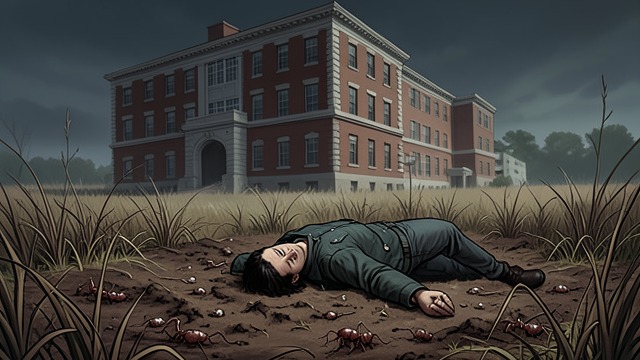
When David examines the place where Sally Palmer lay, he treats the dead grass, maggots, and remaining traces of decomposition as parts of one forensic record. The larvae’s development suggests that the body has not been at the site for long, even though the heat has hastened visible decay.
He estimates roughly nine or ten days since death, while carefully distinguishing that interval from the time the body may have spent elsewhere. The crime scene is therefore not simply a place of discovery: it is a record whose testimony must be separated from the history of the body.
A measure, not certainty
David’s explanation quiets the skepticism of investigators who initially treat insect evidence as elementary. His expertise proves useful precisely because the evidence is ordinary: insect life cycles, soil, and weather can constrain what happened without supplying a complete answer.
The estimate also reveals the limits of forensic certainty. Decomposition is a clock affected by heat, humidity, wounds, and location; reading it requires disciplined qualification rather than a single confident number.
The Dog’s Unequal Clock
The Dog’s Unequal Clock
Comparing remains
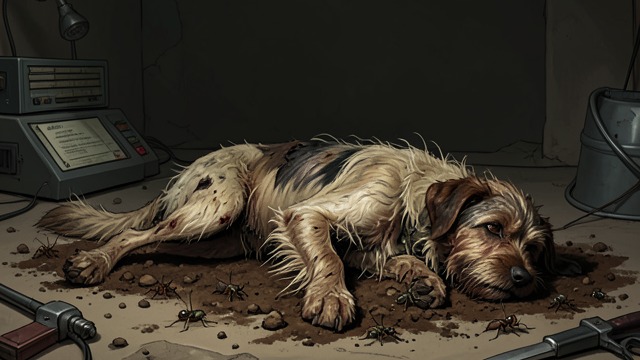
At Sally Palmer’s farm, David examines the remains of Bess, whose body has dried and been picked over in conditions unlike those at the marsh. The dog appears to have been dead longer than the woman, but the comparison is complicated by differences in body size, fur, exposure, soil, and insect access.
The distinction matters because it may reveal a sequence: Sally could have been abducted before she was killed. David offers a cautious estimate rather than pretending that a human decomposition model transfers cleanly to an animal.
Evidence under pressure
Mackenzie needs an answer that could help estimate how long a later captive might survive. David’s analysis supplies a possible interval, not a guarantee, and its uncertainty is emotionally consequential rather than academic.
The examination makes clear that forensic interpretation depends on context. The same processes that make bodies legible also make them variable, so expertise consists partly in knowing where a conclusion must stop.
Chemistry Beyond the Pathologist

Chemistry Beyond the Pathologist
From impression to measurement
In the mortuary laboratory, David combines chemical analysis with weather records and the earlier insect evidence. The amino-acid results place Sally’s death within a narrow window, around nine days before discovery, turning a field estimate into a more carefully bounded conclusion.
This work distinguishes the visible state of remains from the hidden interval that produced it. The body’s chemistry preserves information that ordinary observation can no longer recover, extending forensic knowledge beyond what a conventional examination can establish.
The return to an old vocation
David’s competence comes back with an unsettling fluency. He had tried to exchange the dead for the living, yet the body’s measurable transformations draw him back into the specialized work he once performed after personal bereavement.
The results do not identify the killer or solve the emotional mystery of death. They answer a narrower question—when the body ceased to live—and show both the power and the boundary of scientific explanation.
Death’s Measurable Limit
Death’s Measurable Limit
A second reading
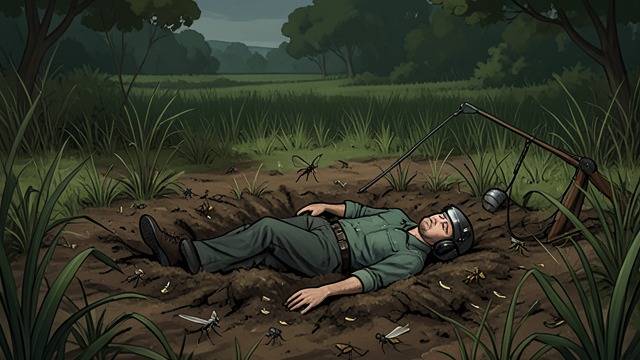
When Lyn Metcalf’s body is discovered, David again estimates time from the condition of tissue, insect activity, and the surrounding ground. Laboratory results later confirm that she died several days after her abduction, allowing investigators to infer that she was held alive before being killed.
The same forensic logic now carries sharper urgency. A time interval that would otherwise be a retrospective fact becomes a measure of how long a missing person may have remained alive and how narrow the chance of rescue has become.
What science cannot restore
The evidence can reconstruct sequence but cannot reverse it. It cannot return either woman to the lives they had, nor erase the violence recorded in their remains.
David’s work thus embodies a central tension: the dead can still communicate facts, but their bodies cannot explain the meaning of what was done to them. The forensic clock grants knowledge, not redemption.
The Sunday Sally Palmer’s body is discovered
The day after the discovery, at Sally Palmer’s marsh crime scene
Several days after the marsh examination, at Sally Palmer’s farm
The Friday when laboratory results refine Sally Palmer’s time of death
After Lyn Metcalf’s body is found and examined
