Abduction and murder of Lyn Metcalf
The Chemistry of DeathThe abduction and murder of Lyn Metcalf turns a disappearance into the clearest confirmation that the violence surrounding Manham is part of a continuing pattern. Her body’s condition gives David Hunter a provisional account of when she died and suggests it was moved after death; its distinctive treatment leads Mackenzie to conclude that the same killer murdered Sally Palmer. The discovery also indicates that Lyn remained alive for at least part of the time she was missing, sharpening the personal and investigative stakes of the case.
Disappearance and warning signs
Lyn had been missing for nine days when the police found her. The investigation into Sally Palmer’s murder had already revealed how easily an absence could go unremarked in the village: Sally had not been seen since a pub barbecue, failed to collect a grocery order, and stopped her usual visits to the newsagent for a newspaper. No one had reported her missing. That earlier failure to notice Sally’s absence offers a bleak contrast to the urgency of the search for Lyn, but it also shows how long a disappearance could remain indistinct from an ordinary interruption to village life.
There were possible signs of threat before Lyn vanished, though their meaning remained uncertain. A witness told Mackenzie that Sally had been annoyed when someone left a dead stoat on her doorstep, which she took for a sick joke. Hunter connected the report with the swan wings found with Sally’s body and the mallard tied to a stone on the morning Lyn disappeared. Mackenzie considered whether the dead animal might have been a marker or warning, but allowed that children could have left it. The evidence makes the stoat part of a developing pattern of animal signs, not proof of who left it or why.
The investigation had also encountered a misleading discovery: an excavation produced a skeleton that Hunter identified as someone who had been dead long before Lyn went missing. With no soft tissue remaining, it could not be Lyn’s recently missing body. Its identification as a long-dead student briefly offered a reprieve from the possibility that the grave contained Lyn, but it did not resolve her disappearance. Mackenzie’s urgent call to Hunter came while the doctor was about to begin afternoon surgery. Hunter initially assumed it concerned the student; Mackenzie’s brief announcement that the police had found her ended that hope.
Discovery and examination
The body lay face down and partly concealed among hummocks of marsh grass. Lyn was unrecognizable, and a single running shoe remained on one foot. Hunter had encountered her only the week before, and deliberately set that memory aside to examine the body. The contrast between the missing young woman and the forensic evidence before him marks the scene as both a professional task and a personal shock; he nevertheless proceeded with the examination.
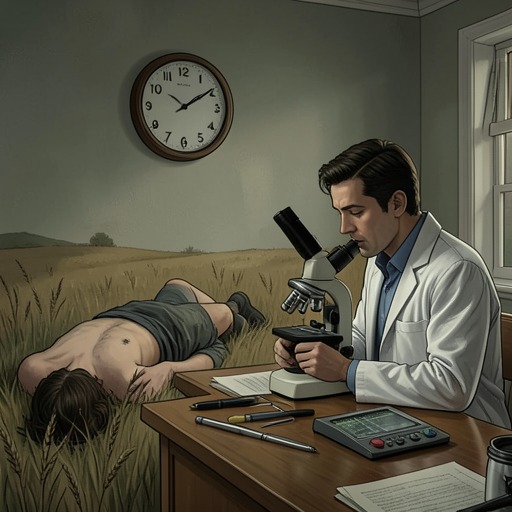
The body had been dead for several days. Hunter noted that soft tissue remained and that skin slippage was only beginning. Larvae were active in the wounds, and their development, considered alongside the steady hot weather, supported an estimate of six to eight days since death. When Mackenzie pressed for a narrower estimate, Hunter qualified it: assuming the body had not been moved and the weather had remained constant, six or seven days was his best preliminary assessment. The estimate was not a formal identification or an exact time of death, but it could be compared with the known period of Lyn’s disappearance.
Hunter found a throat wound and several other injuries, fewer than on Sally Palmer’s body. The body was desiccated, though not to the same extent as Sally’s, consistent with Lyn having been dead for less time. Hunter’s initial interpretation was that she had bled out. The surrounding vegetation was blackened by alkaline products associated with decomposition; he proposed that Lyn had been killed elsewhere and brought to the discovery site. He treated this as a preliminary inference, noting that soil testing would be needed to check it.
Evidence linking the murders
The examination changed markedly when crime-scene officers turned the body over. Lyn’s abdomen had been cut open, and objects became visible as the body was moved. An officer identified them as baby rabbits. The discovery was outside Hunter’s experience; Mackenzie, normally ruddy-faced, was visibly shocked. Unlike Sally’s body, Lyn’s had no swan wings. That absence does not erase the similarities between the cases, but it is a concrete difference in how the two bodies were treated.
After seeing the rabbits, Mackenzie concluded that the same man had killed both women. Hunter had already compared the two bodies: both had throat wounds and showed marked desiccation, and he considered Lyn’s injuries similar to Sally’s, though fewer. These observations support a connection within the investigation, while Hunter’s caution about what an examination alone could establish remains important. The conclusion is presented through the accumulating physical evidence and Mackenzie’s assessment, not through a confession or a fully known account of the killer’s actions.
The time Lyn remained captive
The dates give the disappearance a further, disturbing dimension. Lyn had been missing for nine days, while Hunter estimated that she had been dead for six or seven. Mackenzie drew the implication: if the estimate was broadly right, Lyn had been kept alive for at least two days after her disappearance. The calculation is necessarily approximate, since Hunter’s time-since-death assessment depends on the weather and on the assumption that the body had not been moved. Even with those qualifications, the gap makes the case more than a murder followed immediately by concealment: it points to a period in which Lyn was alive in the killer’s control.
The evidence does not disclose where she was held, what happened during that interval, or why the killer prolonged it. The narrative preserves that uncertainty rather than filling it with an invented explanation. Later, while captive, Jenny Hammond fears that she will die before her captor returns; her situation echoes the terror of being held beyond the moment of abduction, but does not establish that Lyn and Jenny experienced the same treatment. Lyn’s case supplies the earlier evidence that the killer may keep a victim alive after taking her.
Consequences and significance
The discovery strengthens the connection between Lyn’s disappearance and Sally Palmer’s murder, while giving the investigation a more precise chronology to work with. Insects, remaining tissue, weather, desiccation and the condition of the vegetation are not merely signs of decay: read together, they help Hunter estimate the interval since death and distinguish the likely discovery site from the place of killing. His conclusions remain provisional, but their limits are part of their value. The body offers evidence, not certainty on demand.
For Manham, Lyn’s death removes the possibility that her disappearance will end in a safe return and confirms that the village is confronting a serial pattern rather than an isolated loss. For the investigation, the baby rabbits and the similarities to Sally’s injuries provide a strong link between the murders. For Hunter, the examination brings professional observation into direct contact with the memory of a woman he had recently seen alive. The case’s defining reversal is therefore both evidentiary and human: the search finds Lyn, but what it establishes is how long she may have been missing, how she died, and how closely her fate is bound to the earlier murder.