Bank House
The Chemistry of DeathBank House serves as more than a village surgery: it is the large, shared house where David Hunter takes on the work Henry Maitland can no longer manage alone. Its rooms retain Henry’s imprint even as David’s responsibilities grow, and its practical functions become decisive when Jenny Hammond is brought there in a medical emergency and a familiar image in Henry’s office gives David a vital clue.
Setting and Arrival
Bank House stands beyond a narrow, tree-lined lane reached from the village green. A wide gate marks the entrance to its drive; the gatepost carries a sign for Bank House and a brass plaque identifying Dr H. Maitland. The drive passes between yews and through tended gardens before descending to the courtyard of an imposing Georgian house. The approach establishes the practice as a substantial country residence as well as a place of work.
David first arrives in wet weather, newly away from London and unfamiliar with the village. A woman at the door takes his coat and leads him to a large lounge, where a fire is burning. The room’s wood paneling, old leather chesterfield, Persian carpet and polished floorboards give it the character of an established home rather than a clinical reception area. Offered tea, David waits there as rain falls outside. The welcome and the domestic setting contrast with the exhaustion he carries on arrival; even the comfort of the room makes him wary of falling asleep.
The Surgery and Its Rooms
The medical practice occupies a self-contained clinic entered by a back door. An old conservatory, thick with plants tended by Janice, serves as the reception and waiting room. Henry’s private living quarters are elsewhere on the ground floor, while the scale of the house leaves room for both the household and the clinic. The arrangement makes Bank House a working home in which professional and domestic spaces coexist without being identical.
David takes over Henry’s former consulting room and uses it regularly. Its furnishings and contents preserve the former doctor’s presence: an old hunting oil, a roll-top desk, a leather-seated captain’s chair, and shelves of medical books and journals. The library extends beyond general practice to include Kant, Nietzsche and a full shelf of psychology texts, a subject Henry is especially interested in. David’s own contribution is a computer monitor on the desk, an innovation Henry accepts only after months of persuasion. The room therefore records a gradual transition, not a clean change of ownership: David works there, but the room still feels shaped by Henry’s habits and interests.
A Practice Passing Between Doctors
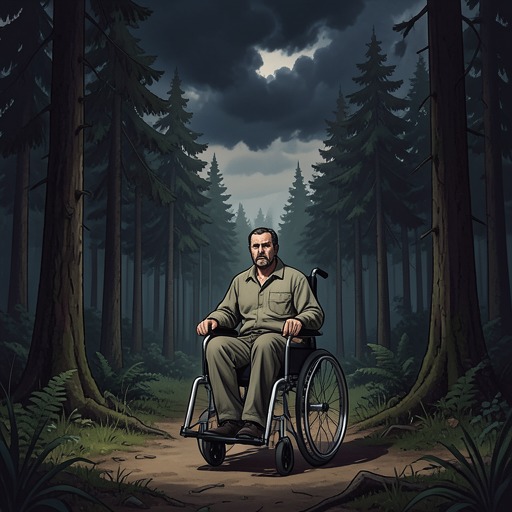
Henry never recovers sufficiently to return to full-time work after the car crash that leaves him paraplegic and kills his wife, Diana. He buys an automatic Land Rover Defender while still hoping that he might drive—and walk—again, but the doctors tell him that neither recovery will happen. In time, he accepts their judgment. The vehicle later passes to David, as does an increasing share of the medical practice.
David’s position at Bank House begins as temporary cover. His contract is extended and then becomes a partnership once it is clear that Henry cannot run the practice alone. At first the two doctors divide the work more or less equally; gradually, more of it falls to David. Yet the transfer of duties does not immediately transfer the village’s regard. Many residents continue to see Henry as the proper doctor, while David, despite his growing workload and long use of the consulting room, remains a newcomer in Manham. Bank House thus embodies a tension between practical succession and social recognition: the work changes hands by necessity, but local standing changes more slowly.
David’s work also reaches beyond the consulting room. During the murder investigation, he applies forensic knowledge at outdoor scenes, explaining how insect development and decomposition can help estimate time since death while cautioning that weather and other variables limit certainty. His judgments connect medical expertise to the investigation, but the distinction in setting matters: Bank House is his professional base, not the location of those examinations. The practice’s significance lies partly in how it sustains a doctor whose responsibilities extend into the wider emergencies of village life.
Emergency and Discovery
When the police are preparing to search for Jenny, David returns to Bank House because the medical kit in his car contains no insulin and the surgery’s supply is kept in a refrigerator. He rushes inside while Janice is still there after the evening clinic and searches Henry’s study for the medicine. The familiar rooms become an urgent resource: the practice has what he needs, though David must still get the insulin to Jenny and cannot provide the full treatment she requires there.
After Jenny is brought back, David lays her on the couch in Henry’s office and recognizes that insulin alone cannot replace hospital care, including intravenous fluids and salts. He depends on Henry to help prepare a syringe while an ambulance is called. The episode makes Bank House’s dual nature concrete: it is a home and a practice, and, in crisis, a place where immediate intervention is possible but definitive treatment remains beyond its capacity.
The search for supplies also turns the office’s ordinary objects into evidence. As David opens the drugs cabinet for syringes, a photograph falls; he then notices the wedding photograph beside it. He recognizes that Diana’s dress matches one he has seen in a cellar elsewhere in the case. The discovery transforms a familiar picture—one he has seen many times—into a connection that demands attention. Bank House is therefore tied not only to care and professional succession but also to the investigation’s dawning recognition: in Henry’s office, domestic memory and criminal evidence occupy the same space.