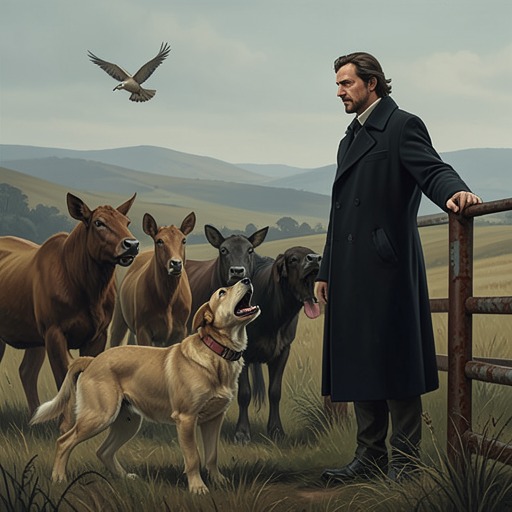
Birds as the killer’s cruel markers
The Chemistry of DeathBirds as the killer’s cruel markers are both physical clues and deliberate displays in the Manham investigation. The swan wings found with Sally Palmer’s body first invite interpretations of religious or classical symbolism; a mallard tied to a standing stone before Lyn Metcalf’s abduction gives the imagery a more immediate role as intimidation. Mackenzie’s eventual reading is less ceremonial: the killer uses animals to demonstrate control, provoke fear, and make the investigation reckon with his presence.
The swan wings and the first image
The earliest striking bird image appears in photographs of a body discovered in marsh grass. Sam Yates had reported that the body seemed to have wings, and the photographs confirmed that two white swan wings had been placed at its back. Because the body’s sex could not be determined from the images, the wings—not an identifiable face or other personal feature—dominated the first visual impression. Their placement produced the appearance of a fallen angel, an arresting image that could suggest a symbolic message even before investigators knew who the victim was.
The photographs also present the wings as part of a crime scene rather than an isolated emblem. When David Hunter reaches the site, the flattened, dead grass still outlines where the body lay; feathers remain scattered across it. The crime-scene officers believe the feathers may be from a swan and have sent them to an ornithologist for identification. This distinction matters: the striking appearance encourages interpretation, but the investigation still has to establish the material facts behind it. The wings are evidence of staging, while their species and significance remain subjects for inquiry.
The image’s apparent grandeur is undercut by the investigation’s practical attention to remains and surroundings. Hunter examines the photographs as potential forensic evidence, and the scene preserves a trace of the body’s position alongside feathers. Bird imagery therefore arrives in two forms at once: a composed display that seems to invite symbolic reading, and physical material that can be examined and tested. The contrast helps explain why the wings attract speculation without, by themselves, proving a religious or mythic motive.
The mallard at the standing stone
The bird associated with Lyn Metcalf is not another image of a completed display. During a run through the woods, Lyn finds a mallard bound to a standing stone with wire around its neck and feet. It is still alive. Once she realizes that it could not have been left there long, she understands that someone has arranged for her to find it. The discovery turns an animal display into a direct threat: the bird is evidence that an unknown person has recently been nearby and may know her route.
The encounter links the staged bird to another disturbing discovery, a dead hare that Lyn had passed on the path. Taken together, the animals make the woods feel deliberately arranged around her movements rather than simply dangerous by chance. Lyn flees, and a snare brings her down as she approaches the way out. The mallard thus functions in the sequence not only as an image but as a warning placed along a route, part of the circumstances leading into her abduction.
The wire gives the display investigative significance beyond its effect on Lyn. Mackenzie tells Hunter that the wire used in the snares that brought Lyn down is the same type as the wire used to bind the mallard; he considers it a safe assumption that the materials may come from the same batch, although that has not been established. The bird, the traps, and the attack are consequently connected by a practical clue as well as by their shared atmosphere of cruelty. The evidence does not make the bird itself a complete explanation of the crime, but it ties the display to the methods used against Lyn.
Signature, spectacle, and competing explanations
Mackenzie initially acknowledges several possible readings. The mallard might have been placed to panic Lyn, or it might be a statement or signature. The swan wings had already prompted speculation about angels, religion, and classical symbolism, and the police consult psychologists and other specialists, including over the possibility of pagan ritual or Satanism. But Mackenzie draws a distinction between a bird that has been sacrificed or mutilated and one simply tied in place. In his view, the latter points less convincingly to ritual than to a person who enjoys hurting animals and showing off.
That interpretation shifts attention from what birds conventionally symbolize to what the killer does with them. Mackenzie sees the bird and the traps as ways of asserting presence and authority: they complicate the search, make people watch for further danger, and leave the impression that the person responsible is directing events. Hunter suggests that the killer may be marking territory, and Mackenzie agrees in qualified terms, describing a pattern of placing traps at strategic points and standing back to watch what happens. The birds are therefore not merely decorative clues. Their placement makes cruelty public and turns the landscape into a means of exerting control.
The investigation also receives an earlier, less certain animal clue. A witness says that, at the barbecue where Sally Palmer was last seen, she complained that someone had left a dead stoat on her doorstep and that she regarded it as a sick joke. At first, the incident has no confirmed link to the killer: it could have been the work of children, or it could have served as a warning or a claim of territory. Mackenzie’s later assessment that the killer uses birds as a signature makes the stoat report newly suggestive, but does not settle who left it. The episode broadens the pattern from birds to animals more generally while preserving an important uncertainty between a threatening marker and an unrelated act.
The pattern’s significance
The bird displays carry different kinds of information, and their meaning changes as evidence accumulates. The swan wings establish deliberate staging and provoke symbolic speculation. The mallard makes the threat immediate to Lyn, while the wire associates the display with the snares used against her. The stoat report offers a possible earlier warning connected to Sally, but remains unverified. Read together, the incidents make animal cruelty a recurring feature of the investigation without proving that every animal discovery has the same author or purpose.
That distinction keeps the imagery from resolving too neatly into a code. The killer’s actions may look ritualistic because the swan wings create an angel-like figure, yet Mackenzie doubts that the later bird display supports a religious explanation. His alternative—cruelty made conspicuous, a bid to show control—fits the mallard’s placement and the wider use of traps, but even the stoat remains uncertain. The birds function most securely as signs of deliberate staging and intimidation; their deeper symbolism is a question the investigation tests rather than a fact it can simply assume.