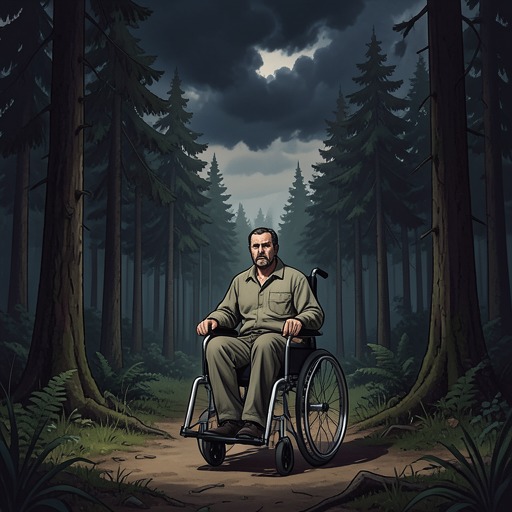
David Hunter and Henry Maitland
The Chemistry of DeathDavid Hunter and Henry Maitland are joined first by the practical needs of a rural medical practice and then by a partnership that becomes part of their daily lives. Henry hires David after a car accident has left him unable to work independently; what begins as a temporary arrangement gradually makes David responsible for much of the practice. Their association carries both professional reliance and personal warmth, but it unfolds in a village where Henry remains the accepted doctor and David continues to be treated as an outsider.
Hiring and First Impressions
David accepts the post by return of mail, then arrives a day earlier than Henry expected. The meeting makes the difference between their circumstances immediately visible: Henry greets him from a wheelchair, and notices David’s momentary hesitation before they shake hands. Henry responds with a wry smile rather than embarrassment or self-pity. His composure sets the tone for their dealings: his disability is an ordinary fact of the working relationship, not a reason to disguise what the job will require.
Henry explains that a car accident has left him unable to manage alone for the time being. He has relied on locums for about a year, but the succession of unfamiliar doctors is bad for a community that dislikes change. His decision to hire David is therefore both personal and practical: he needs help, and he wants continuity for his patients. David, formerly employed at a university and accustomed to London, recognizes that the village post will be a substantial departure. Henry gives him an opportunity to raise any last-minute doubts, and, when David confirms his decision, arranges for Janice to show him to his room. David will stay at Henry’s house, begin work the next morning, and discuss matters further over dinner.
From Temporary Post to Partnership
Henry hopes at first that he may recover enough use of his legs to return to work. He buys an automatic Land Rover Defender after the accident, holding on to the possibility that he might drive again and eventually walk. His doctors tell him otherwise. In time, Henry accepts that he will not regain the use he had hoped for, and his working arrangement with David changes accordingly.
David’s temporary contract is extended and then converted into a partnership when Henry can no longer run the practice alone. At first the two divide the workload more or less equally; increasingly, more of it falls to David. The change is incremental rather than a single handover: David takes on a growing share as Henry’s limits become settled, while Henry remains involved in the practice and in the life of the house. The old Land Rover, once Henry’s, also passes to David, a practical inheritance that reflects how responsibilities and possessions shift between them.
Working Together in Henry’s House
The practice and their living arrangements overlap. David stays in Henry’s large house, whose ground floor includes the self-contained clinic and Henry’s private rooms. David takes over Henry’s former consulting room, though its furnishings and books continue to bear Henry’s imprint. The room contains Henry’s medical books and journals, works of philosophy, and a shelf of psychology texts; David’s computer monitor is a relatively modest addition, accepted by Henry only after months of persuasion. Even after David has used the room regularly, it still feels more like an expression of Henry’s personality than his own.
Their relationship also appears in small routines beyond clinical work. Janice often brings Henry Sunday lunch, and Henry insists that he can cook for himself, though he rarely resists her meals. He asks David about the news that the Yates brothers have found a body, having already heard about it from Janice. Later, when David asks Henry to cover an evening surgery, Henry agrees and asks whether something has happened. These ordinary exchanges show a working relationship in which each can ask for practical help, and in which the events beyond the clinic readily enter their conversation.
Trust, Disclosure, and the Village
David does not immediately tell Henry why Mackenzie has visited him. He feels that Henry deserves an explanation, but expects it would require more discussion than he is ready to undertake. When Henry agrees to cover the surgery, David asks for time and promises to tell him everything by the weekend. Henry accepts the delay and invites him to Sunday lunch, suggesting that conversation may be easier over a meal. The exchange conveys familiarity and consideration, but also a limit: David trusts Henry enough to recognize an obligation to him, yet postpones the disclosure while the investigation and its implications remain difficult to explain.
Their different standing in Manham complicates the partnership. Henry is still regarded by most residents as the proper doctor, even as more of the work passes to David. David has long since stopped minding that distinction, but it reinforces his sense that he remains a newcomer. The contrast is sharp during the search for Lyn Metcalf: villagers rally together, yet the discovery that the attacks must be connected to someone local turns solidarity into suspicion. Henry and David work within the same community, but professional usefulness does not automatically give David the belonging that Henry’s longstanding place in the village affords him.
The Partnership’s End
After the events surrounding the murders, David does not return to work at the surgery. Even after the police have left Bank House, going back would be too painful. He arranges for a locum to cover the practice until a permanent doctor can be found or patients register elsewhere. His departure therefore ends more than a job: it dissolves the arrangement that had grown from Henry’s need for a dependable replacement into a partnership and made Henry’s former consulting room David’s workplace.
David also recognizes the force of the village’s old distinction between the established doctor and the newcomer. Former patients now meet him with reserve, and his earlier status as a suspect continues to shape how some regard him. As he prepares to leave Manham, he concludes that he never belonged there. The relationship with Henry is thus tied to a larger, uneasy change in David’s life: the practice gives him work and a place in Henry’s household, but it cannot secure his acceptance by the community, and it does not keep him in Manham once the crisis has passed.