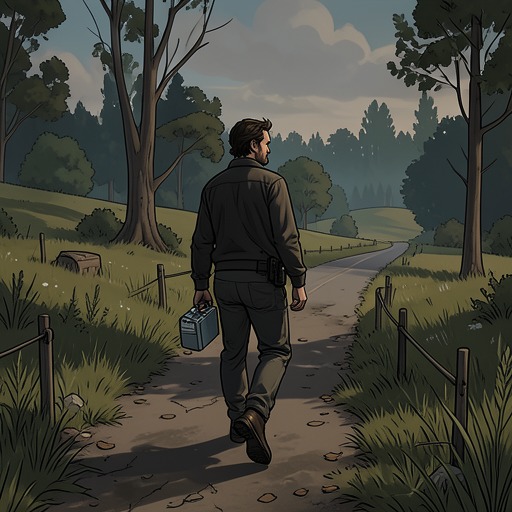
David Hunter and Jenny Hammond begin a relationship
The Chemistry of DeathDavid Hunter and Jenny Hammond begin a relationship through a gradual movement from unspoken attraction to chosen intimacy. Its decisive turn is not a declaration but a sequence of small, qualified gestures: David’s sudden nervousness, Jenny’s request not to hurry, a fleeting kiss, and, later, her decision to see his home. Their closeness develops alongside grief and fear rather than replacing them; at its most intimate, David’s tears become part of the encounter, and Jenny’s response allows him to remain present instead of retreating into memory.
Attraction Before It Is Named
The possibility of a relationship first reaches David through Tina, who tells him that Jenny likes him. Alone after Tina has gone, he questions both what her remark means and what he feels in return. He tries to dismiss Tina’s words as the product of drink and tells himself not to read too much into them, yet his sudden nervousness unsettles that explanation. The episode establishes an emotional change before David can comfortably give it a name: attraction is registered first as agitation, then resisted in thought.
Over the following days, David and Jenny see each other regularly. One evening they drive to a restaurant in Horning, where linen tablecloths, candles, and a substantial wine list contrast with the limited choices David associates with local dining. The evening also marks a shift from tentative interest toward personal trust. They seem to have known each other for years, though they have only recently met, and David links that sense of familiarity to what each has endured. Their common knowledge of how abruptly ordinary life can become tragic works like a private language, present even when neither needs to explain it.
David tells Jenny about Kara and Alice, and about the forensic work he has been doing for Mackenzie. Jenny listens without interrupting. When he has finished, she briefly touches his hand and tells him she thinks he is doing the right thing; she lets the contact linger before withdrawing it. The gesture makes support tangible without turning the conversation into a confession or demanding a response. They move on to another subject without awkwardness, showing an ease in which serious disclosure and ordinary conversation can coexist.
A Boundary, and a First Kiss
The ease of the dinner does not carry unchanged into the drive back. As they approach Manham, Jenny withdraws into herself; conversation first becomes stilted and then stops. When David asks whether everything is all right, she answers too quickly and begins to leave, but hesitates. She apologizes and says she does not want to hurry into anything. David can only nod, numb with uncertainty. Jenny immediately clarifies that she is not saying she does not want a relationship; she asks for time, repeating that it is not yet.
The boundary is accompanied by a counter-gesture: before David can answer, Jenny leans into the car and gives him a brief kiss, then hurries inside. For him the moment is both exhilarating and uncomfortable. He feels breathless and buoyed, but guilty as well. The kiss confirms mutual desire without erasing her request to move slowly, so the scene’s forward movement depends on restraint as much as attraction.
The words not yet also echo for David beyond their relationship. He remembers Linda Yates using the same answer when he asked whether she had dreamed about Lyn. The repetition briefly binds the developing intimacy to the wider uncertainty surrounding the village, but David does not treat the two answers as equivalent explanations. The phrase stays with him because it has acquired more than one context: a boundary between Jenny and himself, and a reminder of an unresolved question elsewhere in Manham.
From Tension to Chosen Intimacy
A later drive back to Manham is marked by silence and David’s self-reproach. He curses himself for making such a fuss about Scarsdale and assumes that Jenny has had enough. As he turns toward her road, however, Jenny asks him not to stop there; she wants him to show her where he lives. Her request changes the direction of the evening. The earlier withdrawal had left David uncertain whether she wished to continue, while this choice brings her into his private space on her own initiative.
At his home they stand awkwardly in the half-light, looking at one another without moving. Jenny’s voice is unsteady when she asks where the bedroom is. The hesitation that preceded their first kiss has not disappeared, but neither does it prevent her from choosing what happens next. In the bedroom she is initially tense and trembling, and David is hesitant too. The scene does not present intimacy as an effortless escape from the past: at first, memory tries to impose its own pattern of shape, texture, and scent. Gradually, the present takes over.
Afterward Jenny lies curled against David, her breath soft against his chest, and puts her hands to his face, tracing the wetness on his cheeks. When he tries to dismiss it, she tells him she understands and that it is all right. David laughs and hugs her; he lifts her chin, and they kiss slowly before moving together again. His tears do not vanish as a condition of closeness. Instead, Jenny’s quiet acknowledgment lets him remain with her, and he finds that the moment is all right.
Significance Within the Story
The relationship begins not with a clean break from bereavement but with David allowing new attachment to occupy the same emotional space as old loss. At dinner he speaks openly about Kara and Alice; later, memory intrudes into intimacy, and his tears remain visible to Jenny. Her response is not to explain or correct his grief, but to accept it. The progression from disclosure and a lingering touch to a requested pause, a kiss, and a shared night gives their relationship a pattern of approach that makes room for uncertainty.
The contrast between Jenny’s two departures and returns is especially important. After the first evening she hurries into her house while leaving David with a kiss and a limit: not yet. Later, after a silent drive in which David believes he has damaged the connection, she asks to see his home and initiates the move toward the bedroom. The shift does not cancel her earlier boundary; it shows that waiting has not meant refusal. Their intimacy is therefore established through repeated acts of choosing, with Jenny’s timing and David’s vulnerability both shaping its beginning. That tenderness develops while a killer remains at large in Manham, placing their private closeness against a continuing atmosphere of danger rather than outside it.