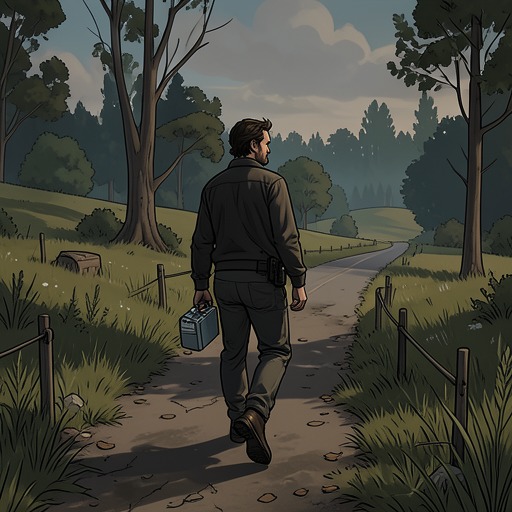
David Hunter—Jenny Hammond
The Chemistry of DeathDavid Hunter and Jenny Hammond’s relationship moves from guarded attraction toward intimacy, shaped by what each has endured and tested by the violence surrounding them in Manham. Jenny’s caution sets the pace: she makes clear that she does not want to rush, even as she signals that she does want a relationship. Their growing closeness offers David a connection beyond his bereavement, but danger and his unsettled place in the village prevent the relationship from becoming a simple return to normal life.
First signs of attraction
The relationship first takes shape through the attention of other people and David Hunter’s uncertainty about his own response. After Tina tells him that Jenny Hammond likes him, David sits alone and tries to dismiss the suggestion as something Tina said because she had been drinking. His reasoning does not settle the matter: he becomes nervous, and the scene leaves him aware that Jenny’s feelings may matter to him before he is ready to admit as much.
That hesitation belongs to a wider atmosphere of suspicion and instability. After the disappearance of Lyn Metcalf, villagers gather to search, but the shared effort is already undercut by the realization that the person responsible for the attacks may be local. The search briefly gives Manham a sense of communal purpose; at the same time, suspicion begins to divide the people taking part. When Lyn’s body is found, the village’s grief carries particular force because she was born there and had married in its church. These events establish the dangerous setting around David and Jenny’s developing connection, rather than a secure community outside the crises.
Trust and deliberate pacing
As David and Jenny see one another more often, they discover a form of mutual understanding grounded in their experiences of tragedy. During dinner at a restaurant in Horning, David tells Jenny about Kara and Alice, and about his forensic work for Mackenzie. Jenny listens without interrupting and briefly touches his hand when he finishes. She tells him that she thinks he is doing the right thing, lets the contact linger, and then moves the conversation on without embarrassment. Her response is supportive but not grand: she receives what he has disclosed and leaves him room to continue as himself.
The evening also makes clear that closeness does not remove uncertainty. On the drive back to Manham, Jenny grows quieter as they approach her house. When David asks whether everything is all right, she prepares to leave, then pauses to explain that she does not want to hurry into anything. She immediately clarifies that her hesitation does not mean she wants no relationship. She asks for time, gives him an uncertain smile, kisses him briefly, and goes inside. David is left both buoyed and guilty. The exchange matters because Jenny combines a boundary with an unmistakable gesture of affection: neither person has to mistake patience for rejection.
Intimacy and the pressure of danger
The closeness they have negotiated eventually becomes physical intimacy, though the account presents the moment through their hesitation and emotional response rather than explicit detail. At David’s home, Jenny appears nervous, as does David. They stand uncertainly in the dim room until Jenny asks where the bedroom is. She remains tense at first, then gradually relaxes; afterward she lies against him and touches his face, while he is crying. The scene links their intimacy to David’s bereavement without making Jenny a substitute for the people he has lost: memory intrudes, but the present gradually takes its place.
That connection is not a one-sided effort to console David. Later, when he has not contacted Jenny, she tells him she was worried and glad he is all right. She explains that although they had agreed to take a couple of days, she would like to see him if he wants to. David responds that he does. Their exchange reverses the earlier pattern of Jenny asking for time: she now initiates renewed contact, and he meets her directly. Their relationship depends on repeated acts of choosing to approach, rather than on a single declaration that resolves their uncertainty.
Crisis and unresolved ending
The danger that surrounds them becomes immediate when Jenny is abducted. David thinks of her as someone who came to Manham after surviving an assault because she believed it would be safer than a city, only to become a victim of an even worse attack. Her peril brings his past loss into the present: he feels as though the nightmare of losing Kara and Alice is happening again, but this time he does not know whether Jenny is alive or what she is enduring. His fear is sharpened by the evidence of what happened to the other victims. For David, the relationship is no longer only a source of new intimacy; Jenny’s survival becomes inseparable from the possibility of another devastating bereavement.
The surviving evidence does not establish the eventual course of David and Jenny’s relationship. It does establish that their connection has become serious enough for Mackenzie to ask David how well he knows her and how seriously they are involved, questions David answers by saying that they have only just begun seeing each other. At the novel’s close, David decides that his life as Manham’s doctor is over. After Henry Maitland’s crimes and the police investigation, some former patients still regard David with reserve, in part because he was once a suspect; he concludes that he does not belong in the village and puts his house on the market. The account records no corresponding decision by Jenny and gives no final reunion or separation. Their relationship therefore ends in narrative suspension: its emotional significance is clear, but its future is left open as David prepares to leave Manham.
Significance
The relationship’s movement is defined by contrast: Jenny can ask David to wait and later be the one to seek him out; David, accustomed to grief and guardedness, can receive care as well as offer it. Their shared knowledge of tragedy functions as a quiet bond, visible in Jenny’s listening and in David’s fear when she disappears. Yet the novel does not treat intimacy as protection from violence or as a cure for grief. Their growing closeness unfolds amid murder, abduction, and a community in which belonging remains uncertain. David’s departure gives that uncertainty a final shape, while leaving unanswered whether the relationship can continue beyond the place that brought them together.