Dreams of Kara and Alice
The Chemistry of DeathDreams of Kara and Alice give David Hunter a recurring imagined home in which he can again be with his dead wife and daughter. Their force comes from the tension between sensory intimacy and loss: the dream makes reunion feel complete, yet Kara recognizes it as a drug-shaped illusion, and its final appearance leaves the house empty. The dreams thus move from a refuge that promises return to a farewell David can accept.
The Dream House and Its Familiarity
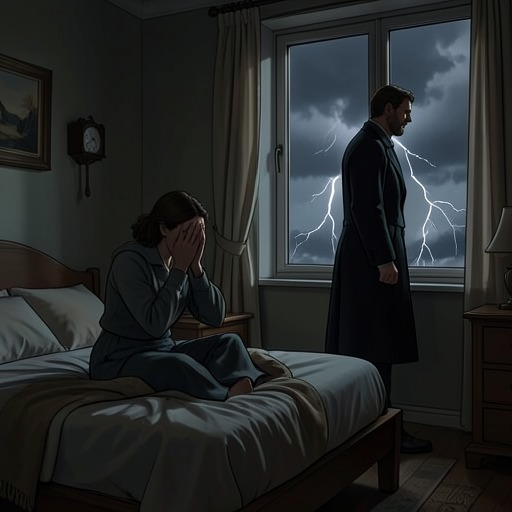
The dream’s setting is a warm, furnished house that David knows intimately despite never having visited it in waking life. Its details are unusually concrete: an old, heavy clock ticks slowly; a log fire burns in the grate; bookshelves fill one wall; lamps soften the room’s corners; and a white bowl of oranges rests on a cherrywood table. David imagines the clock’s polished wood, its beeswax-and-age smell, and the brass curve of its winding key. Although he cannot see the clock, he feels able to anticipate it. The dream turns an unseen object into something remembered and almost touchable.
This sensory precision makes the house feel less like an arbitrary fantasy than a settled home. David experiences the room as familiar and peaceful, and Kara and Alice inhabit it as a family. When he sees Kara seated opposite him with Alice curled on her lap, overwhelming joy makes him feel that everything is all right and that he has returned to them. The dream offers not merely their images but the appearance of ordinary domestic life restored: a shared room, a child beside her mother, and time measured by the clock’s unhurried strokes.
Reunion Challenged by Reality
The dream’s emotional certainty is challenged by Kara. Her face is sad even as David rejoices, and she tells him that the experience is being produced by the drug and is false. She urges him to fight it. David initially resists that warning because being together again seems to him exactly what he wants; Kara’s insistence that reunion cannot be right exposes the difference between his longing and the reality of his loss.
An orange becomes the dream’s most tangible test of whether David will remain inside that illusion. He can feel its weight and dimpled skin, imagine the juice released as he peels it, and almost smell its zest. He understands that eating it would be an act of acceptance from which there would be no return. He puts it back. The small gesture gives physical form to his hesitation: he does not simply wake at once, but has to relinquish the scene’s inviting reality. Kara’s tearful smile follows his refusal, while his question about whether her earlier warning referred to this moment receives no answer.
Farewell and Awakening
The encounter turns from reunion toward separation when David asks whether he will see Kara again. She tells him he will not need to, because he will not need to see her any more. Her answer does not deny their bond; it places the dream’s comfort within a future in which David can live without returning to it. He tells her he loves her, and she comes over to embrace him. He buries his face in her hair for the last time, wanting not to let go while knowing that he must.
The clock’s disappearance marks the boundary between the dream and waking. As David tastes tears, he realizes that he can no longer hear its ticking; darkness follows, and he finds himself paralysed and suffocating. The abrupt bodily distress contrasts with the room’s earlier warmth and the dream’s assurance of restored family life. The transition does not make the reunion real. Instead, it makes the cost of leaving the dream immediate, as the imagined home gives way to David’s vulnerable waking body.
The Final Visit and Its Meaning
On the night before he leaves Manham for good, David dreams of the house once more. Its familiar peaceful character remains, but Kara and Alice are gone. He wanders through the unoccupied rooms knowing that this is his final visit and that their absence is as it should be. In the earlier encounter, the dream demanded that he choose not to accept the orange and not to mistake drug-produced happiness for a genuine return. In this last visit, no such choice is required: the family is already absent, and David recognizes that the dream’s purpose has ended.
Linda Yates had told David that dreams happen for a reason, though he considers the word dream inadequate for what he experienced. His reflection leaves the experience unexplained rather than reducing it to a neat diagnosis. What changes is its hold on him. He wakes with wet cheeks, but no longer treats the tears as evidence that something is wrong. The recurring house has carried his grief through an imagined reunion and a conscious farewell; its final emptiness makes room for departure without erasing his love for Kara and Alice.