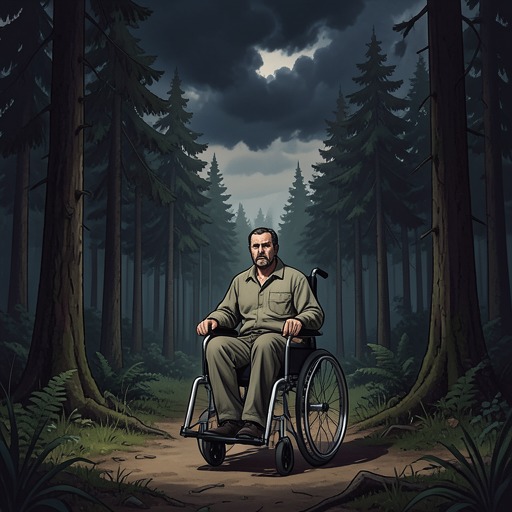
Henry Maitland’s paraplegia
The Chemistry of DeathHenry Maitland’s paraplegia is a lasting consequence of the car accident that killed his wife, Diana, and the turning point that reorganizes his working life. Introduced through a brief moment of hesitation over his wheelchair, Henry is neither able to return to his former independence nor removed from the practice: his disability changes how he works, how the practice is staffed, and how others understand his authority.
Onset and first encounter
When David Hunter arrives to take a temporary post, Henry extends his hand without rising. Only then does David notice the wheels beneath Henry’s chair; Henry has already noticed David’s hesitation and answers it with a wry smile. His calm manner makes the physical fact unmistakable without turning the introduction into an appeal for pity. He explains that a car accident has left him unable to manage by himself for the time being, while leaving open the possibility that he may recover some use. His candour establishes the practical reason for the vacancy: he has relied on locum doctors for about a year and is tired of a succession of unfamiliar faces.
That first explanation holds hope and limitation together. Henry presents the possibility of recovery as uncertain, not assured, and the need for assistance as an immediate fact. The problem is not only that he cannot perform everything alone; repeated short-term cover also disrupts continuity in a village that, as he tells David, dislikes change. His decision to seek a more lasting colleague therefore responds both to his own circumstances and to the demands of the practice.
The accident and the loss of expected recovery
The later account clarifies the permanence of the change. The accident left Henry paraplegic and killed Diana. He had bought an old Land Rover Defender after the crash while still hoping that he might drive again and walk again. The vehicle records that expectation in practical form: it was an attempt to prepare for a return to abilities that he had not yet accepted were lost. In time, however, the doctors told him that he would never regain the ability to walk or drive, and Henry eventually had to accept their judgment.
His response to medical authority is openly sceptical. He dismisses the doctors as people who think themselves God merely because they wear white coats. The remark conveys his resistance to their certainty, but the account also marks its limit: eventually, even Henry accepts that they were right. His paraplegia is not presented as a temporary interruption followed by recovery. The hope of regaining movement gives way to a lasting condition around which his work and daily reliance on others must be arranged.
Work, dependence, and changing roles
Henry’s physical limitations keep him from returning to full-time work, but they do not end his involvement in medicine. David’s six-month locum contract is first extended and then converted into a partnership when it becomes clear that Henry can no longer run the practice on his own. At first the two doctors divide the workload more or less equally. As time passes, an increasing share falls to David, a gradual shift rather than a single handover.
The arrangement complicates any simple division between doctor and patient, or between the capable practitioner and the person who needs help. Henry remains part of the practice even as its daily demands exceed what he can manage alone. David takes over Henry’s old consulting room and later inherits the battered automatic Land Rover as well as an expanding share of the work. The car, like the partnership, connects Henry’s former plans to the altered life that follows the accident.
Standing in Manham
The practical transfer of work does not immediately transfer Henry’s standing. In many villagers’ eyes, he remains the proper doctor, despite David’s growing responsibilities. David has long since stopped minding, but he still understands himself as a newcomer to Manham, likely to remain one. Henry’s authority is thus sustained by more than the amount of work he can personally perform: the community continues to recognize him as its established doctor while the practice increasingly depends on David.
Henry’s paraplegia therefore shapes a continuing adjustment rather than a clean exit from professional life. He cannot return to full-time practice or recover the movement he once hoped to regain, yet he remains embedded in the institution he built and in the community that regards him as its proper doctor. The change is visible in the wheelchair and in the altered division of labour, but also in the long interval between expecting recovery and accepting that it will not come.